

The New Great Game: Why the Indian Ocean Will Decide the 21st Century
Updated: Oct 15

History has repeatedly demonstrated that the rise and fall of great powers is closely linked to their ability to control the world's oceans. From the Portuguese and Dutch empires to Britain and eventually the United States, maritime dominance has often translated into economic prosperity, military strength, and geopolitical influence. While the twentieth century was shaped largely by the Atlantic and Pacific Oceans, the twenty-first century is witnessing a profound strategic shift. Increasingly, the Indian Ocean is emerging as the centre of global competition, where trade, energy, military power, and diplomatic influence converge.
Stretching from the eastern coast of Africa to the western shores of Australia, the Indian Ocean connects some of the world's fastest-growing economies and carries the lifeblood of global commerce. Nearly every major power now views this vast maritime region as essential to its long-term national interests. For India, situated almost at the geographical centre of this ocean, the stakes could not be higher. Geography has presented India with a remarkable strategic advantage, but transforming that advantage into enduring influence requires sustained vision, investment, and partnerships.
The Lifeline of Global Commerce
The Indian Ocean is far more than a body of water separating continents. It serves as one of the world's busiest maritime highways, facilitating the movement of energy resources, manufactured goods, and raw materials between Asia, Africa, Europe, and the Middle East. A substantial share of global trade passes through its sea lanes every day, making uninterrupted access to these waters essential for the functioning of the international economy.
Strategic maritime chokepoints such as the Strait of Hormuz, the Bab el-Mandeb Strait, and the Strait of Malacca further amplify the region's importance. Any disruption in these narrow waterways can send shockwaves through global energy markets, increase shipping costs, and destabilise economies across multiple continents. Consequently, the security of the Indian Ocean has become a concern not only for regional states but also for the world's leading economic powers.
China's Expanding Maritime Footprint
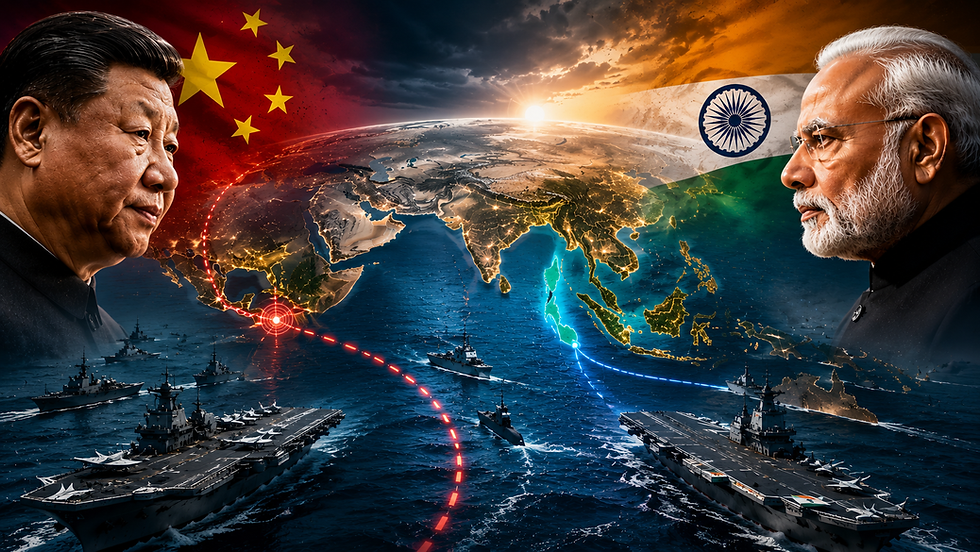
China's rapid economic rise has significantly increased its dependence on maritime trade and imported energy. To safeguard these vital interests, Beijing has steadily expanded its presence across the Indian Ocean through investments in ports, logistics infrastructure, and naval deployments. This strategy is often associated with the concept popularly known as the "String of Pearls," referring to a network of strategically located facilities stretching from the South China Sea to the Arabian Sea.
Although China presents these initiatives primarily as commercial projects under the Belt and Road Initiative, many analysts argue that dual-use infrastructure can provide valuable logistical support for military operations during periods of crisis. The establishment of China's overseas military base in Djibouti further illustrates Beijing's determination to protect its expanding overseas interests and maintain a sustained naval presence far from its own coastline.
For India and several other regional powers, these developments represent both a strategic challenge and an opportunity to strengthen their own maritime capabilities.
India's Geographic Advantage
Unlike many other powers, India does not need to project itself into the Indian Ocean—it is already at its centre. The Indian peninsula extends deep into the ocean, providing natural access to major shipping routes that connect East Asia, the Middle East, Africa, and Europe. The Andaman and Nicobar Islands, positioned near the Strait of Malacca, further enhance India's strategic leverage by overlooking one of the world's busiest maritime chokepoints.
This geographic position enables India to monitor critical sea lanes, support humanitarian operations, protect maritime commerce, and contribute to regional security. However, geography alone is insufficient. Lasting influence depends upon capable naval forces, maritime surveillance, diplomatic engagement, and strong partnerships with like-minded nations.
India's vision of SAGAR—Security and Growth for All in the Region—reflects an effort to position itself as a responsible maritime power committed to stability, cooperation, and shared prosperity throughout the Indian Ocean Region.
The Role of Other Major Powers
The strategic significance of the Indian Ocean has drawn the attention of virtually every major power. The United States continues to maintain a substantial military presence through partnerships, forward deployments, and key facilities such as Diego Garcia. Australia, Japan, France, and the United Kingdom have also expanded their engagement in regional security initiatives.
The emergence of the Quadrilateral Security Dialogue (Quad) demonstrates how maritime cooperation has become an increasingly important element of Indo-Pacific strategy. While the Quad is not a military alliance, it reflects a shared interest in preserving freedom of navigation, supporting international law, and ensuring a stable regional balance of power.
This growing network of partnerships indicates that the Indian Ocean is no longer viewed merely as a transit route but as a central arena in global strategic competition.
Challenges Beyond Military Competition
The Indian Ocean's future will not be determined solely by naval deployments or military bases. Non-traditional security challenges—including piracy, terrorism, illegal fishing, climate change, natural disasters, cyber threats to maritime infrastructure, and disruptions to undersea communication cables—are becoming increasingly significant.
Ensuring maritime security therefore requires a comprehensive approach that integrates defence capabilities with diplomacy, economic cooperation, technological innovation, and environmental resilience. Nations that successfully combine these elements will enjoy greater influence across the region.
The Strategic Vanguard Perspective
The Indian Ocean should not be viewed simply as another geopolitical theatre. It is the strategic crossroads where economics, energy, diplomacy, technology, and military power intersect. Control over territory alone will not determine future influence. Instead, the ability to secure maritime trade, maintain credible partnerships, protect critical infrastructure, and uphold a stable regional order will shape the balance of power in the decades ahead.
India possesses an extraordinary geographical advantage that few nations can match. Yet geography offers only potential—not destiny. Converting strategic location into lasting influence requires consistent investment in naval modernisation, maritime domain awareness, infrastructure development, regional diplomacy, and economic connectivity.
The New Great Game is already underway. Its outcome will depend not only on fleets and bases but also on vision, resilience, and strategic leadership. For India, the Indian Ocean is not merely a surrounding body of water—it is the maritime foundation upon which its future role as a leading global power may ultimately rest.
Related Strategic Vanguard Analysis
India's contemporary maritime posture builds on the region's growing strategic importance. Read India’s Indian Ocean Strategy.
Regional sea-lane competition is closely tied to the strategic value of narrow maritime passages. Explore The Malacca Strait.
Undersea cables are another critical layer of the Indian Ocean's strategic infrastructure. Read The War Beneath the Ocean.

Comments