

The Malacca Strait: India’s Strategic Advantage Over China | Indian Navy & Indo-Pacific
Updated: 2 days ago

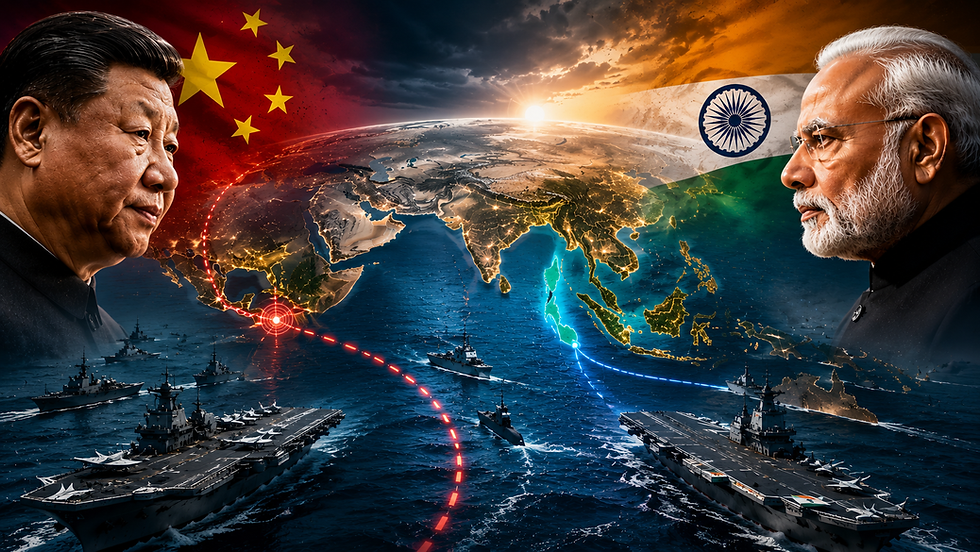
There are places on the world's map that appear relatively insignificant until we understand what passes through them. The Malacca Strait is one of those places. Situated between the Malay Peninsula and the Indonesian island of Sumatra, this narrow maritime passage connects the Indian Ocean with the waters of Southeast Asia and the South China Sea. Its geographical dimensions may be modest compared with the enormous oceans surrounding it, but its economic and strategic importance is anything but modest. Vast quantities of commercial goods and energy supplies move through the wider Malacca Strait maritime corridor, linking the resource-rich regions of the Middle East and the Indian Ocean with the industrial and economic centres of East Asia. For China in particular, maritime connectivity is fundamental to economic security. This makes the Malacca Strait more than simply an important shipping route; it is one component of a much larger strategic system upon which the Asian economy depends. Yet what makes this geography particularly interesting from an Indian perspective is what lies immediately to the west. India's Andaman and Nicobar Islands extend deep into the eastern Indian Ocean, placing Indian territory relatively close to the maritime approaches leading toward Southeast Asia. In an era in which India and China are increasingly competing for strategic influence across the Indo-Pacific, this geographical fact deserves far greater attention. The important question is not whether India "controls" the Malacca Strait—it clearly does not—or whether New Delhi could simply shut the waterway and cripple China's economy. Such claims are simplistic and ignore international law, the sovereignty of Southeast Asian states, alternative routes and the complexity of modern naval warfare. The more serious strategic question is whether India's geographical position gives it meaningful leverage over developments in the eastern Indian Ocean and the maritime routes connecting the Indian Ocean to East Asia. That answer is considerably more interesting: India possesses a geographical advantage that, if supported by sufficient naval, surveillance, logistical and diplomatic capabilities, can become an important element of its Indo-Pacific strategic power.
China's Malacca Dilemma
China's extraordinary economic growth has been accompanied by an equally extraordinary dependence on maritime commerce. Modern Chinese industry requires energy, raw materials, components and access to international markets, while the country's large population and industrial economy consume enormous quantities of imported energy. A substantial portion of China's international trade therefore depends upon secure maritime transportation, including routes connecting the Indian Ocean with Southeast Asia and the South China Sea. This creates what is commonly described as China's "Malacca dilemma": the concern that a significant part of China's maritime economic lifeline passes through geographical areas that Beijing does not control. The point is not that China would necessarily be unable to obtain energy or goods if the Malacca Strait were disrupted. China has alternative routes, including other maritime passages and overland infrastructure, and has spent years attempting to reduce the vulnerability associated with excessive dependence on any single route. But strategic vulnerability does not require complete isolation. If a major maritime route becomes contested during a conflict, the consequences could include longer shipping distances, higher insurance costs, increased military protection requirements, delays, uncertainty and pressure on supply chains. In a prolonged crisis, even the possibility of disruption can influence strategic calculations. This is why maritime chokepoints matter so much to military planners. Their significance lies not merely in the ability to physically close them, but in the fact that controlling or monitoring access around them can affect the choices available to another power. For China, the Malacca Strait is therefore part of a wider problem: how to maintain reliable access to the global maritime system while competing with other major powers across the Indo-Pacific. For India, that same geography presents an opportunity—not to threaten global commerce recklessly, but to develop the ability to monitor and understand a strategically vital maritime environment close to Indian territory.
Why the Andaman and Nicobar Islands Matter
The strategic importance of the Andaman and Nicobar Islands becomes much clearer when viewed on a map rather than simply as a remote Indian Union Territory. The islands extend southward from the eastern edge of the Bay of Bengal toward Southeast Asia and place India in an unusually advantageous geographical position. India's mainland is separated from the principal maritime routes of Southeast Asia by considerable distances, but the island chain provides a forward presence considerably closer to these routes. In naval strategy, distance matters. A military force positioned closer to an important maritime area can potentially observe activity more efficiently, maintain a persistent presence, support operations and respond more rapidly than a force operating exclusively from distant bases. But the real value of the islands in the twenty-first century is not simply the physical presence of Indian territory. Modern maritime warfare is increasingly a contest of information. Satellites, maritime patrol aircraft, drones, radar systems, electronic surveillance, surface ships and submarines can collectively create an increasingly detailed picture of activity across the ocean. The Andaman and Nicobar Islands can therefore contribute to India's broader maritime domain awareness, allowing New Delhi to better understand what is moving through the eastern Indian Ocean and the approaches toward Southeast Asia. This becomes particularly important because the Indian Ocean is no longer a relatively uncontested strategic space. China's expanding naval capabilities, its growing economic and diplomatic presence across the region, and the increasing involvement of the United States, Japan, Australia and other Indo-Pacific powers are transforming the maritime environment. India's island geography gives it a natural forward position from which to observe this changing environment. The advantage, however, must be converted into capability. Islands alone do not create naval power. Their strategic value depends upon infrastructure, sensors, communications, aircraft, ships, submarines, logistics and personnel capable of operating effectively across the surrounding waters.
The Six Degree Channel and India's Maritime Position
The waters surrounding the Andaman and Nicobar Islands contain several important maritime passages, including the Six Degree Channel south of the island chain. These routes form part of the broader network connecting the Indian Ocean with Southeast Asia. Their importance lies in the movement of commercial and military vessels through the wider region and in the ability of a capable maritime power to monitor those movements. This is where India's geographical advantage becomes particularly relevant. The modern Indian Navy does not need to physically dominate every vessel or every kilometre of ocean in order to exercise strategic influence. What matters is the ability to maintain awareness, deploy forces when required and contribute to deterrence. A network combining island-based infrastructure, maritime patrol aircraft, unmanned systems, satellites, surface combatants and submarines can give India an increasingly sophisticated picture of activity across the eastern Indian Ocean. Such capabilities also strengthen India's ability to cooperate with friendly maritime powers. Information-sharing and coordinated maritime awareness with countries across the Indo-Pacific can multiply the value of India's geographical position. Yet this advantage should not be exaggerated. China is a major military power with sophisticated naval, missile, air and surveillance capabilities of its own. Beijing is also developing alternative trade routes and infrastructure designed, among other purposes, to reduce vulnerabilities associated with maritime chokepoints. India's geographical position is therefore not a magic strategic lever. It is better understood as a potential force multiplier—a geographical advantage that becomes increasingly valuable when combined with credible military capabilities, technological sophistication and sound diplomacy.
What If a Taiwan Conflict Changes the Region?
The strategic significance of the Malacca Strait becomes even more apparent when we consider the possibility of a major crisis around Taiwan. A conflict involving China and Taiwan would not necessarily remain confined to the immediate waters around the island. Depending on its scale and the involvement of the United States, Japan and other regional powers, military operations could affect the wider East Asian maritime environment, including the South China Sea and important commercial shipping routes. The consequences would not necessarily be limited to military activity either. Global shipping could face higher insurance premiums, vessels could be rerouted, energy prices could rise and governments could become increasingly concerned about the security of maritime supply chains. In such a scenario, India would face a complicated strategic situation. New Delhi would have to protect its own economic and energy interests while simultaneously monitoring the movement of Chinese naval forces and the broader consequences of instability spreading toward the Indian Ocean. This is where the Andaman and Nicobar Islands could become particularly important. Their value would not be that India could suddenly "close" the Malacca Strait, but that India would possess a forward geographical position from which it could contribute to maritime surveillance and maintain awareness of developments along important approaches to Southeast Asia. If Chinese naval forces were operating farther west than usual, or if commercial shipping patterns changed dramatically because of a regional war, India's ability to observe and interpret those developments would become increasingly important. The strategic objective would therefore be information, readiness and deterrence rather than reckless interference with international commerce. A crisis involving Taiwan could demonstrate just how interconnected the Indian and Pacific maritime theatres have become.
India Cannot Simply Block China
One of the most common mistakes in discussions about the Malacca Strait is to reduce India's strategic position to the claim that India could simply "block China's oil." That makes for a dramatic headline, but it is poor strategic analysis. The Malacca Strait passes through an international maritime environment involving sovereign Southeast Asian states whose interests cannot be ignored, and any major military attempt to disrupt commercial shipping would have profound diplomatic and economic consequences. China also possesses alternative routes and has been actively attempting to diversify its energy and trade infrastructure. Furthermore, modern warfare does not allow strategic planners to assume that an adversary will simply accept a blockade without attempting to counter it. The real value of India's position is therefore much more sophisticated. India can seek the ability to observe, influence, deter and respond. If New Delhi can maintain a strong maritime surveillance network, operate capable naval forces from the eastern Indian Ocean, and cooperate effectively with regional partners, then any major power planning military operations across the Indo-Pacific must take India's position into account. That is a considerably more durable form of strategic leverage than the simplistic idea of physically shutting down a waterway. The objective for India should not be to turn the Malacca Strait into an instrument of economic coercion, but to ensure that its own geographical position cannot be strategically ignored.
India's Larger Maritime Opportunity
The Malacca Strait ultimately reveals something much larger about India's position in the emerging Indo-Pacific order. India sits between two enormous maritime theatres. To the west are the Arabian Sea, the Persian Gulf and the maritime routes connecting India with the energy-producing regions of the Middle East. To the east are the Bay of Bengal, Southeast Asia, the Malacca Strait and the wider waters leading toward the South China Sea and Pacific. India therefore occupies a geographical position between major energy suppliers and major manufacturing economies. This is an advantage that cannot be purchased or created through military expenditure. Geography has already given India the position; the challenge is developing the capabilities necessary to use it intelligently. That means strengthening maritime surveillance, expanding naval capacity, maintaining credible submarine and aviation capabilities, improving island infrastructure, developing unmanned systems, strengthening logistics and deepening relationships with other maritime powers. India's partnerships with countries such as Japan, Australia and the United States are particularly relevant in this context because strategic geography becomes more valuable when combined with information-sharing, coordinated exercises, interoperability and diplomatic cooperation. At the same time, India must retain strategic autonomy and avoid allowing its maritime strategy to become dependent upon the objectives of another power. The goal should be an Indian maritime capability strong enough to protect India's own interests and give New Delhi meaningful choices during a regional crisis.
The Future of the Indo-Pacific Will Be Maritime
The Malacca Strait demonstrates a fundamental reality about the future balance of power in Asia: the Indo-Pacific is a connected strategic system, not a collection of isolated theatres. Energy from the Middle East reaches Asian economies through maritime routes. Manufacturing economies depend upon uninterrupted shipping. Naval forces increasingly operate across enormous distances. Ports, islands, sea lanes and chokepoints form an interconnected network in which developments in one part of the region can rapidly affect another. China understands the importance of this maritime system and is investing heavily in naval power, overseas access and alternative infrastructure. India is increasingly recognising that its own future security cannot be separated from developments in the Indian Ocean and the wider Indo-Pacific. For New Delhi, the objective should not be maritime domination for its own sake. It should be the development of sufficient capability to protect India's economic interests, maintain freedom of action, deter coercion and ensure that India has a meaningful voice in the strategic affairs of the region. The Malacca Strait is important in this calculation because it sits near the point where India's geographical advantage intersects with China's maritime vulnerability. That intersection does not guarantee India victory in any future conflict, but it provides New Delhi with an asset that could become increasingly valuable as strategic competition intensifies.
Conclusion
The Malacca Strait is a narrow maritime passage, but its strategic significance extends across some of the world's most important economic and military regions. For China, it represents one element of a broader maritime vulnerability created by dependence on international trade and imported energy. For Southeast Asia, it is a vital commercial environment. For the global economy, it is one of the critical arteries of maritime trade. And for India, its importance is magnified by the presence of the Andaman and Nicobar Islands, which give New Delhi a forward geographical position near the eastern approaches to the Indian Ocean. India should not view this advantage through the simplistic lens of being able to "block China." The real opportunity is far more sophisticated: to develop the surveillance, naval, technological, logistical and diplomatic capabilities required to turn geography into strategic leverage. In a future Indo-Pacific crisis, India's ability to see what is happening, understand its implications and possess credible options for responding could be far more important than any dramatic claim about closing a chokepoint. Geography has already placed India in a strategically significant position. The question now is whether India can build the capabilities necessary to make that geography count. The Malacca Strait does not give India control over China's destiny—but it gives India a seat much closer to one of the most important maritime equations shaping the future of Asia.
Strategic Vanguard examines geopolitics, defence, military technology, international security and India's changing strategic position through an independent Indian strategic lens.
Related Strategic Vanguard Analysis
The Malacca Strait is one part of India's wider maritime operating environment. Read India’s Indian Ocean Strategy.
Pressure on Taiwan would have implications for the wider network of Asian sea lanes. Explore Is China Preparing for a Blockade of Taiwan?.
The global importance of narrow maritime passages is explored in this broader analysis. Read The New Great Game: Why the World's Strategic Chokepoints Matter More Than Ever.


Comments