

China's Biggest Strategic Fear Isn't America. It's the Indian Ocean
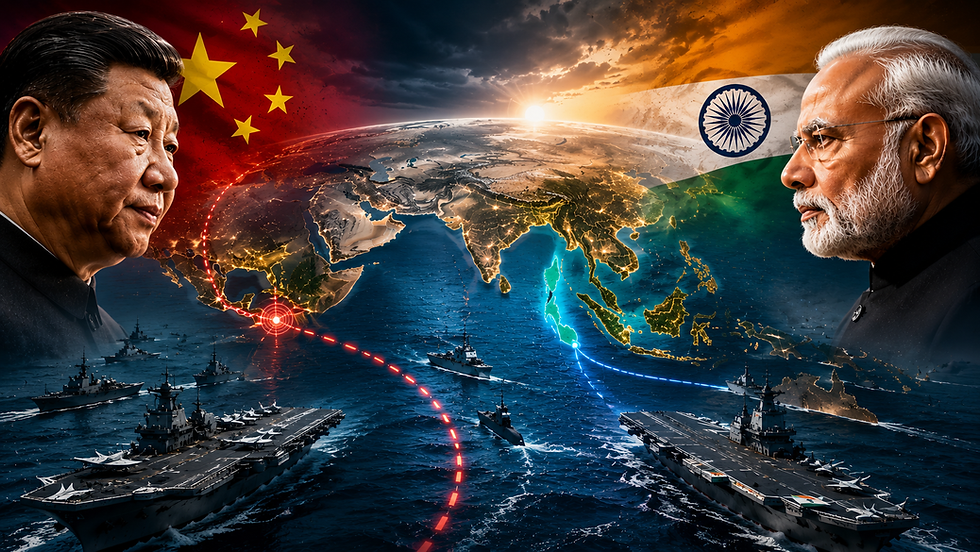
For much of the past decade, discussions about China's rise have been dominated by familiar flashpoints. Taiwan remains the most dangerous potential conflict zone in Asia. The South China Sea continues to witness military posturing and competing territorial claims. Meanwhile, the broader Indo-Pacific has emerged as the primary theatre of strategic competition between China and the United States.
Yet beneath these headline-grabbing disputes lies a less discussed reality—one that may ultimately prove far more consequential for China's long-term ambitions. The greatest challenge confronting Beijing may not come from Washington, Taipei, or even a coalition of regional powers. Instead, it may stem from geography itself.
China's extraordinary economic rise has been built upon global trade, industrial production, and access to overseas energy resources. All three depend heavily on maritime routes that pass through the Indian Ocean. Unlike the Western Pacific, where China enjoys the advantages of proximity and extensive military infrastructure, the Indian Ocean presents an entirely different strategic environment. Here, Beijing finds itself operating far from home, dependent on vulnerable supply lines, and confronting a geographical reality that overwhelmingly favors India.
The question is therefore not whether China can project power into the Indian Ocean. It already can. The more important question is whether China can ever overcome the strategic disadvantages imposed by geography and establish enduring influence in a region that India naturally dominates.
The Ocean Behind China's Rise
Modern China's economic miracle has been powered by an uninterrupted flow of resources from across the globe. Crude oil from the Middle East, natural gas from multiple suppliers, minerals from Africa, and countless other commodities travel thousands of kilometers before reaching Chinese ports. These supply chains have enabled Beijing to transform itself into the world's manufacturing powerhouse and the second-largest economy on earth.
The Indian Ocean sits at the center of this system. It serves as the maritime bridge connecting the energy-rich Gulf region and African resource exporters with the industrial centers of East Asia. Every day, a vast network of tankers and cargo vessels traverses these waters carrying the commodities that sustain Chinese growth. Without secure access to these sea lanes, China's economy would face significant disruption.
This dependence creates a strategic dilemma. Throughout history, great powers have sought to reduce vulnerabilities in critical supply chains. Nations become uncomfortable when essential economic lifelines depend upon routes they do not fully control. China's position in the Indian Ocean reflects precisely this concern. While Beijing has invested heavily in naval modernization and overseas infrastructure, it remains fundamentally dependent upon maritime corridors that lie far beyond its immediate sphere of influence.
As China's global ambitions expand, this dependence becomes increasingly significant. A nation aspiring to global power status cannot ignore the security of the routes upon which its prosperity depends. Consequently, the Indian Ocean has emerged as one of the most important regions in Chinese strategic thinking.
Why the Malacca Strait Still Haunts Beijing
Perhaps no concept better illustrates China's maritime anxieties than the so-called "Malacca Dilemma." The Strait of Malacca, located between Malaysia and Indonesia, represents one of the most important maritime chokepoints in the world. A substantial proportion of China's energy imports pass through this narrow corridor before continuing toward Chinese ports.
From Beijing's perspective, dependence on a single maritime bottleneck presents obvious risks. Any disruption—whether caused by conflict, piracy, geopolitical tension, or other factors—could affect the flow of vital imports. While some discussions exaggerate the likelihood of a deliberate blockade, the underlying concern remains valid. Strategic planners are trained to consider vulnerabilities, even those that may never materialize.
This concern has shaped Chinese policy for years. Investments in pipelines, alternative transportation routes, and maritime infrastructure projects all reflect attempts to reduce strategic dependence on vulnerable chokepoints. The objective is not necessarily to eliminate risk entirely, which is impossible, but rather to create multiple pathways capable of sustaining China's economic needs.
Yet despite these efforts, geography remains stubborn. Maritime transport continues to offer the most efficient means of moving large volumes of energy and trade. Consequently, the Indian Ocean and the routes leading through the Strait of Malacca remain central to China's economic security.
The String of Pearls: Ambition Meets Geography
China's growing presence across the Indian Ocean has often been described through the framework of the "String of Pearls." The concept refers to a network of ports, infrastructure investments, and logistical facilities stretching from East Asia to Africa. Locations such as Gwadar in Pakistan, Hambantota in Sri Lanka, and China's military facility in Djibouti frequently feature in discussions about Beijing's long-term strategy.
Supporters of the theory argue that China is methodically constructing the foundations of a future maritime network capable of supporting sustained naval operations. From this perspective, infrastructure projects serve not merely economic purposes but also strategic objectives, gradually expanding China's influence across the region.
However, the relationship between commercial infrastructure and military power is often misunderstood. Ports can facilitate naval operations, but they do not automatically create maritime dominance. Sustained military presence requires logistics, maintenance facilities, political reliability, intelligence networks, and secure supply chains. Access is valuable, but access alone does not eliminate distance.
This distinction is important because geography continues to shape outcomes. Even with access to facilities across the Indian Ocean, Chinese naval forces must still operate far from their primary bases and industrial centers. Every deployment requires complex logistical planning. Every operation depends upon lengthy supply chains. These challenges do not disappear simply because a port exists.
The String of Pearls undoubtedly enhances China's regional influence. Yet it does not fundamentally erase the geographical realities that continue to favor India.
Why Geography Continues to Favor India
One of the oldest truths in geopolitics is that geography matters. Technologies evolve, governments change, and alliances shift, but geography remains remarkably constant.
India occupies a uniquely advantageous position within the Indian Ocean. Its peninsular geography extends deep into the region, providing access to both the Arabian Sea and the Bay of Bengal. Major shipping routes pass near India's maritime approaches, while Indian naval forces operate relatively close to home bases and support infrastructure.
These advantages are often overlooked because they appear so obvious. Yet history repeatedly demonstrates the value of proximity. Nations operating near home generally enjoy logistical efficiencies that distant powers struggle to replicate. Supply lines are shorter. Maintenance is simpler. Reinforcements arrive faster. Operational flexibility increases.
For India, these benefits are structural rather than temporary. They are rooted not in policy decisions but in geography itself. This does not guarantee success. Strategic advantages can be squandered through poor planning or inadequate investment. Nevertheless, India's position provides opportunities that few countries enjoy.
China, by contrast, must overcome distance whenever it operates in the Indian Ocean. Its growing naval capabilities certainly reduce this challenge, but they cannot eliminate it entirely.
The Andaman Factor
If India's geography provides a natural advantage, the Andaman and Nicobar Islands amplify it significantly.
Located near critical maritime routes connecting the Indian Ocean and the Pacific, these islands occupy one of the most strategically important positions in the broader Indo-Pacific region. Their location enhances India's maritime awareness and strengthens its ability to monitor shipping activity across key transit routes.
The significance of the islands is not simply military. Their true value lies in the options they provide policymakers. Strategic flexibility often matters more than raw military power. A nation that possesses multiple options enjoys greater freedom of action during periods of crisis.
For this reason, the Andaman and Nicobar Islands remain central to India's maritime strategy. They represent one of the clearest examples of how geography can generate lasting strategic leverage.
SV Strategic Take
Much of the contemporary discussion surrounding China's naval expansion focuses on numbers. Analysts compare fleet sizes, shipbuilding rates, and defense budgets. These metrics are important, but they do not tell the entire story.
Strategic competition is rarely determined by numbers alone. It is shaped by geography, logistics, political relationships, economic resilience, and operational endurance. In the Indian Ocean, these factors continue to provide India with significant advantages despite China's impressive military modernization.
This does not mean India should become complacent. China's maritime capabilities will continue to grow, and Beijing's interest in the Indian Ocean is unlikely to diminish. The region will become increasingly contested over the coming decades. India must therefore continue investing in naval modernization, maritime domain awareness, and regional partnerships.
Nevertheless, the central reality remains unchanged. China is attempting to secure influence within a region that geography naturally places within India's strategic orbit. That challenge will shape the future trajectory of the India-China maritime rivalry.
Conclusion: The Ocean That Could Shape Asia's Future
The future balance of power in Asia may not be decided solely in the Taiwan Strait or the South China Sea. Increasingly, the Indian Ocean is emerging as a critical arena where economic security, maritime influence, and geopolitical competition intersect.
China's rise depends upon secure access to the sea lanes that cross these waters. India occupies the geographic center of the region through which those sea lanes pass. This simple reality creates a strategic dynamic that neither side can ignore.
The competition between India and China in the Indian Ocean is not a contest that will be settled by a single crisis or military confrontation. It is a long-term struggle shaped by geography, economics, infrastructure, diplomacy, and maritime power.
China can build more ships.
It can invest in more ports.
It can expand its global presence.
But geography remains the one factor that cannot be negotiated away.
And in the Indian Ocean, geography still favors India.


Comments