

Why the Indian Ocean Will Decide the 21st Century: India vs China’s Silent Naval War
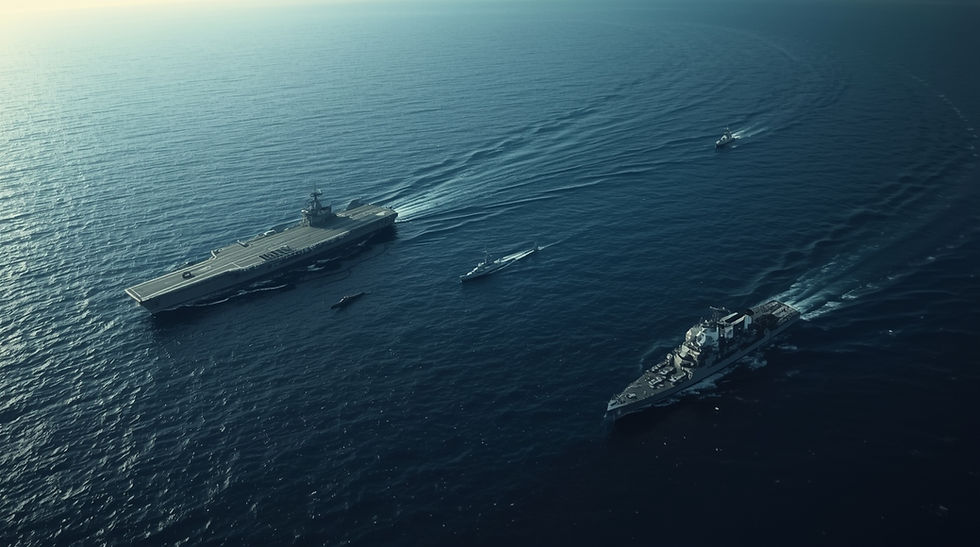
The twenty-first century will not be decided in Europe, nor in the Middle East, and perhaps not even in the skies of Eastern Europe or the Taiwan Strait. Its true arena lies largely unseen, beneath the waves and across vast stretches of blue water — the Indian Ocean. This ocean, often overlooked in popular geopolitical discourse, has quietly emerged as the most decisive maritime space of our time. Whoever shapes the security architecture of the Indian Ocean will influence global trade, energy flows, military balance, and the future of international power itself. At the heart of this contest lies a silent, strategic, and long-term naval rivalry between two Asian giants: India and China.
For centuries, the Indian Ocean was a highway of commerce rather than conflict. Ancient traders from India, Arabia, East Africa, and Southeast Asia crisscrossed its waters long before Europe discovered sea power. The monsoon winds dictated trade routes, cultures intermingled, and the ocean remained remarkably free of hegemonic domination until colonial powers arrived. The British Empire later turned the Indian Ocean into the backbone of its global maritime dominance, using India as the fulcrum of imperial power. When colonialism receded, the ocean entered a period of relative calm, dominated indirectly by Western naval forces, especially the United States Navy after the Second World War.
That calm is now ending. The Indian Ocean today carries nearly half of the world’s container traffic, over sixty percent of global oil shipments, and almost all east–west digital data cables linking Asia with Africa and Europe. It connects the energy-rich Middle East with manufacturing hubs in East Asia, and it sustains the economies of India, China, Japan, and Southeast Asia. Any disruption in this ocean would ripple through global markets instantly. This is why strategists increasingly refer to the Indian Ocean not merely as a trade route, but as the world’s most critical strategic commons.
China understands this reality perhaps better than any other power. Despite being a continental state for most of its history, modern China is fundamentally dependent on maritime trade. Over eighty percent of its oil imports pass through the Indian Ocean, primarily via the narrow Malacca Strait. This dependence creates what Chinese strategists call the “Malacca Dilemma” — a vulnerability where hostile naval forces could choke China’s economy in times of conflict. For Beijing, securing sea lines of communication across the Indian Ocean is not optional; it is existential.
India, by contrast, occupies a unique and often underappreciated position. Geographically, the Indian subcontinent juts deep into the Indian Ocean like a massive aircraft carrier. India sits astride major sea lanes connecting East Asia, Africa, and the Middle East. Unlike China, India does not need to transit chokepoints to access the Indian Ocean — it is already there. From the Andaman and Nicobar Islands near the Malacca Strait to the Lakshadweep Islands near critical shipping lanes in the Arabian Sea, India enjoys an unparalleled natural advantage. Geography, however, only becomes power when it is matched with strategy, doctrine, and sustained naval capability.
The rivalry between India and China in the Indian Ocean is not loud or theatrical. There are no massive naval battles, no dramatic confrontations, and few headlines. Instead, it is a slow, patient, methodical contest unfolding through port access agreements, submarine patrols, maritime surveillance, undersea infrastructure, and influence over smaller littoral states. This is a silent naval war — one fought with long-term positioning rather than immediate conflict.

China’s approach to the Indian Ocean is often described through the concept of the “String of Pearls.” Though Beijing officially downplays the term, the reality is unmistakable. China has invested heavily in ports and logistics facilities stretching from the South China Sea to the Horn of Africa. Gwadar in Pakistan, Hambantota in Sri Lanka, Kyaukpyu in Myanmar, and Djibouti in East Africa are not isolated commercial projects; they form a network that provides China with logistical reach, intelligence access, and potential military utility. Even when these ports are presented as civilian infrastructure, their strategic value is undeniable.
The establishment of China’s first overseas military base in Djibouti marked a turning point. For the first time in modern history, China openly signaled its intention to maintain permanent military presence far from its shores. Djibouti sits at the mouth of the Red Sea, near the Bab el-Mandeb strait — a chokepoint through which a significant portion of global trade passes. From here, Chinese naval forces can monitor shipping, protect energy routes, and support long-duration deployments in the Indian Ocean. What began as anti-piracy operations has quietly evolved into sustained power projection.
Submarines form the most sensitive dimension of this rivalry. China’s deployment of nuclear and conventional submarines into the Indian Ocean has increased steadily over the past decade. These deployments are not merely symbolic; they serve intelligence-gathering, crew training, and deterrence objectives. Chinese submarines docking in Colombo or Karachi send subtle but unmistakable messages. They also force India to devote significant resources to anti-submarine warfare, maritime domain awareness, and undersea sensor networks.
India, for its part, has responded not with panic, but with recalibration. New Delhi has long viewed the Indian Ocean as its natural sphere of influence, but it was slow to articulate a comprehensive maritime strategy. That has changed. India’s naval doctrine now explicitly recognizes the Indian Ocean as the primary theater of strategic competition. The focus has shifted from coastal defense to sea control, sea denial, and power projection. Aircraft carriers, long-range maritime patrol aircraft, nuclear-powered submarines, and island-based surveillance systems are no longer luxuries — they are necessities.
The Andaman and Nicobar Islands have emerged as India’s unsinkable forward base. Located just a few hundred kilometers from the Malacca Strait, these islands allow India to monitor and potentially influence one of the world’s busiest maritime chokepoints. Unlike China, which must negotiate access to foreign ports, India operates from sovereign territory. Runway expansions, naval facilities, and joint commands in the islands signal India’s intent to turn geography into strategy.
Yet the India–China naval contest is not solely about ships and submarines. It is equally about partnerships and norms. India has quietly strengthened maritime cooperation with countries like the United States, Japan, Australia, France, and Indonesia. Exercises such as Malabar are not rehearsals for war, but demonstrations of interoperability, signaling that India is not alone in the Indian Ocean. These partnerships enhance surveillance, intelligence sharing, and collective deterrence without formal alliances.
China, meanwhile, seeks influence through economic leverage. Debt-financed infrastructure projects create dependencies that can later translate into strategic concessions. Hambantota’s ninety-nine-year lease is often cited as a cautionary tale. While China denies militarization, the distinction between commercial and military use becomes increasingly blurred in modern naval strategy. Dual-use infrastructure is the currency of twenty-first-century maritime power.
Smaller Indian Ocean states find themselves caught between opportunity and anxiety. Chinese investments promise development, but also bring strategic strings. India, conscious of historical perceptions of dominance, treads carefully, offering capacity-building, disaster relief, and maritime security assistance rather than coercion. This softer approach aligns with India’s broader vision of the Indian Ocean as a region of shared prosperity rather than exclusive control. Whether this vision can withstand China’s financial muscle remains an open question.
Technology is rapidly reshaping this silent naval war. Satellites, underwater drones, seabed sensors, and artificial intelligence-driven analytics are transforming how oceans are monitored and contested. Control of undersea cables — which carry the vast majority of global internet traffic — has become a strategic priority. The Indian Ocean’s seabed is no longer empty; it is becoming a contested space of digital arteries and sensor networks. Dominance in this domain will confer immense informational power.
Climate change adds another layer of complexity. Rising sea levels, intensifying cyclones, and shifting fisheries affect littoral states disproportionately. Naval forces increasingly double as humanitarian responders. India’s rapid disaster relief operations during tsunamis and cyclones have strengthened its regional credibility. China, too, seeks to project an image of a responsible maritime power through humanitarian missions. In the Indian Ocean, soft power and hard power increasingly intersect.
The United States looms in the background of this rivalry, not as a direct participant, but as a strategic balancer. Washington views the Indian Ocean as integral to the broader Indo-Pacific framework. While the US Navy remains the most powerful force in the region, it increasingly relies on partners like India to maintain regional stability. This creates both opportunity and risk for New Delhi. Strategic alignment enhances India’s leverage, but excessive dependence could compromise autonomy — a core principle of Indian foreign policy.
What makes the India–China contest in the Indian Ocean uniquely consequential is its long-term nature. This is not a rivalry seeking immediate victory. It is a generational competition over norms, access, and influence. Ships launched today will serve for decades. Ports built now will shape geopolitics for half a century. Decisions made quietly, without headlines, will determine whether the Indian Ocean remains open, balanced, and multipolar — or slides into dominance by a single power.
India’s challenge is not merely to counter China, but to define a credible maritime vision of its own. A vision that reassures neighbors, deters adversaries, and integrates economic growth with security. This requires sustained investment, institutional reform, and strategic patience. Naval power is expensive, slow to build, and easy to neglect — but impossible to improvise in crisis.
China, meanwhile, must reconcile its expanding naval footprint with regional trust deficits. Power projection without reassurance breeds resistance. The Indian Ocean is not the South China Sea; it is vast, diverse, and historically resistant to domination. Chinese naval presence will continue to grow, but whether it translates into accepted leadership remains uncertain.
As the twenty-first century unfolds, conflicts may erupt elsewhere, but the underlying balance of power will increasingly be shaped by what happens in the Indian Ocean. Energy security, trade stability, digital connectivity, and military deterrence all converge here. The silent naval war between India and China is not about conquest; it is about shaping the environment in which all future conflicts and collaborations will occur.
History teaches us that oceans do not forgive strategic neglect. Those who control maritime commons shape the rules of global order. In the coming decades, the Indian Ocean will decide not only the fate of Asia, but the trajectory of the world. And in its deep waters and distant ports, the quiet rivalry between India and China will continue — patient, calculated, and profoundly consequential.
Watch the complete analysis in our youtube channel:


Comments