

Beyond Fighters and Missiles: Why India Must Build Its Own Heavy Transport Aircraft

India today operates one of the most technologically diverse and professionally trained air forces in the world, equipped with modern fighter jets, airborne early warning platforms, aerial refueling tankers, and expanding surveillance networks, yet beneath these visible elements of air power lies a less glamorous but far more decisive capability that ultimately determines whether military force can be applied effectively across large distances, and that capability is strategic airlift, the ability to move troops, armored vehicles, artillery systems, helicopters, engineering equipment, and humanitarian relief supplies rapidly and repeatedly across thousands of kilometers under both peace and wartime conditions.
In modern warfare, the side that can shift forces quickly, reinforce vulnerable sectors, and sustain forward deployments over long periods gains a decisive operational advantage, regardless of how advanced individual weapon systems may be, and this is why heavy transport aircraft form the logistical backbone of every major military power, enabling not only rapid response but also long-term endurance in contested environments.
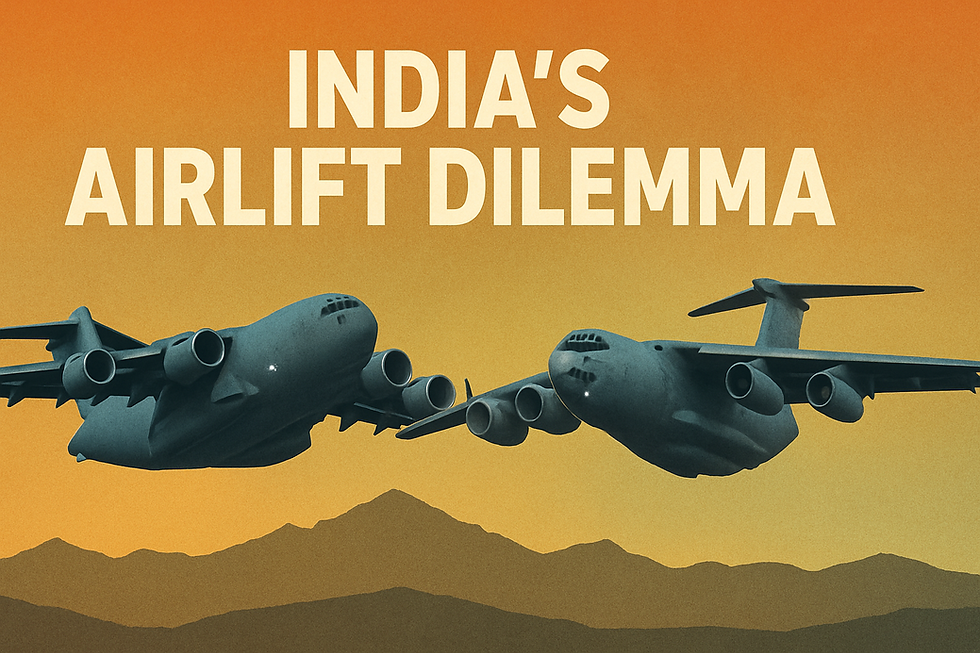
At present, India’s heavy airlift capability rests primarily on two aircraft types, the American C‑17 Globemaster III and the Russian‑origin IL‑76, both of which have served the Indian Air Force with distinction in military deployments, disaster relief operations, and evacuation missions, yet the strategic sustainability of this fleet structure is increasingly under question as global production realities, aging airframes, and shifting geopolitical conditions converge to create a looming capability gap.
The C‑17 Globemaster III represents the most capable heavy transport aircraft in Indian service, able to carry main battle tanks, large artillery systems, helicopters, and fully equipped infantry units directly into forward airfields, including short or semi‑prepared runways, a feature that has proven invaluable in high‑altitude and remote regions where ground infrastructure is limited or vulnerable to disruption.
These aircraft have played key roles in reinforcing border areas during periods of heightened tension, delivering humanitarian aid during natural disasters, and conducting complex evacuation operations involving Indian citizens stranded abroad, demonstrating not only technical performance but also strategic flexibility, yet despite these achievements, the C‑17 fleet in Indian service consists of only eleven aircraft, a number that is sufficient for peacetime contingencies and limited surge operations but inadequate for sustained high‑intensity conflict involving multiple theaters.
Compounding this limitation is the fact that C‑17 production has been permanently closed, with Boeing having shut down the assembly line after completing final orders for the United States and allied customers, making any future expansion of India’s C‑17 fleet practically impossible, as restarting such a production line would require massive financial investment, re‑establishment of supply chains, and long‑term procurement commitments that are highly unlikely in the current global defense market.
Over time, even maintaining the existing fleet will become more expensive as spare parts grow scarcer and maintenance requirements increase, a normal lifecycle reality for any complex aerospace platform, but one that becomes strategically significant when the platform in question forms the backbone of national logistics capability.
Alongside the C‑17, the Indian Air Force continues to operate the IL‑76, an aircraft that has been a workhorse of military airlift for decades and that has supported everything from troop movements to heavy cargo transport across long distances, yet these aircraft are now approaching or exceeding forty years of service in many cases, placing them well beyond their original design expectations and introducing increasing challenges related to structural fatigue, avionics obsolescence, and rising maintenance cycles.
While modernization programs and life‑extension upgrades can mitigate some of these issues, they cannot reverse the fundamental physical limitations of aging airframes, and as availability rates decline, the number of aircraft that can be relied upon at any given time steadily decreases, reducing surge capacity precisely when it may be needed most.
This creates a strategic contradiction in which India’s operational requirements for heavy airlift are expanding while the effective size and reliability of its transport fleet are gradually shrinking, a trend that becomes particularly concerning when viewed against the backdrop of India’s evolving security environment and growing regional responsibilities.
India today faces persistent military pressure along its northern and eastern borders, ongoing instability along its western frontier, and rising maritime competition across the Indian Ocean, all of which demand rapid mobility of forces, flexible redeployment options, and sustained logistical support to maintain deterrence and operational readiness.
The concept of a two‑and‑a‑half front scenario, involving potential simultaneous challenges from multiple directions combined with internal security commitments, places extraordinary strain on logistics networks, because units may need to be moved quickly between theaters, heavy equipment must be repositioned over long distances, and reserves must be deployed in compressed timelines, tasks that cannot be accomplished efficiently through road and rail transport alone, particularly in mountainous or infrastructure‑limited regions.
In such contexts, strategic airlift becomes not merely a support function but a core operational enabler, allowing commanders to respond to shifting threat vectors, reinforce vulnerable sectors, and maintain operational tempo even when surface transportation routes are constrained or disrupted.
This logistical reality is further amplified by India’s island territories, particularly the Andaman and Nicobar Islands, which occupy a strategically critical position near major maritime choke points and play an increasingly important role in India’s maritime surveillance and power projection strategy, yet sustaining military infrastructure on these islands requires a constant flow of personnel, fuel, construction materials, and specialized equipment, much of which must be delivered by air during emergencies or periods of heightened alert.
In any future conflict scenario involving contested sea lines of communication, reliance on maritime transport alone could prove risky, making airlift capability essential for maintaining operational continuity and deterrence posture in these forward areas.
Beyond military considerations, heavy transport aircraft are indispensable for humanitarian assistance and disaster relief operations, an area where India has consistently demonstrated leadership across South Asia and the wider Indian Ocean region, responding rapidly to earthquakes, cyclones, floods, and humanitarian crises with medical teams, relief supplies, and engineering units, often reaching affected areas before many other international actors.
Such operations depend heavily on the availability of large cargo aircraft capable of carrying heavy equipment, field hospitals, water purification systems, and bulk supplies directly to damaged or austere airfields, underscoring that strategic airlift capacity contributes not only to warfighting but also to diplomacy, regional stability, and India’s international reputation as a responsible regional power.
Similarly, evacuation missions involving Indian nationals abroad have become more frequent as geopolitical instability and conflict zones proliferate, requiring rapid deployment of transport aircraft to extract civilians under tight timelines and uncertain security conditions, missions that again depend on sufficient airlift capacity rather than on limited diplomatic or commercial transport options.
Given this expanding range of responsibilities, it is natural to ask whether India can simply procure additional heavy transport aircraft from global suppliers to strengthen its fleet, yet the reality of the international aerospace market offers very few viable options, particularly for platforms in the true heavy‑lift category capable of carrying main battle tanks and oversized military equipment.
With C‑17 production closed, Western alternatives effectively do not exist, and while some have speculated about possible production restarts, the industrial and financial barriers make such outcomes extremely unlikely, especially when even the United States has focused on extending the life of existing fleets rather than initiating new heavy airlift programs.
The Russian option, represented by newer variants of the IL‑76, offers theoretical capability improvements over older models, but long‑term sustainability remains uncertain due to international sanctions, constrained industrial capacity, and shifting priorities within the Russian aerospace sector, raising legitimate concerns about spare parts availability, upgrade pathways, and long‑term operational reliability.
India’s recent experience with maintaining Russian‑origin systems across multiple service branches has already highlighted vulnerabilities associated with external supply chains during periods of geopolitical tension, and extending such dependence into the core logistics backbone of the armed forces would introduce risks that are strategically difficult to justify.
China’s Y‑20 heavy transport aircraft has significantly enhanced the People’s Liberation Army’s mobility and power projection capabilities, yet for India, procuring strategic logistics platforms from a primary military competitor is fundamentally incompatible with national security imperatives, given concerns related to software integrity, avionics security, maintenance dependencies, and the broader strategic implications of embedding adversary technology within critical defense infrastructure.
This leaves India facing a situation where none of the available global platforms can reliably and sustainably meet its long‑term heavy airlift requirements, making continued reliance on imports an increasingly fragile strategy at a time when operational demands are only expected to grow.
In this context, the development of an indigenous heavy transport aircraft emerges not as an aspirational industrial project but as a strategic necessity rooted in operational realities, geopolitical risk management, and the long‑term sustainability of India’s military doctrine.
Such a program would involve significant technical challenges, including airframe design for extreme payloads, advanced materials engineering, flight control systems capable of handling wide weight variations, and most critically, the development or integration of high‑thrust turbofan engines capable of sustained heavy‑lift operations across diverse climatic and geographic conditions.
Engine development in particular represents one of the most complex and capital‑intensive aspects of aerospace engineering, and unless India makes substantial progress in this domain, some degree of external dependence may remain, yet even partial indigenous capability combined with diversified international partnerships would significantly reduce strategic vulnerability compared to complete reliance on imported platforms.
From an industrial standpoint, a heavy transport aircraft program could serve as a catalyst for advancing composite manufacturing, avionics integration, systems engineering, and precision fabrication across the broader aerospace sector, strengthening collaboration between public institutions such as HAL and DRDO and private firms including Tata, L&T, and Mahindra Aerospace, which have already demonstrated growing competence in complex defense manufacturing projects.
Such industrial development would not only support military objectives but also generate spillover benefits for civilian aviation, space launch systems, and advanced manufacturing more broadly, contributing to long‑term technological self‑reliance and economic growth.
Critics often argue that indigenous aerospace programs are prone to delays, cost overruns, and performance shortfalls, and while these risks are real, it is equally important to recognize that dependence on foreign suppliers carries its own long‑term costs, including vulnerability to political pressure, limited upgrade autonomy, and restricted access to source codes and mission systems, all of which constrain operational flexibility over the lifecycle of the platform.
Moreover, financial investments in domestic aerospace programs tend to circulate within the national economy, supporting high‑skill employment, research institutions, and industrial infrastructure, rather than flowing outward as foreign exchange payments, making such expenditures part of a broader strategy of economic and technological development rather than purely defense consumption.
Heavy transport aircraft also possess strong civil‑strategic utility, as platforms designed for military logistics can be rapidly repurposed for large‑scale disaster response, medical evacuation, and humanitarian relief operations, providing governments with flexible national assets capable of responding to domestic emergencies as well as international crises.
In the long term, successful development of an indigenous heavy transport aircraft could also open avenues for defense exports to countries that seek reliable airlift capability but are constrained by political, financial, or strategic considerations that limit access to Western systems and discourage reliance on Chinese platforms, creating opportunities for defense cooperation and strategic partnerships aligned with India’s broader foreign policy objectives.
While such export potential should not be the primary driver of the program, it represents an important secondary benefit that can help achieve economies of scale, reduce per‑unit costs, and sustain production lines over extended periods, improving overall program viability.
Ultimately, the debate over heavy transport aircraft is not about technological prestige or industrial symbolism, but about the fundamentals of military effectiveness, because without reliable logistics, even the most advanced combat units cannot be sustained, and in conflicts where speed, adaptability, and endurance determine outcomes, mobility becomes as decisive as firepower.
As India continues to invest in indigenous fighter aircraft, expand naval shipbuilding, and modernize missile and surveillance systems, leaving the logistics backbone dependent on shrinking and uncertain external supply options would represent a critical strategic inconsistency, undermining the very capabilities that frontline modernization seeks to enhance.
Heavy transport aircraft may not attract the same public attention as stealth fighters or aircraft carriers, but they are the silent enablers of power projection, crisis response, and sustained military operations, and nations that neglect this dimension of capability often find themselves constrained in moments of strategic urgency.
For India, the coming decades are likely to involve greater regional responsibilities, more complex security challenges, and higher expectations from partners across the Indo‑Pacific and beyond, and meeting these expectations will require not only capable combat forces but also the logistical depth to support rapid and sustained action across vast distances.
In this strategic context, developing an indigenous heavy transport aircraft is not merely an option to be considered when convenient, but a foundational investment aligned with India’s long‑term goals of strategic autonomy, industrial capability, and credible deterrence, ensuring that national security decisions are not constrained by external production lines, geopolitical shifts, or supply chain disruptions.
If pursued with consistent political commitment, realistic timelines, and strong public‑private collaboration, such a program could transform a looming vulnerability into a long‑term strategic advantage, reinforcing India’s ability to respond decisively to both military threats and humanitarian crises while strengthening the domestic aerospace ecosystem.
In the final analysis, national power is not defined solely by the weapons a country possesses, but by its ability to deploy, sustain, and adapt its forces across time and space, and in that decisive contest of mobility and logistics, heavy transport aircraft occupy a central and irreplaceable role, making India’s choices in this domain among the most consequential for its future security and strategic independence.
Watch the complete analysis-

Comments