

Putin’s Visit to India: The Blunt Message to Washington and the New Power Equation
Updated: Oct 15
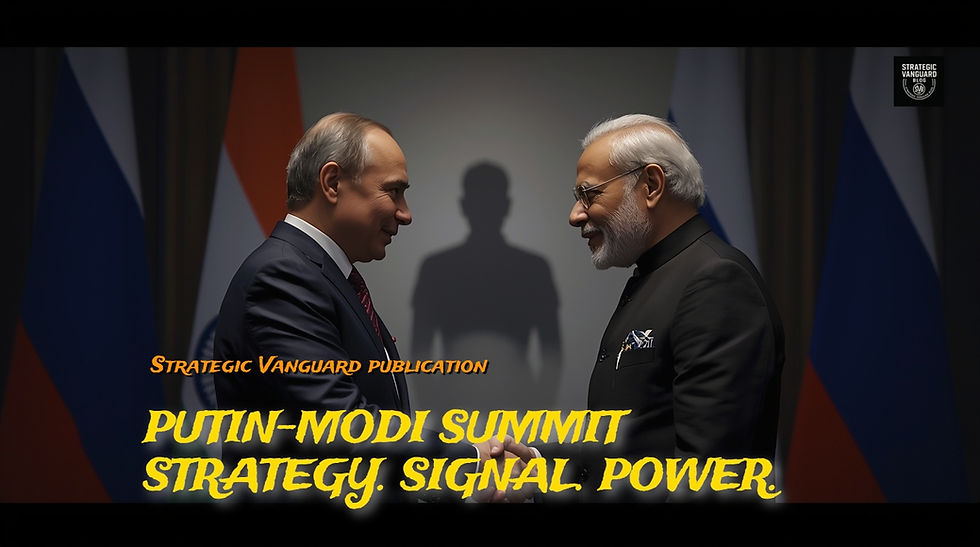
Vladimir Putin’s visit to India has triggered strong reactions across global capitals. Western media framed it as a symbolic gesture, while Russian outlets portrayed it as a strategic triumph. But beneath the noise lies a deeper, sharper message — one that India has sent to the United States with surprising clarity.
This was not just a diplomatic meeting. This was a statement of power, autonomy, and geopolitical balance.
🇮🇳 India’s Message to Washington: No Arm-Twisting
For months, American policymakers have tried to pressure New Delhi:
Reduce oil imports from Russia
Distance India from Moscow
Align firmly with the West on Ukraine
Limit defense cooperation with Russia
Yet India’s stance has remained unchanged: Strategic autonomy is non-negotiable.
Putin’s visit made that explicit.
By hosting the Russian President at a time when US–Russia tensions are at their peak, India signaled:
It will not be dictated to by any power
It will not sacrifice a time-tested partnership
It will pursue national interest without hesitation
For Washington, this visit is a reminder that India is a partner, not a follower — and certainly not a pawn in great-power competition.
🇷🇺 Why Putin Needed This Visit
For Russia, India is not merely a diplomatic ally — it is a strategic necessity.
Russia depends on India for:
Long-term stable oil revenue
A massive defense market
Joint weapons development (BrahMos, Su-30 upgrades, etc.)
Diplomatic legitimacy beyond China
Access to the Global South
With economic sanctions biting and military needs evolving, Russia cannot afford to lose India. This visit was Putin’s way of strengthening a lifeline — economically, strategically, and politically.
💼 The Deals Signed: Billions in Defense, Oil & Technology
Putin’s India visit was not symbolic. It produced tangible agreements:
Defense & Military:
Acceleration of pending contracts
New joint-production plans under Make in India
Upgrades for Indian Air Force and Navy systems
Energy:
Long-term oil supply agreements
Closer cooperation in refining and petrochemicals
Discussions on LNG and coal supply
Nuclear & Technology:
Expansion of nuclear cooperation projects
Collaboration in cyber, space, and digital technologies
These deals reinforce a simple truth:India–Russia relations are evolving, not fading.
🌏 What This Means for Global Power Dynamic
This visit reshapes multiple strategic triangles:
1. India–US Relations
The US is forced to accept that India will not take sides blindly.Partnership with America remains important — but not at the cost of sovereignty.
2. India–Russia Relations
A 70-year partnership gains new relevance in a fractured global order.
3. China’s Concerns
Beijing watches warily.A stronger India–Russia axis prevents Russia from becoming too dependent on China.
4. Global South Leadership
India positions itself as the voice of the emerging world — independent, assertive, and pragmatic.
⚖️ India’s Long Game: Strategic Autonomy Above All
India refuses to be trapped in Cold War binaries. It seeks cooperation with the US, energy security with Russia, and competitive stability with China — all at the same time.
This is not balancing. This is power positioning.
Putin’s visit proves that India is charting its own path, guided by one principle:
“India chooses only one side — its national interest.”
🧭 Conclusion
Putin’s visit to India is more than a diplomatic headline.It is a recalibration of the geopolitical map.It signals a multipolar world where India rises as an independent, assertive power capable of shaping global outcomes.
Washington has received the message.Moscow has reinforced the partnership.The world witnessed a new chapter in realpolitik.
India has spoken — and it spoke loudly.
Watch the complete analysis-


Comments