

Why Great Powers Think in Decades, Not Headlines: The Secret Behind Long-Term Global Strategy
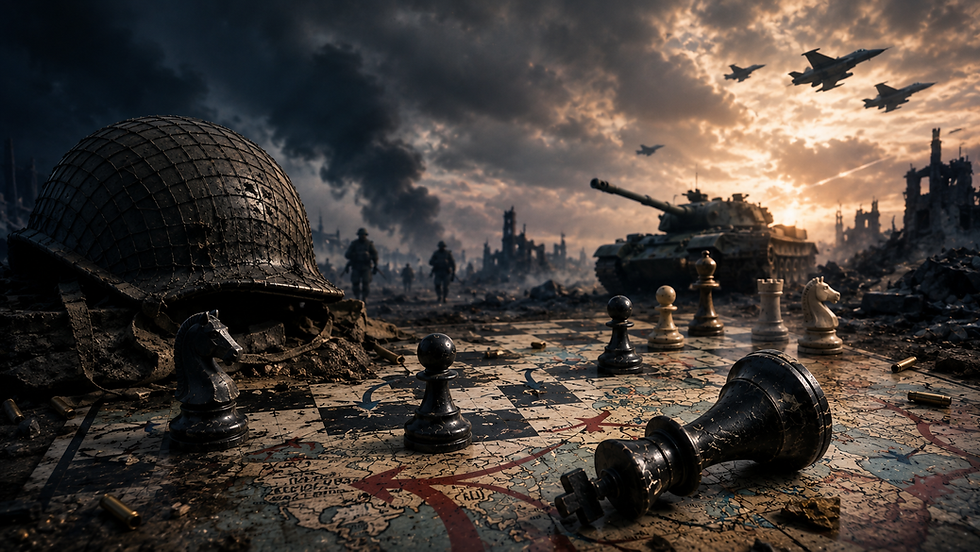
Every day, the world is flooded with breaking news. A missile test captures international attention, a summit dominates political discussions, sanctions reshape economic relationships, or a military confrontation becomes the headline across global media. Modern news cycles encourage us to view geopolitics as a sequence of isolated events, each appearing urgent and decisive. Yet the nations that have shaped history rarely make decisions based solely on what happened this morning. Behind every headline lies a much deeper process of strategic thinking that unfolds over decades rather than days. Great powers understand that lasting influence is not created by reacting to every crisis but by steadily pursuing long-term national objectives. While headlines explain what happened today, strategy seeks to determine what the world should look like ten, twenty, or even fifty years from now. This difference between reacting to events and shaping them is what separates ordinary states from enduring great powers.
The distinction between tactics and strategy is fundamental to understanding international politics. Tactics are concerned with winning today's battle or resolving an immediate challenge, whereas strategy focuses on achieving national objectives over generations. A nation may win individual military engagements, negotiate favourable agreements, or respond effectively to short-term crises, but these achievements become truly meaningful only when they contribute to a broader national vision. History repeatedly demonstrates that tactical victories can ultimately become strategic failures if they are not aligned with long-term goals. Conversely, countries that occasionally suffer setbacks often emerge stronger because they remain committed to a coherent strategic direction. Successful grand strategy requires patience, consistency, and the discipline to prioritize future advantages over immediate political gains.
Time itself is one of the most powerful strategic assets available to a nation. Countries that think in decades invest in capabilities whose benefits may not become visible for many years. They build infrastructure that supports future economic growth, educate generations of scientists and engineers, modernize their armed forces through sustained investment, strengthen institutions, cultivate technological leadership, and develop resilient industrial bases. None of these initiatives generate dramatic headlines when they begin, yet together they create the foundations of national power. Strategic competition is therefore less about spectacular moments and more about thousands of disciplined decisions that gradually transform a country's position in the international system.
China provides one of the clearest contemporary examples of long-term strategic planning. Over several decades, Beijing has systematically expanded its industrial capacity, invested heavily in advanced technology, modernized its military, developed world-class infrastructure, and pursued global connectivity through large-scale economic initiatives. Whether one agrees with China's policies or not, its rise demonstrates the cumulative power of sustained planning. The remarkable transformation of China's economy and military did not occur because of a single policy or leader. It resulted from a long-term national vision that remained focused despite changing global circumstances. The lesson is not about copying any particular model but about understanding how consistent strategic objectives can reshape the balance of power over time.
The United States offers another example of how enduring strategy shapes global influence. Its worldwide alliance network, leadership in scientific research, technological innovation, financial institutions, and military presence did not emerge overnight. They were built gradually through decades of investment, institution-building, and strategic partnerships. Although individual administrations often differ in their policies and priorities, many of America's core strategic interests have remained remarkably consistent across generations. This continuity allows national capabilities to accumulate over time, reinforcing its position within the international system. Great powers understand that while governments change, national interests often endure.
India now stands at an important strategic crossroads. As one of the world's fastest-growing major economies and an increasingly influential geopolitical actor, India faces the challenge of balancing immediate political demands with long-term national development. Investments in manufacturing, defence production, maritime security, artificial intelligence, semiconductor technology, space exploration, education, infrastructure, and innovation are not simply policy choices for the present; they are decisions that will shape India's strategic position for decades. Building comprehensive national power requires patience because many of these investments produce their greatest benefits only after years of sustained effort. Countries that consistently invest in their future are better prepared to navigate the uncertainties of an increasingly competitive international environment.
One of the greatest dangers of modern media is that it often exaggerates the importance of short-term events while overlooking the slower but more significant trends transforming the global order. A diplomatic dispute may dominate headlines for a week, while technological breakthroughs, industrial expansion, demographic shifts, naval modernization, or educational reforms receive comparatively little attention. Yet it is frequently these quieter developments that determine the future distribution of power. Strategic thinkers therefore train themselves to look beyond the immediate news cycle and identify the deeper structural changes that shape international politics. Understanding these underlying trends provides a clearer picture of where the world is heading than simply following daily headlines.
History consistently rewards nations that combine vision with patience. Great civilizations, empires, and modern states achieved prominence through decades of institution-building, economic development, technological advancement, and military modernization rather than through isolated moments of success. Likewise, many powerful states entered periods of decline when short-term political calculations replaced long-term strategic thinking. National strength ultimately depends not only on military capability or economic performance but also on the ability to maintain a coherent vision that survives changing governments and evolving international conditions. Strategic continuity remains one of the defining characteristics of successful great powers throughout history.
Perhaps the most valuable lesson for citizens, policymakers, and students of geopolitics is to develop the habit of asking different questions. Instead of asking only what happened today, we should also ask what trends are unfolding over the next twenty years and how current events fit within those larger patterns. This shift in perspective fundamentally changes the way we interpret international affairs. Rather than reacting emotionally to every headline, we begin to recognise the long-term currents that drive global politics and understand why patient strategy so often triumphs over immediate reaction.
Great powers are not built in a single election cycle, a single military campaign, or a single diplomatic victory. They are built through decades of disciplined investment, institutional strength, technological progress, strategic patience, and an unwavering commitment to national objectives. Headlines may explain today's events, but only long-term strategy explains tomorrow's world. For anyone seeking to understand geopolitics beyond the daily news cycle, learning to think in decades rather than headlines is perhaps the most important strategic lesson of all.


Comments