

The Invisible Weapon That Wins Wars: Why Military Logistics Matters More Than Missiles

When people think about military power, they tend to focus on what they can see. Images of fighter jets soaring across the sky, aircraft carriers dominating the oceans, missile launches lighting up the night, and tanks rolling across battlefields have become synonymous with military strength. Governments proudly display these symbols during military parades, defence exhibitions, and strategic demonstrations because they represent visible power. They capture attention, inspire confidence, and project deterrence. Yet beneath every fighter aircraft, every missile battery, every warship, and every armored formation lies a far less glamorous reality. None of these systems can operate without an extensive support network that keeps them fueled, supplied, maintained, and operational. This hidden network is rarely discussed outside military circles, but it often determines the difference between victory and defeat. In the end, the most important weapon in warfare may not be a weapon at all. It may be logistics.
Military history repeatedly demonstrates that battlefield success is only one part of warfare. The ability to sustain military operations over weeks, months, and even years often proves far more decisive than the ability to achieve spectacular victories in the opening stages of a conflict. Armies that appear invincible can quickly become ineffective if they cannot move supplies, transport fuel, replace equipment, or maintain their forces in the field. Logistics is the bridge between military capability and military effectiveness. It transforms weapons into combat power and strategy into operational reality.
The Hidden Foundation of Military Power
The fascination with military hardware often creates a dangerous illusion. Many observers assume that superior technology automatically translates into military superiority. While advanced weapons certainly provide advantages, they are only one component of a much larger system. A modern fighter aircraft may represent billions of dollars in investment, but it requires thousands of maintenance hours, specialized spare parts, trained technicians, secure communications networks, and vast quantities of fuel to remain operational. A warship may dominate headlines, yet it depends upon an equally sophisticated network of ports, logistics hubs, repair facilities, and replenishment vessels. Even the most advanced missile system becomes irrelevant once its ammunition stocks are depleted.
Logistics is therefore not simply a support function. It is a combat multiplier. It determines how long a military force can operate, how rapidly it can move, and how effectively it can respond to changing battlefield conditions. In modern warfare, where operations can stretch across continents and multiple domains, logistics often becomes the central pillar of military power.
Napoleon's Lesson: When Logistics Defeats Genius
Few military commanders in history have enjoyed a reputation as formidable as Napoleon Bonaparte. By the early nineteenth century, he had defeated numerous European coalitions and established France as the dominant power on the continent. His military genius appeared unmatched. Yet even Napoleon discovered that strategic brilliance cannot overcome logistical failure.
In 1812, Napoleon launched his invasion of Russia with one of the largest armies Europe had ever seen. More than half a million soldiers crossed into Russian territory with expectations of a decisive victory. Instead, they encountered a logistical nightmare. Russian forces retreated deeper into their territory, destroying supplies and infrastructure as they withdrew. The vast distances of Russia stretched French supply lines to their limits. Food became scarce. Horses died in huge numbers. Equipment deteriorated. Disease spread rapidly among exhausted troops. By the time winter arrived, the logistical system supporting Napoleon's army had collapsed.
The Russian campaign remains one of history's most powerful reminders that military success depends upon sustainment. Napoleon was not defeated solely by Russian soldiers. He was defeated by geography, infrastructure, weather, and the inability of his logistical system to support a prolonged campaign. His greatest enemy was not the Russian Army. It was logistics.
Operation Barbarossa and Germany's Fatal Miscalculation
More than a century later, Nazi Germany would repeat a remarkably similar mistake. In June 1941, Germany launched Operation Barbarossa, the largest invasion in military history. German forces achieved spectacular early victories, destroying Soviet formations and advancing hundreds of kilometers into Soviet territory. To many observers, German victory appeared inevitable.
Yet behind the scenes, logistical challenges were steadily undermining the campaign. Fuel consumption exceeded expectations. Vehicle breakdowns increased. Supply routes became increasingly vulnerable. Rail networks proved incompatible with German requirements. Spare parts struggled to reach frontline units. The deeper German forces advanced, the more difficult it became to sustain them.
When winter arrived, these logistical weaknesses became impossible to ignore. The Wehrmacht possessed excellent tactical doctrine and highly capable soldiers, but neither could compensate for a failing supply system. Germany ultimately lost not because it lacked battlefield effectiveness, but because it could not sustain military operations across the vast expanse of the Eastern Front. Logistics once again proved stronger than military ambition.
How Logistics Helped Win World War II
If logistics can destroy armies, it can also create victory. The Allied victory in World War II is perhaps the greatest demonstration of logistics as a strategic weapon. The United States and its allies built an unprecedented industrial and logistical machine capable of supporting military operations across multiple continents simultaneously.
Factories produced extraordinary quantities of weapons and equipment, but production alone was insufficient. Those resources needed to be transported across oceans, delivered to combat zones, maintained in operational condition, and continuously replenished. Massive cargo fleets crossed the Atlantic and Pacific Oceans. Rail networks moved supplies across continents. Fuel pipelines extended across Europe. Repair facilities ensured equipment remained combat-ready. Supply depots supported millions of personnel.
The Normandy landings in 1944 are often remembered as a triumph of courage and operational planning. Yet D-Day was fundamentally a logistical achievement. The invasion represented the culmination of years of preparation, planning, transportation, and sustainment efforts. Without logistics, there would have been no liberation of Europe. The Allies won because they possessed not only military strength, but the logistical capability to sustain that strength.
Why Modern Warfare Depends More on Logistics Than Ever
Contrary to popular belief, technological progress has not reduced the importance of logistics. In fact, it has increased it. Modern military systems are more sophisticated, more complex, and more resource-intensive than anything seen in previous eras. Advanced aircraft require extensive maintenance. Precision-guided munitions depend upon highly specialized production chains. Warships require continuous support and replenishment. Satellites, drones, cyber systems, and networked command structures all rely upon infrastructure that must be maintained and protected.
As military technology advances, logistical requirements become increasingly demanding. Every new capability creates new sustainment challenges. A military force may possess cutting-edge equipment, but without secure supply chains and resilient logistical networks, those capabilities quickly lose effectiveness. Modern warfare is therefore not simply a contest of technology. It is a contest of sustainment.
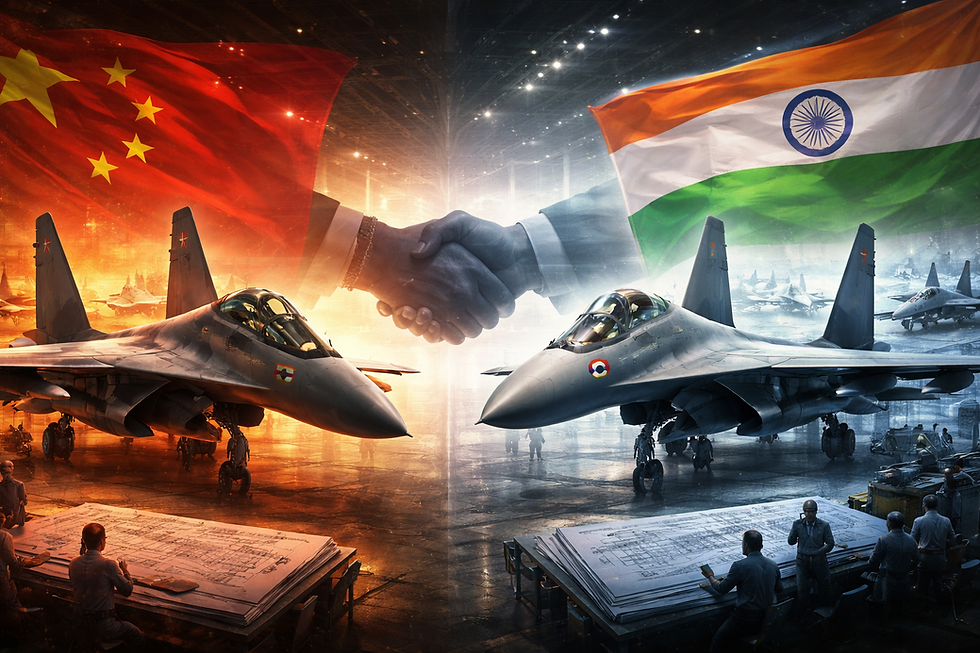
The India-China Infrastructure Race
For India, logistics carries particular strategic significance. The country's security environment includes some of the most challenging terrain on Earth. The Himalayan frontier presents extraordinary obstacles to military mobility and sustainment. High altitudes, harsh weather conditions, difficult terrain, and limited transportation corridors create unique logistical challenges.
This reality explains why infrastructure development has become a critical component of India's national security strategy. Roads, bridges, tunnels, airfields, and logistics hubs are not merely economic assets. They are strategic assets. They determine how quickly forces can be deployed, reinforced, and sustained during a crisis.
China has invested heavily in transportation infrastructure across the Tibetan Plateau, enhancing its ability to mobilize military forces near the border. India has responded by accelerating its own infrastructure projects, improving connectivity and strategic mobility across key regions. The competition is about far more than roads and railways. It is about operational readiness, deterrence, and military effectiveness. In the Himalayas, infrastructure is military power.
The Future Battlefield of Logistics
The future of military logistics will be shaped by emerging technologies and new strategic challenges. Artificial intelligence will increasingly optimize supply chains and maintenance schedules. Autonomous vehicles may transport supplies through contested environments. Advanced sensors and satellite networks will provide real-time visibility across logistical systems. Predictive maintenance technologies will reduce equipment failures and improve readiness.
At the same time, logistics will become an increasingly attractive target for adversaries. Cyberattacks may disrupt transportation networks. Supply chains could face sabotage. Space-based systems supporting military logistics may become vulnerable to attack. Future conflicts will likely feature intense competition over the networks that sustain military power.
The battlefield of tomorrow will not eliminate logistics. It will elevate logistics to an even greater level of strategic importance.
Conclusion: The Weapon Nobody Sees
Military history delivers a remarkably consistent lesson. Weapons win battles. Logistics wins wars.
Throughout history, armies have risen and fallen based on their ability to sustain operations. From Napoleon's failed invasion of Russia to Germany's logistical struggles in World War II, from Allied victory in Europe to modern conflicts in Ukraine, the pattern remains unchanged. Military power is not defined solely by the weapons a nation possesses. It is defined by its ability to maintain, transport, support, and sustain those weapons over time.
The next time a fighter jet roars overhead or a missile launch captures headlines, it is worth remembering the invisible system operating behind the scenes. Fuel depots, supply routes, warehouses, maintenance facilities, transport networks, engineers, mechanics, and logistics specialists all contribute to military effectiveness. They may never appear in military parades, but they form the foundation upon which military power is built.
Because in the final analysis, the most important weapon on the battlefield may be the one that never fires a shot.
Join the Discussion
Military history repeatedly demonstrates that logistics can determine the outcome of wars, yet it remains one of the least understood aspects of military power.
Do you believe logistics is more important than weapons in modern warfare?
Can superior infrastructure and supply chains outweigh technological advantages on the battlefield?
How significant is the India-China infrastructure race in shaping the future balance of power in the Himalayas?
Join the discussion in the Strategic Vanguard Community and share your perspective with fellow readers.
👉 Discuss this article in our Strategic Vanguard Community Group

Comments