

Technology Transfer or Technology Theft? How Defence Agreements Shape Global Power—China vs India
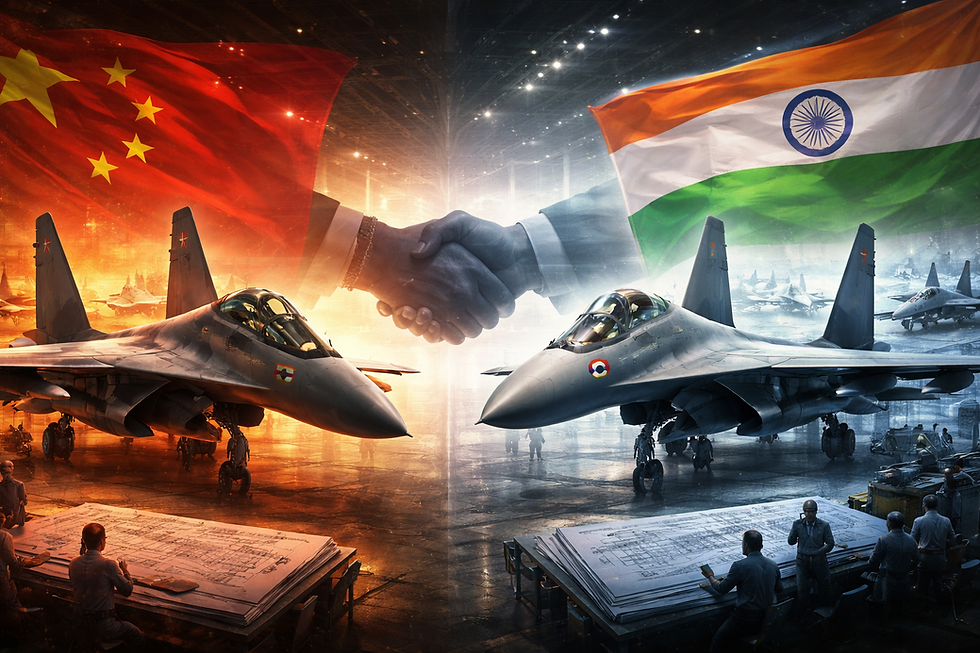
In international politics, defence agreements are not merely contracts—they are instruments of power. The manner in which nations interpret, exploit, or respect these agreements often determines whether they rise as trusted partners or feared disruptors.
Few case studies illustrate this contrast better than China and India, two rising powers that started from comparable industrial baselines in the late Cold War era yet diverged sharply in how they used foreign military technology.
China chose strategic exploitation.India chose strategic restraint.
Both approaches produced results—but at very different costs.
Licensed Production: A Double-Edged Sword
Licensed production is designed as a controlled pathway:
The supplier shares manufacturing know-how
The recipient gains industrial depth
Intellectual property remains protected
In theory.
In practice, licensed production has become one of the most abused mechanisms in defence history.
China and the SU-27: From Licensee to Imitator
China’s agreement with Russia in the 1990s to manufacture the SU‑27 under license as the J-11 was supposed to be limited in scope.
Instead, it became a blueprint for industrial leapfrogging.
What China Did Differently
China:
Systematically disassembled imported kits
Mapped metallurgy, aerodynamics, and avionics
Integrated indigenous radar, sensors, and weapons
Gradually replaced Russian engines and electronics
The result was the J-11B, followed by the J-16, aircraft that retained Russian DNA but were functionally Chinese.
Russia protested. Contracts were violated. Trust collapsed.
But China had already achieved its objective.
Leapfrogging an Entire Aerospace Generation
By aggressively reverse-engineering foreign platforms, China compressed four decades of aerospace learning into less than twenty years.
This strategy enabled:
Indigenous AESA radars
High-thrust turbofan engines
Integrated sensor fusion
Rapid transition toward stealth platforms
Today, China is openly testing sixth-generation combat aircraft, something unthinkable without that early breach of trust.
Strategically, the gamble worked.
Diplomatically, the bill came later.
India and the SU-30MKI: Discipline Over Disruption
India’s experience with licensed production of the SU‑30MKI could not be more different.
India assembled and manufactured over 270 airframes—one of the largest licensed fighter production runs in the world.
Yet India:
Respected IP boundaries
Paid royalties consistently
Integrated upgrades transparently
Sought joint development rather than unilateral copying
This approach did not create a leapfrog—but it created something else.
Credibility.
The Cost of Playing by the Rules
India’s restraint had consequences:
Indigenous engines lagged
Radar and sensor maturity arrived late
Platform timelines stretched by decades
While China moved to next-generation systems, India often found itself catching up, forced to start R&D from first principles.
Strategically painful—but politically invaluable.
Trust as a Strategic Asset
In defence geopolitics, trust is currency.
India’s reputation as a rule-abiding partner enabled access that China never received.
The clearest example lies beneath the oceans.
Submarine Technology: Why Germany Trusted India, Not China
Germany has historically guarded its submarine propulsion technologies with extreme caution.
China was explicitly denied access due to fears of reverse engineering.
India, however, received technology transfer under Project-75, enabling indigenous submarine construction at Mazagon Dock Shipbuilders Limited.
This decision was not sentimental—it was strategic.
Germany trusted India not to copy, violate, or proliferate sensitive technology.
That trust cannot be reverse-engineered.
Sanctions, Policy Shocks, and Strategic Vulnerability
India’s rule-based approach comes with vulnerabilities:
Sanctions risk
Export control regimes
Political shifts in supplier nations
The same trust that enables collaboration also creates dependency choke points.
China eliminated this risk early—by burning bridges.
India accepted the risk—by preserving them.
Two Paths, Two Futures
China | India |
Fast capability growth | Slower but sustainable growth |
High sanctions risk | High trust quotient |
Rapid leapfrogging | Long gestation cycles |
Strategic suspicion | Strategic credibility |
Neither path is morally pure.Neither path is strategically perfect.
The Emerging Middle Path
India is now attempting a hybrid strategy:
Co-development instead of licensing
Modular collaboration
Indigenous cores with foreign subsystems
Iron-clad contracts
This shift reflects a mature understanding:Trust alone is not power—but power without trust is brittle.
Conclusion: Power Is Not Just What You Build—It’s Who Trusts You
China chose speed over trust—and succeeded militarily, at a diplomatic cost.
India chose trust over speed—and paid in time, but gained strategic legitimacy.
As global defence cooperation enters an era of tighter controls and suspicion, India’s path may prove slower—but more survivable.
In the next article on Ambat Legal Insight, we will examine:
How treaty violations reshape international law
Why iron-clad defence agreements are now essential
And how nations are legally hardening technology transfer in response to China’s playbook
This is not just about aircraft or submarines.
It is about the future architecture of global power.


Comments