

The Geography of Power: How Five Maritime Chokepoints Control the World's Trade and Security

Every generation believes that technology has rewritten the rules of international politics. The invention of aircraft supposedly ended the dominance of navies. Nuclear weapons were expected to make geography irrelevant. Satellites, cyber warfare, artificial intelligence, and hypersonic missiles have each been presented as revolutionary developments capable of rendering physical terrain obsolete. Yet history has repeatedly demonstrated that while technology changes the methods through which nations compete, geography continues to define the arena in which that competition takes place. Mountains still shape military campaigns. Rivers continue to influence borders. Oceans remain the highways of global commerce. Above all, a handful of narrow waterways continue to determine whether economies prosper, militaries project power, or global supply chains remain intact. These narrow passages—known as maritime chokepoints—are among the most strategically valuable locations on Earth.
Around 80% of global merchandise trade by volume is transported by sea. The overwhelming majority of crude oil, liquefied natural gas, manufactured goods, industrial components, fertilizers, food grains, and critical minerals move aboard commercial ships navigating a complex network of maritime routes that connect continents. While the oceans themselves are vast, these shipping routes converge at surprisingly few locations where geography compresses global maritime traffic into narrow corridors. Any disruption at one of these points can send shockwaves through energy markets, insurance premiums, commodity prices, manufacturing supply chains, and even military operations thousands of kilometres away.
Modern geopolitics is therefore not simply a contest between armies or economies. It is equally a contest over access, control, surveillance, and protection of these maritime arteries. The ability to safeguard sea lines of communication has become one of the defining characteristics of great powers. Conversely, the inability to secure maritime access can leave even the strongest economies vulnerable to coercion. This reality explains why major naval powers continuously invest billions of dollars in aircraft carriers, submarines, destroyers, maritime patrol aircraft, overseas logistics facilities, intelligence networks, and strategic partnerships. These investments are not merely about displaying national prestige; they are fundamentally about ensuring uninterrupted access to the world's maritime highways.
For India, this reality carries particular significance. Situated at the heart of the Indian Ocean, India occupies one of the world's most advantageous strategic locations. Almost every major east-west maritime route passes close to India's coastline, placing the country in a uniquely favourable position to influence regional security. As India's economy expands and its dependence on imported energy grows, maritime security is no longer simply a naval concern but an essential pillar of national security, economic stability, and diplomatic influence. The emergence of the Indo-Pacific as the primary theatre of global strategic competition has further elevated the importance of maritime geography in Indian strategic thinking.
What Exactly Is a Maritime Chokepoint?
A maritime chokepoint is a naturally or artificially constrained waterway through which a substantial proportion of international shipping must pass. Because ships cannot easily bypass these routes without incurring enormous financial and operational costs, these locations possess immense strategic value. Unlike open oceans where vessels have multiple navigation options, chokepoints compress traffic into predictable channels, making them simultaneously efficient for commerce and vulnerable during crises.
Their importance extends far beyond commercial shipping. Naval deployments, humanitarian missions, anti-piracy operations, submarine patrols, undersea communication cables, offshore energy infrastructure, and maritime surveillance activities frequently converge around these narrow passages. Consequently, nations seek not only to secure their own access but also to deny potential adversaries unrestricted movement during periods of conflict.
Throughout history, control of maritime chokepoints has repeatedly altered the balance of power. Ancient empires fought over strategic ports. Colonial powers established overseas naval bases to dominate trade routes. During both World Wars, control of sea lanes became decisive for sustaining industrial production and military logistics. Even in the twenty-first century, regional conflicts in West Asia, instability in the Red Sea, and increasing strategic competition in the Indo-Pacific demonstrate that geography remains as relevant today as it was centuries ago.
Unlike natural resources, maritime geography cannot be relocated. Oil fields may be discovered elsewhere, factories may move to new countries, and technologies may evolve rapidly, but narrow straits, canals, and maritime passages remain fixed. This permanence explains why maritime strategy demands long-term planning extending across decades rather than election cycles.
Why Chokepoints Matter More Than Ever
The twenty-first century has witnessed an unprecedented expansion of global trade. Supply chains stretch across continents, with components manufactured in multiple countries before final assembly elsewhere. Energy imports travel thousands of kilometres before reaching consumers. Rare earth minerals mined in one region support semiconductor production in another, while finished electronics are exported worldwide. This intricate economic web depends fundamentally upon uninterrupted maritime transportation.
Globalisation has therefore increased, rather than reduced, dependence upon maritime chokepoints. A temporary disruption at a major passage can delay thousands of ships, increase freight rates, create shortages of essential commodities, and undermine investor confidence. Insurance companies immediately reassess maritime risk, shipping firms reroute vessels at considerable expense, and governments begin evaluating emergency measures to protect energy supplies and maintain economic stability.
Military planners recognise another equally important dimension. Since naval forces also rely upon these routes for strategic mobility, controlling or threatening a chokepoint provides substantial leverage during crises. A nation need not necessarily occupy an adversary's territory to impose severe economic pressure. The credible ability to disrupt maritime commerce may itself become a powerful strategic instrument.
Consequently, the world's principal maritime chokepoints have evolved into zones where economics, diplomacy, intelligence, and military power intersect. They represent far more than narrow waterways; they are strategic crossroads through which the prosperity and security of nations increasingly flow.
In the following sections, we shall examine the five maritime chokepoints that collectively shape the modern geopolitical landscape and explain why they remain indispensable to understanding global strategy in the twenty-first century.
The Five Gateways That Keep the Global Economy Moving

If geography determines the distribution of power, then maritime chokepoints are the pressure valves through which that power is exercised. Every day, thousands of merchant vessels, oil tankers, liquefied natural gas carriers, container ships, naval task forces, fishing fleets, and research vessels pass through a handful of narrow waterways that connect the world's oceans. These passages are far more than convenient routes; they are strategic assets whose uninterrupted operation underpins the modern international economic order. A disruption lasting only a few days can delay billions of dollars' worth of trade, while a prolonged closure can trigger inflation, energy shortages, and geopolitical instability across continents. This extraordinary concentration of global commerce means that only five principal chokepoints collectively influence a substantial portion of maritime trade, making them indispensable to every major economy, regardless of geography.
The Strait of Hormuz: The World's Energy Lifeline
No maritime chokepoint exerts a greater influence over global energy security than the Strait of Hormuz. Situated between Iran to the north and Oman and the United Arab Emirates to the south, this narrow waterway forms the only maritime exit from the Persian Gulf into the Gulf of Oman and the Arabian Sea. While its navigable shipping lanes are relatively narrow, its strategic significance is enormous because the Persian Gulf contains some of the world's largest oil and natural gas reserves.
Around one-fifth of the world's oil consumption and a substantial share of globally traded LNG transit the Strait of Hormuz. Energy exported from Saudi Arabia, Kuwait, Iraq, Qatar, the United Arab Emirates, and Bahrain relies heavily on this single maritime gateway. Countries across Asia—including India, China, Japan, and South Korea—depend extensively on Gulf energy imports transported through Hormuz. Consequently, any military confrontation or disruption in this region has immediate consequences for global oil prices, shipping insurance, and energy security.
The strategic value of Hormuz explains why it remains one of the most heavily militarised waterways on Earth. The United States and its allies have maintained a sustained naval presence in the region for decades, conducting maritime security operations and ensuring freedom of navigation. Iran, meanwhile, possesses significant anti-ship missile capabilities, naval mines, fast attack craft, drones, and submarines designed to threaten shipping during periods of heightened tension. Although permanently closing the strait would be difficult, even the perception of risk can drive up energy prices worldwide. This makes Hormuz not merely a geographic feature but an instrument of geopolitical influence capable of affecting economies thousands of kilometres away.
For India, the Strait of Hormuz represents more than an international concern; it is a critical national interest. A substantial portion of India's imported crude oil transits this passage. Any prolonged disruption would directly affect fuel prices, industrial production, inflation, and economic growth. Consequently, India's maritime strategy increasingly emphasises protecting energy supply chains extending from the Gulf to the Indian coastline.
The Strait of Malacca: The Economic Artery of Asia
If Hormuz is the world's energy valve, then the Strait of Malacca is undoubtedly the economic artery of Asia. Stretching between the Malay Peninsula and the Indonesian island of Sumatra, this narrow passage connects the Indian Ocean with the South China Sea and the broader Pacific Ocean. It serves as the shortest and most economically efficient maritime route linking Europe, the Middle East, Africa, and East Asia.
Most East Asian economies—including China, Japan, South Korea, and Singapore—depend heavily on shipping through the Strait of Malacca. Massive container ships carrying electronics, automobiles, machinery, industrial equipment, consumer goods, and manufactured products travel through Malacca alongside oil tankers transporting Middle Eastern crude to Asian refineries. Every day, an extraordinary concentration of commercial shipping transforms this relatively narrow strait into one of the busiest waterways in the world.
For China, the Strait of Malacca represents a profound strategic vulnerability, often referred to as the "Malacca Dilemma." A substantial proportion of Chinese energy imports and export-oriented trade depends upon uninterrupted access through this route. Chinese strategic planners have long recognised that any conflict involving major naval powers could potentially threaten maritime traffic through Malacca, placing severe pressure on China's economy. This concern has driven Beijing to diversify transportation corridors through pipelines, overland infrastructure, port investments under the Belt and Road Initiative, and the expansion of the People's Liberation Army Navy into the Indian Ocean.
India occupies a uniquely advantageous position relative to the Strait of Malacca. Through the Andaman and Nicobar Islands, India possesses a forward strategic presence overlooking one of the principal approaches to this vital waterway. These islands effectively function as an unsinkable aircraft carrier, enabling maritime surveillance, naval deployments, and air operations across a vast expanse of the eastern Indian Ocean. As India's naval capabilities continue to grow, the strategic significance of the Andaman and Nicobar Command will only increase, reinforcing India's role as a major security provider within the Indo-Pacific.
Bab el-Mandeb: The Gateway Between Europe and Asia
Connecting the Red Sea with the Gulf of Aden, Bab el-Mandeb may appear modest in size, yet its geopolitical importance is immense. Every vessel travelling between Europe and Asia through the Suez Canal must first navigate this narrow passage. Consequently, Bab el-Mandeb functions as a critical gateway linking the Mediterranean Sea with the Indian Ocean.
Its strategic significance has become increasingly evident in recent years as instability in the surrounding region has repeatedly threatened commercial shipping. Missile attacks, drone strikes, piracy, and regional conflicts have demonstrated how vulnerable this maritime corridor remains. Even limited disruptions have compelled numerous shipping companies to reroute vessels around the Cape of Good Hope, adding thousands of nautical miles to voyages, increasing fuel consumption, delaying deliveries, and significantly raising freight costs.
These events have highlighted an important strategic lesson: maritime chokepoints need not be physically blocked to affect global commerce. The mere presence of persistent security risks can alter shipping behaviour, increase insurance premiums, and disrupt supply chains. This reality underscores the importance of sustained multinational maritime security operations designed to preserve freedom of navigation.
For India, Bab el-Mandeb carries both commercial and strategic importance. Indian exports to Europe, imports from the Mediterranean, and naval deployments into the western Indian Ocean all depend upon secure passage through this corridor. Consequently, developments in the Red Sea increasingly feature within India's broader maritime security calculations.
The Suez Canal: Engineering That Changed Global History
Unlike the natural straits discussed above, the Suez Canal represents one of humanity's greatest engineering achievements. By linking the Mediterranean Sea directly with the Red Sea, it eliminated the need for ships travelling between Europe and Asia to circumnavigate Africa. This dramatically reduced travel distances, transportation costs, and delivery times, transforming global commerce.
The strategic importance of the canal has repeatedly been demonstrated throughout history. Political crises, military conflicts, and even accidental obstructions have disrupted maritime traffic, reminding the international community that modern trade remains vulnerable despite technological progress. The 2021 grounding of the Ever Given demonstrated how a single vessel could interrupt one of the world's most important trade arteries and disrupt global supply chains.
For Europe, the Suez Canal represents an essential commercial artery connecting manufacturers with Asian markets. For Asian exporters, it provides the fastest maritime route to Europe. For India, it facilitates trade with Europe, North Africa, and the Mediterranean while reducing transportation costs and strengthening commercial competitiveness.
More importantly, the canal demonstrates that strategic infrastructure is not limited to military facilities. Civilian engineering projects can become geopolitical assets whose importance extends across generations.
The Panama Canal: Linking Two Oceans
On the opposite side of the globe lies another engineering marvel that transformed maritime strategy. The Panama Canal connects the Atlantic and Pacific Oceans, allowing vessels to avoid the lengthy and hazardous journey around Cape Horn at the southern tip of South America.
The canal significantly reduces transit times for commercial shipping moving between the eastern and western coasts of the Americas while also serving global trade between Asia, North America, and Europe. It remains indispensable for container shipping, agricultural exports, energy transportation, and naval mobility.
From a military perspective, the canal enables naval forces to shift between oceans far more rapidly than would otherwise be possible. This flexibility has historically enhanced the strategic mobility of maritime powers, particularly the United States.
Although India relies less directly upon the Panama Canal than the other chokepoints discussed, its continued operation contributes to the efficiency of global trade networks, demonstrating once again how interconnected maritime commerce has become.
The examination of these five strategic gateways reveals a common reality. While separated by thousands of kilometres and differing in geography, they collectively sustain the movement of energy, trade, military forces, and economic prosperity. Their security is therefore not merely a regional concern but a global responsibility. Any nation aspiring to become a major maritime power must understand not only how these chokepoints function individually but also how they interact within the wider architecture of international trade and strategic competition.
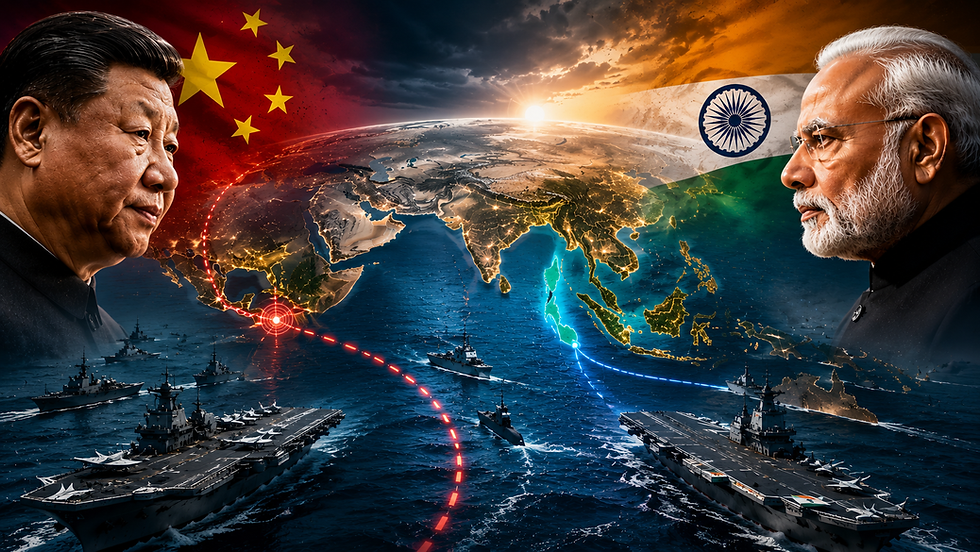
India, China, and the Battle for Maritime Influence in the Indo-Pacific
The importance of maritime chokepoints extends well beyond commercial shipping and energy transportation. In the twenty-first century, they have become central to the geopolitical competition unfolding across the Indo-Pacific. Nations are no longer competing solely for territory or resources; they are increasingly competing for influence over the routes that connect the global economy. Whoever can secure these sea lanes enjoys economic resilience, military mobility, diplomatic leverage, and strategic credibility. Conversely, nations that remain dependent on vulnerable maritime routes without the ability to protect them expose themselves to coercion during periods of crisis. This evolving reality explains why maritime strategy has moved from the periphery of national security planning to its very centre.
For India, this transformation has created both extraordinary opportunities and significant responsibilities. Geographically, India occupies one of the most advantageous positions in the world. Extending deep into the Indian Ocean, the Indian peninsula resembles a natural aircraft carrier projecting influence into one of the busiest maritime regions on Earth. To its west lie the energy-rich waters of the Persian Gulf and the Strait of Hormuz. To its east sits the Strait of Malacca, the gateway connecting the Indian Ocean with the Pacific. South of the Indian peninsula stretch the critical Sea Lines of Communication (SLOCs) linking Africa, the Middle East, Europe, and East Asia. Few nations enjoy such a commanding geographical location, and Indian strategic planners increasingly recognise that geography, if matched with capability, can become a decisive source of national power.
Historically, India viewed maritime security primarily through the lens of coastal defence and regional naval operations. However, the strategic environment has changed dramatically over the past two decades. India's economy has become increasingly dependent on maritime trade. Around 95% of India's merchandise trade by volume and nearly 70% by value is carried by sea and a substantial majority of its energy imports travelling by sea. This dependence means that maritime security is no longer merely a naval issue; it is directly linked to economic growth, industrial production, energy security, and national prosperity. Every disruption in the Indian Ocean has the potential to influence fuel prices, inflation, export competitiveness, and investor confidence within India.
Recognising this reality, India has gradually expanded its maritime vision from coastal defence to regional leadership. Concepts such as SAGAR—Security and Growth for All in the Region—reflect an understanding that India must contribute to maintaining a stable and secure maritime order across the Indian Ocean. Rather than pursuing coercive dominance, India has positioned itself as a net security provider, offering humanitarian assistance, disaster relief, anti-piracy operations, maritime domain awareness, and naval cooperation to regional partners. This approach has strengthened India's diplomatic relationships while enhancing its strategic credibility among smaller Indian Ocean states.
A critical pillar of India's maritime strategy lies in the Andaman and Nicobar Islands. Located near the western approaches to the Strait of Malacca, these islands possess immense strategic value. They enable India to monitor commercial shipping, deploy naval and air assets rapidly, conduct surveillance across a vast maritime area, and cooperate with friendly navies operating in the Indo-Pacific. The Andaman and Nicobar Command, India's only integrated tri-service command, represents a recognition that the future of military operations increasingly requires seamless coordination between naval, air, and land forces. As geopolitical competition intensifies, these islands will likely become even more significant, functioning as a forward operating hub capable of supporting India's maritime ambitions.
While India's geographical position provides strategic advantages, China's maritime circumstances present a very different picture. China's spectacular economic rise has been fuelled by global trade, imported energy, and export-oriented manufacturing. However, this economic success has also created strategic vulnerabilities. A substantial proportion of Chinese crude oil imports and commercial shipping passes through the Strait of Malacca before reaching Chinese ports. This dependence has long troubled Chinese policymakers, who fear that a hostile naval coalition could potentially disrupt these maritime routes during a major conflict. Former Chinese President Hu Jintao famously referred to this concern as the "Malacca Dilemma," a phrase that has since become central to discussions of Chinese maritime strategy.
China's response to this vulnerability has been comprehensive. Rather than relying exclusively on naval expansion, Beijing has pursued multiple initiatives designed to reduce its dependence on any single maritime corridor. The Belt and Road Initiative has financed ports, railways, pipelines, and logistics infrastructure across Asia, Africa, and Europe. Energy pipelines linking China with Central Asia and Myanmar provide partial alternatives to maritime transportation. Investments in ports stretching from Gwadar in Pakistan to Djibouti in the Horn of Africa have expanded China's logistical footprint across the Indian Ocean. Simultaneously, the rapid modernisation of the People's Liberation Army Navy has transformed China into one of the world's foremost naval powers, capable of sustained operations far beyond its immediate coastline.
This expanding Chinese presence has altered the strategic dynamics of the Indian Ocean. Chinese naval deployments, research vessels, intelligence-gathering platforms, and submarine patrols have become increasingly frequent. While Beijing describes many of these activities as supporting international trade and anti-piracy operations, regional powers often interpret them through the broader context of strategic competition. For India, maintaining awareness of Chinese maritime activities has therefore become an essential component of national security planning.
The Indo-Pacific concept has emerged partly in response to these evolving realities. Unlike traditional geographical definitions separating the Indian and Pacific Oceans, the Indo-Pacific recognises that economic and strategic developments increasingly link these two maritime regions into a single interconnected theatre. Commercial shipping, naval deployments, energy transportation, digital communication cables, and geopolitical competition now extend seamlessly across this vast maritime space. Consequently, security developments in the South China Sea can influence strategic calculations in the Arabian Sea, while instability in the Red Sea can affect economic activity throughout East Asia.
Within this evolving framework, partnerships have assumed growing importance. India has strengthened maritime cooperation with countries such as Japan, Australia, France, Indonesia, Singapore, Vietnam, and the United States. These partnerships encompass naval exercises, logistics agreements, intelligence sharing, maritime domain awareness, and capacity building. Among the most visible examples is the Quadrilateral Security Dialogue, commonly known as the Quad, involving India, Japan, Australia, and the United States. Although not a military alliance, the Quad reflects a shared interest in preserving a free, open, inclusive, and rules-based Indo-Pacific where freedom of navigation and international law are respected.
The Indian Navy has correspondingly evolved from a force primarily focused on regional defence into one increasingly capable of blue-water operations. Aircraft carriers, nuclear-powered submarines, long-range maritime patrol aircraft, guided missile destroyers, fleet support ships, and advanced surveillance systems collectively enhance India's ability to protect maritime interests across the wider Indian Ocean Region. Equally important is India's growing investment in Maritime Domain Awareness, integrating satellites, coastal radar chains, unmanned systems, and information-sharing networks to monitor activities across vast oceanic spaces. In maritime strategy, awareness often provides the decisive advantage, enabling governments to respond before crises escalate into conflicts.
Yet military capability alone cannot guarantee maritime security. International law, diplomatic engagement, and cooperative security mechanisms remain equally important. The United Nations Convention on the Law of the Sea (UNCLOS) provides the legal framework governing navigation rights, territorial waters, exclusive economic zones, and maritime dispute resolution. While disagreements regarding interpretation continue in several regions, the broader principle remains clear: predictable rules facilitate stability, whereas uncertainty encourages confrontation. For trading nations such as India, preserving a rules-based maritime order aligns closely with long-term national interests.
The growing strategic importance of underwater infrastructure further reinforces the significance of maritime security. Beneath the oceans lies a vast network of submarine communication cables carrying the overwhelming majority of global internet traffic and international financial transactions. These cables, often running near major shipping routes and chokepoints, constitute critical infrastructure upon which modern economies depend. Protecting them requires sophisticated surveillance capabilities and close international cooperation. Future maritime competition will therefore encompass not only surface shipping but also the invisible digital architecture supporting global connectivity.
Ultimately, the contest for influence in the Indo-Pacific is not solely about naval superiority. It is about ensuring resilience in global supply chains, safeguarding energy security, protecting digital infrastructure, maintaining freedom of navigation, and preserving an international order that enables economic prosperity. Geography has once again become the foundation upon which strategic competition unfolds. For India, whose destiny has always been closely tied to the Indian Ocean, understanding and leveraging this geography may prove one of the defining challenges—and opportunities—of the twenty-first century.

Future Challenges, Emerging Technologies, and the Strategic Vanguard Assessment
As the world moves deeper into the twenty-first century, maritime chokepoints will not become less important; they are likely to become even more critical. While advances in artificial intelligence, autonomous systems, quantum technologies, and space-based surveillance are transforming warfare, they have not altered the fundamental reality that global prosperity still depends on the uninterrupted movement of goods across the oceans. The ships may become smarter, ports may become automated, and logistics networks may become digitally integrated, but the physical geography through which these vessels must pass remains unchanged. Geography continues to impose constraints that no technological innovation has yet been able to overcome.
The next generation of geopolitical competition will therefore revolve around the protection, monitoring, and, where necessary, control of maritime infrastructure. Modern naval strategy is increasingly expanding beyond traditional fleet engagements to encompass cyber security, satellite surveillance, underwater infrastructure protection, unmanned systems, and real-time maritime domain awareness. Future conflicts may not begin with battleships exchanging fire. Instead, they could start with cyberattacks on port management systems, interference with satellite navigation signals, disruption of logistics software, or sabotage of undersea communication cables. These actions, although less dramatic than conventional warfare, possess the potential to inflict enormous economic damage without a single missile being launched.
Artificial intelligence is expected to play a particularly significant role in this transformation. AI-enabled surveillance systems can process enormous volumes of maritime data, identify suspicious shipping patterns, detect illegal fishing activities, monitor submarine movements, and provide commanders with predictive assessments of potential threats. Autonomous surface vessels and underwater drones will increasingly complement conventional naval platforms, extending surveillance capabilities across vast oceanic spaces while reducing operational costs. Nations capable of integrating these technologies effectively will gain a considerable strategic advantage in protecting critical sea lanes.
At the same time, commercial shipping itself is undergoing rapid technological evolution. Smart ports equipped with automated cargo handling systems, blockchain-enabled logistics management, digital customs procedures, and AI-driven traffic management are improving efficiency throughout global supply chains. While these developments increase economic productivity, they also create new vulnerabilities. The more interconnected maritime logistics become, the more attractive they become as targets for cyber warfare and state-sponsored disruption. Consequently, future maritime security will require close cooperation between governments, shipping companies, port authorities, technology firms, and intelligence agencies.
Climate change introduces another strategic variable that cannot be ignored. Rising sea levels, stronger tropical cyclones, changing ocean currents, and increasingly unpredictable weather patterns are already affecting maritime operations. Ports may require significant adaptation to withstand extreme weather events, while changing environmental conditions could influence shipping schedules, insurance costs, and naval deployments. In addition, humanitarian disasters triggered by climate change may increase demands for naval assistance, disaster relief operations, and maritime evacuation missions, further expanding the role of modern navies beyond traditional warfare.
One of the most discussed long-term developments concerns the gradual opening of Arctic shipping routes. As polar ice coverage declines during certain seasons, the Northern Sea Route and other Arctic passages have attracted growing international interest. These routes could shorten travel times between Europe and Asia, potentially offering alternatives to traditional maritime corridors. However, while the Arctic may supplement existing shipping networks in the future, it is unlikely to replace the established chokepoints that have supported global commerce for generations. Seasonal accessibility, harsh operating conditions, limited infrastructure, environmental concerns, and geopolitical competition among Arctic states ensure that the traditional maritime gateways will remain indispensable for the foreseeable future.
Energy transitions may also reshape maritime trade, but not necessarily reduce its importance. As countries diversify away from fossil fuels towards renewable energy, hydrogen, ammonia, and other alternative fuels, maritime transportation will continue to serve as the backbone of international commerce. Critical minerals such as lithium, cobalt, nickel, and rare earth elements—essential for batteries, electric vehicles, renewable energy systems, and advanced electronics—must also travel through maritime supply chains. Thus, while the cargoes may evolve, the dependence upon secure sea routes will remain.
Another emerging dimension of maritime competition concerns strategic resilience. The COVID-19 pandemic, the temporary blockage of the Suez Canal, regional conflicts affecting the Red Sea, and disruptions to global supply chains have collectively demonstrated that efficiency alone is insufficient. Governments and corporations increasingly recognise the importance of redundancy, diversification, and resilience. Alternative shipping routes, strategic petroleum reserves, diversified sourcing, and strengthened logistics partnerships are becoming essential components of national security planning. Maritime strategy is therefore no longer limited to naval operations; it encompasses economics, industrial policy, diplomacy, technology, and infrastructure development.
For India, these evolving dynamics create an extraordinary strategic opportunity. Geography has already granted India one of the most advantageous maritime positions in the world. The challenge now lies in converting this geographical advantage into enduring strategic influence. This requires sustained investment across multiple domains. Naval modernisation must continue with the induction of advanced destroyers, frigates, submarines, aircraft carriers, maritime patrol aircraft, and unmanned systems. Port infrastructure must become more efficient and globally competitive. Indigenous shipbuilding should receive continued policy support to reduce dependence on foreign suppliers. Maritime research, oceanography, undersea surveillance, and cyber security capabilities require sustained expansion. Above all, India must continue strengthening partnerships with like-minded nations while preserving its long-standing commitment to strategic autonomy.
India's maritime diplomacy has already begun reflecting this broader vision. Cooperation with island nations across the Indian Ocean, capacity-building initiatives, humanitarian assistance, disaster relief missions, anti-piracy operations, and participation in multinational naval exercises have enhanced India's standing as a responsible maritime power. Rather than seeking dominance through coercion, India has increasingly emphasised stability, inclusivity, and respect for international law. This approach aligns well with India's civilisational outlook and strengthens its credibility among developing nations that value sovereignty while seeking reliable security partnerships.
Looking ahead, competition across the Indo-Pacific is unlikely to diminish. The strategic rivalry between major powers, expanding naval capabilities, technological innovation, and evolving supply chains will ensure that maritime affairs remain central to international politics for decades to come. The countries that succeed will not necessarily be those possessing the largest fleets alone, but those capable of integrating military strength, economic resilience, technological innovation, diplomatic engagement, and geographical advantage into a coherent national strategy.
Strategic Vanguard Assessment
One of the most persistent misconceptions in strategic discourse is the belief that technological progress has diminished the importance of geography. The evidence suggests precisely the opposite. The more interconnected the global economy becomes, the more valuable strategic geography becomes. Maritime chokepoints illustrate this reality with remarkable clarity. A handful of narrow waterways continue to influence global energy security, commercial trade, military deployments, and geopolitical stability on a scale unmatched by almost any other geographical feature.
For India, this reality carries profound implications. The Indian Ocean is no longer merely India's surrounding maritime space; it is increasingly becoming the centre of gravity for global geopolitics. As competition intensifies between major powers, India's location provides an opportunity that few nations possess. Geography has already placed India at the crossroads of international commerce. The responsibility now lies in developing the maritime capabilities, diplomatic partnerships, technological expertise, and strategic vision necessary to translate this geographical advantage into lasting national power.
The lesson is ultimately straightforward. Nations do not become maritime powers simply because they possess long coastlines or large navies. They become maritime powers when they understand the strategic value of the sea, invest consistently in protecting it, and recognise that prosperity, security, and influence increasingly sail together. In the twenty-first century, the oceans are not barriers separating continents; they are the highways connecting civilisation. The chokepoints along those highways will continue to shape the destiny of nations.
At Strategic Vanguard, we believe that the future of global power will not be decided solely in capitals, battlefields, or financial markets. It will also be determined in the narrow maritime gateways through which the world's trade, energy, technology, and strategic influence continue to flow. Understanding these chokepoints is therefore not merely an exercise in geography—it is an essential step toward understanding the evolving architecture of global power itself.


Comments