

The Hidden War at Sea: How Naval Mines Can Paralyze Global Trade and Military Power
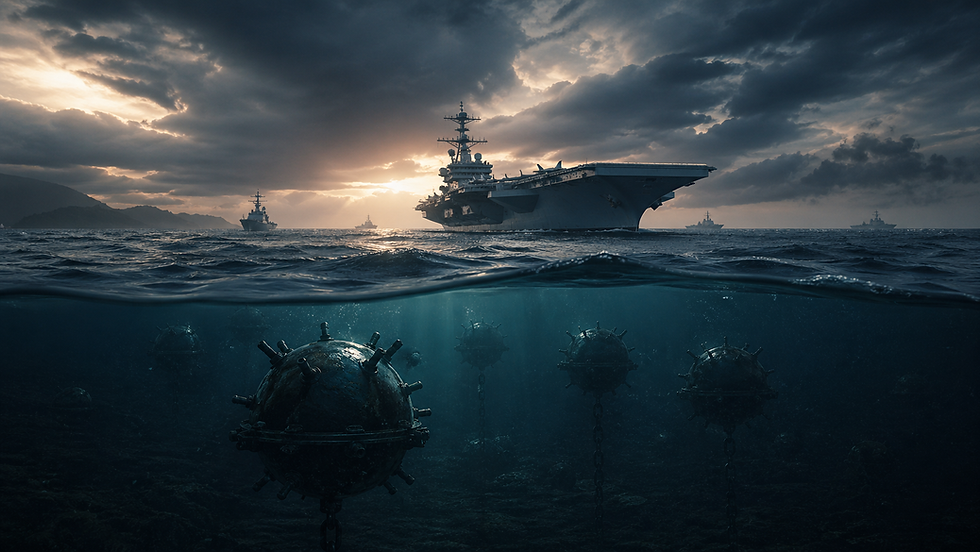
What if the next global crisis doesn’t begin with missiles or warships—but with silence beneath the sea? No warning shots, no headlines at first—just stalled shipping lanes, rising oil prices, and naval fleets forced to halt, not by an enemy they can see, but by a threat they cannot detect. This is the hidden war at sea, where a handful of naval mines can disrupt global trade, challenge the world’s most powerful navies, and reshape the balance of power without a single decisive battle. If you want to understand how modern warfare is quietly evolving—and why the future of global security may depend on what lies beneath the surface—stay with Strategic Vanguard, subscribe, and be part of a community that looks beyond the obvious to see what truly shapes power.
There are wars that unfold in full view of the world—wars of missiles, aircraft, and visible destruction that dominate headlines and define public perception. And then there are wars that unfold in silence, beneath the surface, shaping outcomes long before the first visible act of conflict takes place. Imagine a scenario where global trade begins to slow, not because of sanctions or blockades, not because of naval battles or air superiority, but because of uncertainty. Oil shipments are delayed, shipping lanes become unpredictable, insurance premiums surge, and naval fleets hesitate. No dramatic escalation announces itself, no decisive strike captures attention, and yet the system begins to strain. Beneath the surface of the ocean, hidden in the depths, lies one of the most effective yet underestimated instruments of modern warfare—naval mines. They do not need to dominate the battlefield or destroy entire fleets to achieve their purpose. Their power lies in denial, in uncertainty, and in their ability to transform the maritime domain from a space of freedom into a space of hesitation.
Naval mines are often dismissed as relics of a bygone era, simplistic weapons overshadowed by advanced naval systems, stealth technology, and precision-guided munitions. Yet history consistently challenges this perception. During the Korean War, naval mines proved devastatingly effective, delaying operations and inflicting significant damage on technologically superior forces. Decades later, in the Gulf War, relatively inexpensive Iraqi mines were able to severely damage advanced warships, exposing vulnerabilities that had been underestimated in strategic planning. These moments were not anomalies but indicators of a deeper reality. Technological superiority does not eliminate vulnerability; in many cases, it amplifies it. Highly sophisticated systems often depend on predictable operating environments, and naval mines are designed precisely to disrupt that predictability. They impose friction where speed is expected, caution where confidence is assumed, and delay where momentum is critical.
The strategic logic of naval mines lies not in destruction but in denial. Modern naval doctrine has long been built around the idea of control—control of sea lanes, control of access points, and control of the operational environment. This control ensures the uninterrupted flow of logistics, enables power projection, and sustains economic stability. Naval mines challenge this foundational assumption by introducing uncertainty into the very concept of movement. A fleet that cannot move freely cannot operate effectively, regardless of its strength. Mines do not need to sink ships to be effective; their mere presence forces navies to slow down, to reroute, and to commit resources to detection and clearance. This creates a cascading effect, where operational timelines are disrupted and strategic momentum is lost. In warfare, momentum is not simply an advantage—it is often the deciding factor, and naval mines are designed to erode it without direct confrontation.
Geography amplifies the effectiveness of this strategy. The world’s oceans may appear vast and open, but global trade is concentrated within narrow maritime corridors known as chokepoints. These passages are the arteries of the global economy, connecting regions and enabling the flow of energy, goods, and resources. The Strait of Hormuz is one of the most critical of these, serving as a conduit for a significant portion of the world’s oil supply. The Malacca Strait connects major economic hubs, while the Bab-el-Mandeb links the Indian Ocean to the Mediterranean trade routes. These chokepoints are not just geographic features; they are strategic vulnerabilities. Naval mines exploit these vulnerabilities with remarkable efficiency. A limited deployment in such areas can disrupt not only regional movement but global economic flows, creating consequences that extend far beyond the immediate zone of deployment.
The economic dimension of mine warfare is perhaps its most profound aspect. In an interconnected global economy, maritime trade is the backbone of prosperity, with the majority of goods transported by sea. Naval mines introduce a form of disruption that operates below the threshold of traditional warfare. Shipping companies respond to perceived risk by rerouting vessels, increasing transit times and operational costs. Insurance premiums rise sharply, reflecting heightened uncertainty, and in extreme cases, coverage may be withdrawn entirely. Ports experience congestion as traffic patterns shift, and supply chains begin to fracture under the strain. Markets react not only to actual disruptions but to the anticipation of them, amplifying the economic impact. This form of warfare does not require large-scale destruction or direct confrontation. It leverages uncertainty to create systemic effects, turning localized threats into global consequences. It is, in essence, economic warfare conducted through strategic ambiguity.
At the center of global maritime security stands the United States Navy, a force unmatched in its ability to project power across the world’s oceans. Aircraft carriers, nuclear submarines, and advanced destroyers represent the pinnacle of naval capability, embodying decades of technological innovation and strategic investment. Yet even this level of dominance does not eliminate vulnerability. Mine countermeasure capabilities remain limited relative to the scale and complexity of potential threats. Detecting, identifying, and neutralizing mines is a time-consuming and resource-intensive process, one that cannot be accelerated without compromising effectiveness. This creates a strategic paradox, where the most powerful navy in the world may find itself constrained by one of the simplest forms of weaponry. The issue is not a lack of capability but a mismatch between the nature of the threat and the structure of the response. Mines operate invisibly and passively, while countermeasures require active and deliberate effort. This asymmetry creates space for disruption, even against superior forces.
The operational consequences of mine warfare extend far beyond individual engagements. Carrier strike groups, which serve as the cornerstone of power projection, depend on secure sea lanes for mobility and effectiveness. Amphibious operations require safe approaches to coastal areas, and logistical chains rely on uninterrupted movement to sustain operations. The introduction of mines into these environments creates uncertainty that disrupts planning and execution. Clearance operations must be conducted before movement can resume, delaying timelines and reducing flexibility. In a high-intensity conflict, such delays can alter the balance of power, allowing adversaries to consolidate positions or exploit emerging opportunities. The impact is not limited to physical damage but extends to decision-making, where uncertainty influences strategic choices and operational behavior.
Among modern powers, China has demonstrated a clear understanding of the strategic value of denial. Its maritime strategy is not centered on matching the capabilities of its adversaries in a symmetrical contest but on shaping the operational environment to its advantage. This approach is embodied in the concept of Anti-Access/Area Denial, which seeks to restrict the ability of external forces to operate within contested regions. Naval mines play a critical role in this framework, providing a cost-effective means of complicating access and increasing risk. Deployed within the South China Sea, they contribute to a layered defense that integrates multiple systems and capabilities. The objective is not to achieve dominance through direct confrontation but to create conditions under which confrontation becomes impractical. It is a strategy that prioritizes influence over destruction and seeks to shape outcomes before engagements occur.
A similar logic can be observed in the approach of Iran, which operates within a regional context but with global implications. The Strait of Hormuz serves as a focal point for its strategy, representing both a vulnerability and an opportunity. Naval mines provide a means of exerting influence disproportionate to conventional naval capabilities. In a conflict scenario, even a temporary disruption of this chokepoint could have immediate and far-reaching consequences. Energy markets would react, geopolitical calculations would shift, and the strategic environment would become more volatile. The effectiveness of this approach lies in its ability to create uncertainty, leveraging the interconnected nature of global systems to amplify local actions into global effects.
The evolving nature of mine warfare further enhances its strategic relevance. Traditional mines, while effective, were limited in their functionality and adaptability. Modern systems incorporate advanced sensors, data processing capabilities, and selective targeting mechanisms. They can distinguish between different types of vessels, respond to specific acoustic or magnetic signatures, and remain dormant until optimal conditions are met. Autonomous deployment systems, including unmanned underwater vehicles, enable precise placement without exposing human operators to risk. These developments transform mine warfare from a static defensive measure into a dynamic strategic tool, capable of adapting to changing conditions and integrating with broader operational frameworks. The result is a form of warfare that is both subtle and sophisticated, challenging conventional assumptions about capability and threat.
The challenge of countering this threat is significant. Mine countermeasure operations require a combination of detection, identification, and neutralization, each of which presents technical and operational complexities. Unmanned systems offer potential solutions, allowing for remote operations and reducing risk to personnel. However, their deployment and integration remain works in progress, and scaling these capabilities to meet global demands is a complex undertaking. The issue is not simply technological but strategic, requiring a reassessment of priorities and investments. As the nature of warfare evolves, so too must the frameworks through which it is understood and addressed.
This evolving dynamic reflects a broader shift in strategic thinking. For decades, naval power has been associated with control—the ability to dominate the maritime domain and ensure freedom of navigation. Naval mines challenge this paradigm by introducing the concept of denial as an equally significant factor. Control is no longer absolute if it can be contested through uncertainty. Dominance is no longer sufficient if it cannot guarantee movement. This shift requires a redefinition of power, one that accounts not only for visible capabilities but for the ability to operate effectively within contested environments.
In this context, naval superiority becomes a more complex and conditional concept. It is no longer defined solely by the size of a fleet or the sophistication of its systems but by its resilience in the face of uncertainty. A navy that cannot guarantee safe passage cannot fully exercise its capabilities, regardless of its strength. Naval mines exploit this limitation, targeting not the assets themselves but the conditions under which they operate. They do not seek to defeat an adversary in direct confrontation but to constrain its options and shape its behavior. This form of influence is subtle but profound, altering the strategic landscape without the need for overt conflict.
The implications of this shift extend beyond military considerations to the broader structure of global power. In a world where economic stability depends on maritime connectivity, the ability to disrupt that connectivity becomes a source of influence. Naval mines provide a means of exerting that influence without the need for large-scale confrontation. They operate in the space between peace and war, creating conditions that challenge traditional definitions of conflict. This ambiguity is both a strength and a challenge, complicating responses and blurring the lines between strategic competition and open warfare.
Ultimately, the hidden war at sea is not a future possibility but a present reality. It operates beneath the surface, shaping decisions, influencing strategies, and redefining the parameters of power. Naval mines, in their simplicity, embody a complex truth about modern conflict. That visibility is not always an advantage, that strength can be offset by uncertainty, and that the most decisive actions may be those that remain unseen. As global competition intensifies and maritime domains become increasingly contested, the importance of understanding and addressing this hidden dimension will only grow. Because in the final analysis, control of the seas may no longer belong to those who dominate them, but to those who can deny them.
The hidden war at sea will not announce itself with spectacle, but its consequences will ripple through global trade, military strategy, and the balance of power itself. Naval mines remind us that true dominance is not always about visible strength—it is about control over uncertainty, over movement, and over access. And in a world where the unseen can dictate outcomes, understanding these silent forces is no longer optional—it is essential. If you want to stay ahead of these deeper strategic realities, don’t just watch from the surface. Join us at Strategic Vanguard—visit our website, subscribe for exclusive insights, and become part of a community that sees what others miss and understands what truly shapes power in the modern world.
Watch the complete podcast:


Comments