

Anti-Mine Warfare Explained: The Hidden Naval Capability Crisis Shaping Modern Maritime Power
Updated: Oct 15
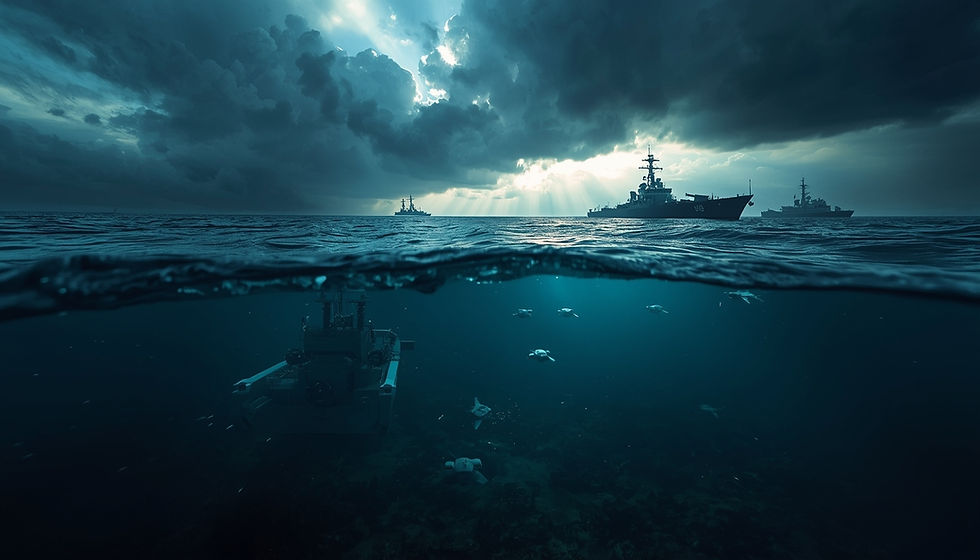
In modern warfare, we often imagine dominance in terms of aircraft carriers, stealth destroyers, and nuclear submarines. We measure power in tonnage, missiles, and technological sophistication. Yet, beneath the surface of this perception lies a paradox that has repeatedly reshaped naval history.
The most effective weapon at sea is often not the most advanced—but the most deceptively simple.
A naval mine.
Cheap to deploy, difficult to detect, and devastating in effect, naval mines have consistently proven capable of denying access to even the most powerful fleets in the world. They do not seek battle. They do not require command once deployed. And yet, they dictate the movement of entire navies.
This is where anti-mine warfare—often overlooked and underfunded—emerges not as a supporting function, but as a decisive determinant of maritime power.
Understanding Anti-Mine Warfare: More Than Just Mine Sweeping
Anti-mine warfare, or Mine Countermeasure (MCM) operations, refers to the detection, classification, and neutralization of naval mines to ensure safe passage for naval and commercial vessels.
It is not a single capability—it is a layered system.
At its core, anti-mine warfare consists of three fundamental pillars:
Detection: Identifying mines using sonar, unmanned systems, and underwater sensors. Classification: Distinguishing real mines from debris or false contacts.Neutralization: Destroying or disabling the mine through remote systems or controlled detonation.
Historically, this role was carried out by dedicated mine-sweeping vessels dragging mechanical or influence sweeps through the water. Today, the domain has evolved into a complex ecosystem involving unmanned underwater vehicles (UUVs), airborne systems, and networked sensor platforms.
Yet despite this technological evolution, one reality remains unchanged:
Mine warfare is inherently slow, methodical, and unforgiving.
And in war, time is often the most critical resource.
Why Naval Mines Still Matter in Modern Warfare
It is tempting to assume that in an era of satellite surveillance and precision weapons, naval mines are relics of the past.
History suggests otherwise.
Naval mines have been responsible for more damage to U.S. naval vessels since World War II than all other forms of attack combined. From the Korean War to the Gulf conflicts, mines have repeatedly demonstrated their strategic value—not through destruction alone, but through denial.
The objective of mine warfare is not necessarily to sink ships.
It is to control behavior.
A single suspected minefield can halt an entire fleet, reroute global trade, or delay critical military operations. In chokepoints such as the Strait of Hormuz, the implications are magnified exponentially.
This is where mine warfare transitions from a tactical tool to a strategic instrument.
The Chokepoint Factor: Where Mines Become Strategic Weapons
Modern maritime strategy is defined not just by open oceans, but by constrained geography.
Critical chokepoints—narrow maritime passages through which global trade flows—serve as pressure points in the international system. Among these, the Strait of Hormuz stands as one of the most consequential.
Roughly a fifth of the world’s oil supply passes through this narrow corridor.
In such an environment, naval mines become exponentially more effective. The narrowness of the waterway limits maneuverability. High traffic density increases vulnerability. And the economic stakes ensure that even minor disruptions have global consequences.
A relatively small number of mines, strategically deployed, can transform this chokepoint into a zone of paralysis.
This is not theoretical.
It is a recurring feature of modern strategic planning.
Anti-Mine Warfare as the Foundation of Sea Control
Sea control is often described as the ability to use the sea for one’s own purposes while denying it to the adversary.
But this definition assumes something fundamental:
That the sea is navigable.
Naval mines challenge this assumption at its core.
Without effective anti-mine warfare capabilities, even the most powerful navy cannot guarantee freedom of movement. Aircraft carriers cannot operate. Amphibious operations cannot proceed. Logistics chains become fragile.
In essence, the absence of anti-mine capability transforms naval superiority into strategic vulnerability.
This is why mine countermeasures are not auxiliary—they are foundational.
The Operational Reality: Why Clearing Mines Is So Difficult
The challenge of anti-mine warfare lies not just in detection, but in certainty.
The ocean is an inherently complex environment. Sonar returns are affected by seabed composition, water salinity, temperature layers, and clutter. Distinguishing a mine from a rock, wreckage, or debris requires time, expertise, and repeated verification.
Moreover, modern mines are no longer passive devices.
They are intelligent systems capable of:
Detecting specific acoustic signatures
Counting passing vessels before activation
Remaining dormant to evade detection
Targeting high-value assets selectively
This transforms mine clearance into a high-risk, high-precision operation.
And crucially—it cannot be rushed.
The Shift to Unmanned Systems: Promise and Limitations
In recent years, navies have attempted to modernize anti-mine warfare through the integration of unmanned systems.
Unmanned underwater vehicles (UUVs), autonomous surface vessels, and airborne drones offer the promise of reducing risk to personnel while increasing operational reach.
However, this transition introduces new complexities:
Dependence on networked systems and data links
Vulnerability to electronic warfare
Limited endurance in contested environments
Integration challenges with traditional naval platforms
Technology enhances capability—but it does not eliminate the fundamental constraints of mine warfare.
The process remains slow.
And in a crisis, slowness can be decisive.
The Strategic Blind Spot: Underinvestment in Mine Countermeasures
Despite their importance, anti-mine warfare capabilities have historically been underfunded and undervalued.
The reason is structural.
Mine warfare is not visible. It does not project power. It does not deter in the conventional sense. It is a defensive, enabling capability—one that becomes relevant only in crisis.
As a result, naval budgets tend to prioritize high-visibility platforms: carriers, destroyers, submarines.
But this creates a paradox.
A navy may possess overwhelming offensive capability—yet remain constrained by its inability to ensure safe passage.
This is not a technological gap alone.
It is a strategic miscalculation.
Transition: From Capability to Crisis
When anti-mine warfare is neglected, the consequences do not remain theoretical.
They manifest suddenly, and often at the worst possible moment.
In regions where adversaries possess robust mine-laying capabilities, the absence of effective mine countermeasures transforms a tactical challenge into a strategic crisis.
This is particularly relevant in the context of the Persian Gulf.
Where Naval Superiority Breaks Down
Modern naval doctrine often equates superiority with visibility—carrier strike groups, advanced missiles, and network-centric warfare.
But true maritime dominance is not defined by what a navy can project.
It is defined by what it can sustain.
Anti-mine warfare exposes a critical truth:
A navy that cannot guarantee access cannot exercise power.
In a contested environment like the Strait of Hormuz, even a limited mine deployment can impose disproportionate costs on a technologically superior force. The time required for clearance, the uncertainty of safe passage, and the economic implications of delay create a strategic dilemma.
This is where asymmetry operates at its most effective.
Not by defeating strength—but by constraining it.
The Strategic Implications for Modern Navies
The lessons are clear, and they extend beyond any single region.
Mine warfare is the great equalizer
Smaller powers can challenge larger navies through denial strategies.
Anti-mine capability is non-negotiable
It is not a secondary function—it is a prerequisite for naval operations.
Chokepoints amplify vulnerability
Geography magnifies the effectiveness of mines and the consequences of delay.
Technology alone is insufficient
Operational doctrine, training, and readiness remain critical.
Time is the decisive factor
The speed of mine clearance can determine the outcome of a conflict before it escalates.
Conclusion: Power Lies in Access, Not Just Force
Naval power in the 21st century is often discussed in terms of expansion—larger fleets, longer ranges, greater firepower.
But the true measure of power lies in something more fundamental:
Access.
The ability to move, operate, and sustain presence in contested waters.
Anti-mine warfare sits at the heart of this reality. It is the unseen enabler of maritime dominance, the quiet guarantor of global trade, and the often-ignored foundation of naval strategy.
Without it, even the most advanced fleets are reduced to spectators—powerful, but constrained.
And in a world defined by chokepoints and strategic competition, that constraint is not a weakness.
It is a vulnerability waiting to be exploited.


Comments