

India’s Future Air Power Revolution: AMCA, Loyal Wingmen, and the Rise of Network-Centric Warfare
Updated: 3 days ago
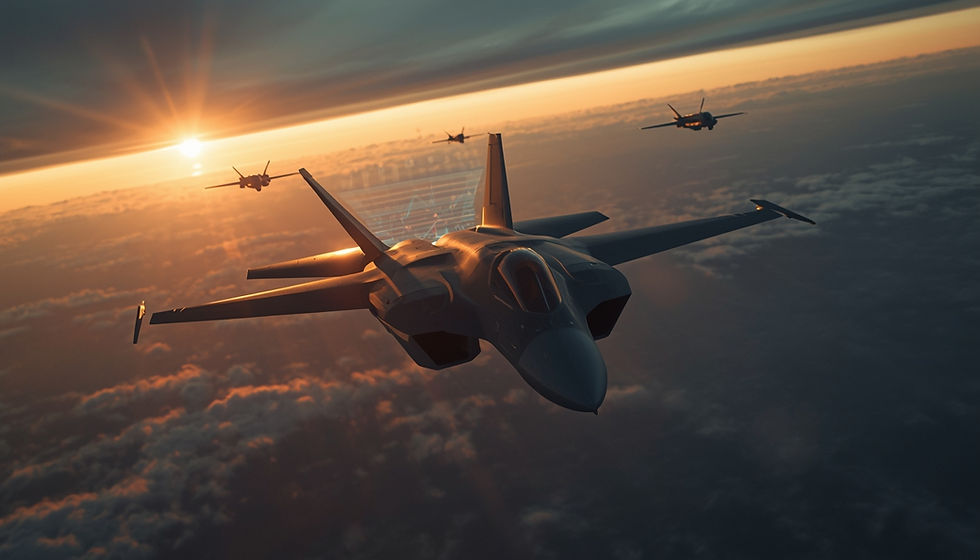
India’s future wars will not be won by individual aircraft. They will be decided by networks.
For decades, air power was measured by numbers: how many fighters a nation possessed, how fast they could fly, and how far they could strike. But the strategic environment of the 21st century is reshaping that equation. Modern warfare is transitioning from platform-centric combat toward network-centric ecosystems where sensors, drones, stealth aircraft, satellites, and data links operate as one integrated organism.
India now stands at the threshold of this transformation. The Advanced Medium Combat Aircraft (AMCA), loyal wingman drone programs, indigenous data networks, and emerging artificial intelligence capabilities are not isolated projects; they represent a structural shift in how the Indian Air Force (IAF) plans to fight future conflicts.
This shift is not optional. It is being driven by geopolitical realities — particularly the rapid modernization of China’s People’s Liberation Army Air Force (PLAAF), the emergence of multi-domain warfare, and the increasing lethality of long-range precision weapons. The future battlefield will reward nations that can integrate platforms into seamless digital architectures rather than relying on individual technological superiority.
India’s future air power must therefore be understood not simply as the introduction of new aircraft, but as a strategic reimagining of warfare itself.
The Indian Air Force historically relied on a mixed fleet strategy combining Soviet-origin platforms, Western technologies, and indigenous developments. This approach allowed flexibility but also created fragmentation in communication systems and operational integration.
During earlier eras, success depended on pilot skill, aircraft maneuverability, and tactical doctrines centered around air superiority and ground support. However, advances in radar, satellite surveillance, and electronic warfare have fundamentally altered the nature of aerial combat. Detection ranges have expanded dramatically, stealth has become central to survivability, and the volume of battlefield data has grown exponentially.
In this new environment, the decisive factor is no longer just the aircraft but the network connecting all assets.
Network-centric warfare integrates sensors, shooters, and command nodes into a unified system that allows real-time decision-making. Instead of individual aircraft searching for targets independently, the network distributes information instantly, enabling coordinated engagements across multiple domains.
For India, this transformation represents both an opportunity and a challenge. The opportunity lies in leapfrogging older paradigms and building indigenous architecture from the ground up. The challenge lies in integrating legacy platforms while developing new-generation systems simultaneously.
At the center of India’s future air power strategy stands the Advanced Medium Combat Aircraft (AMCA).
The AMCA is envisioned as a fifth-generation stealth fighter with advanced avionics, sensor fusion, internal weapons bays, and reduced radar cross-section. Unlike previous programs that focused primarily on airframe performance, AMCA is designed from inception as a networked platform.
Sensor fusion will allow pilots to receive a consolidated battlefield picture derived from onboard sensors, drones, AWACS aircraft, and satellites. This integrated awareness dramatically reduces reaction times and enhances survivability.
Stealth characteristics ensure the aircraft can penetrate heavily defended airspace, while advanced electronic warfare suites will enable both offensive and defensive operations in contested electromagnetic environments.
Strategically, AMCA represents India’s attempt to achieve technological autonomy in high-end combat aviation. While global fifth-generation programs such as the F-35 and China’s J-20 demonstrate the future trajectory of air power, India’s approach reflects a desire to maintain strategic independence while tailoring capabilities to regional requirements.
Yet the true significance of AMCA lies not in its stealth alone but in its role as a command node within a larger combat network.
Parallel to the AMCA program is India’s development of loyal wingman drones — unmanned systems designed to operate alongside manned fighters.
These drones extend the reach and survivability of human pilots by performing high-risk missions such as reconnaissance, electronic warfare, decoy operations, and even strike roles. By distributing risk across multiple platforms, loyal wingmen change the cost-benefit calculus of air combat.
The concept fundamentally alters the relationship between manned and unmanned systems. Instead of replacing pilots, autonomous drones act as force multipliers controlled by or coordinated with human operators.
India’s initiatives in this area include programs under the Combat Air Teaming System (CATS), where drones operate as extensions of manned aircraft.
Strategically, loyal wingmen offer several advantages. They increase operational flexibility, reduce pilot risk, and enable scalable force projection. More importantly, they align with the broader transition toward distributed warfare, where multiple smaller platforms collaborate to overwhelm adversary defenses.
Network-centric warfare represents the connective tissue binding these elements together.
In traditional operations, command structures relied on hierarchical communication chains. Network-centric systems, by contrast, allow decentralized decision-making supported by real-time data sharing.
This approach enhances resilience against electronic warfare and improves responsiveness in rapidly evolving combat environments.
For India, building such a network requires advancements in secure data links, AI-assisted decision systems, cyber defense infrastructure, and interoperable communication protocols.
The integration of airborne early warning systems, satellites, ground-based radar networks, and naval assets creates a multi-domain picture that transforms the way air operations are conducted.
The strategic implications extend beyond aerial combat. Network-centric warfare enables coordinated operations across land, sea, air, space, and cyber domains, aligning with the emerging concept of multi-domain operations embraced by leading military powers.
The geopolitical context makes this transformation urgent.
China’s rapid advancements in stealth aircraft, long-range missiles, and integrated command networks pose a significant challenge to India’s air superiority ambitions. The PLAAF has invested heavily in networked warfare concepts, including data fusion and distributed operations.
To maintain strategic balance, India must adopt similar or superior operational architectures rather than relying solely on platform upgrades.
Meanwhile, regional dynamics in the Indo-Pacific emphasize long-range operations over vast maritime spaces. Air power increasingly intersects with naval strategy, requiring aircraft capable of operating as part of joint force networks.
This convergence reinforces the importance of integrating AMCA and loyal wingmen within broader joint warfare frameworks.
A key transition moment emerges here.
India’s historical air power doctrine emphasized tactical flexibility and pilot-centric combat. The future demands a shift toward algorithm-assisted decision-making and system-level coordination.
This transition involves cultural as well as technological change. Pilots must become mission commanders within networked ecosystems, and military planners must prioritize data dominance alongside air superiority.
The success of this transformation will depend not only on technological innovation but also on doctrinal evolution and training adaptation.
India’s future air power will not be defined by whether AMCA matches foreign stealth fighters in raw specifications. The true strategic question is whether India can build a resilient network architecture that integrates manned aircraft, autonomous drones, space-based sensors, and cyber capabilities into a coherent operational system.
The AMCA risks becoming just another advanced fighter if developed in isolation. Its real value emerges only when paired with loyal wingman concepts and supported by robust network-centric infrastructure.
India’s strategic advantage lies in timing. Because the country is still building its next-generation architecture, it has the opportunity to design an ecosystem optimized for multi-domain warfare rather than retrofitting legacy systems.
However, this also presents risk. Fragmented procurement, bureaucratic delays, and inconsistent technological standards could undermine integration efforts.
The future battlefield will reward systems thinking rather than platform thinking. Nations that fail to integrate will find even advanced aircraft struggling against coordinated networks.
India’s challenge is therefore less about technological capability and more about strategic coherence.
The shift toward network-centric warfare marks a turning point in the evolution of Indian air power.
AMCA symbolizes stealth and autonomy. Loyal wingmen represent distributed force multiplication. Network-centric systems embody the digital backbone connecting all elements.
Together, they form the foundation of India’s next-generation combat doctrine.
The strategic implications extend beyond air superiority. They influence deterrence, escalation control, and regional power balance. In an era where wars may be decided by information dominance as much as kinetic capability, the ability to integrate and coordinate becomes the decisive factor.
India’s future air power, therefore, is not simply about flying higher or faster. It is about thinking differently — building a networked force capable of adapting to the complex realities of modern warfare.
And in that transformation lies the true revolution.


Comments