

The Drone Production Race: Why Cheap Weapons Can Create Expensive Problems
Updated: 30 minutes ago
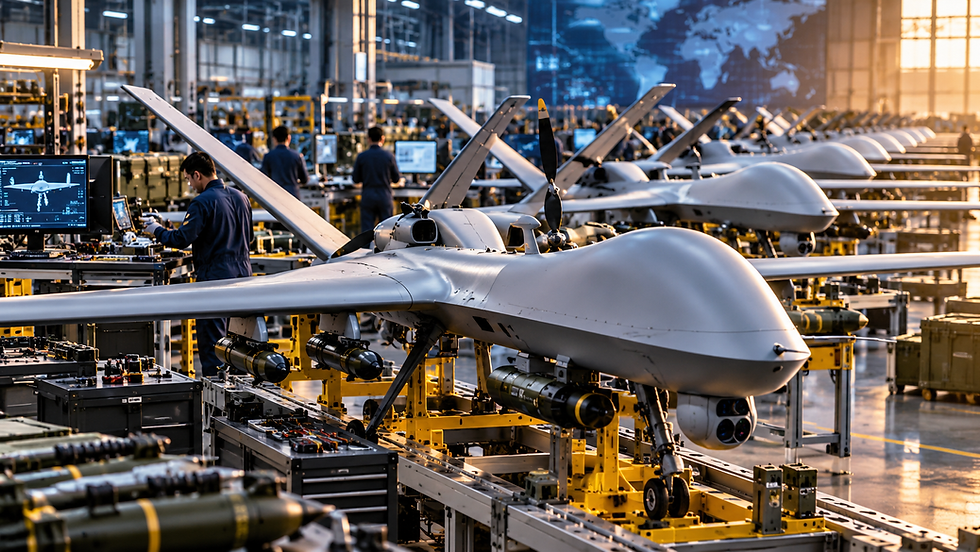
The modern drone is often described as a low-cost weapon that allows smaller forces to challenge expensive military platforms. That description captures only part of the transformation. The decisive contest is increasingly between systems that can be manufactured, adapted and replaced at scale and the defensive networks designed to stop them. A relatively inexpensive unmanned aircraft can force a defender to expend a costly interceptor, but the attacker must also manufacture airframes, motors, batteries, navigation systems and payloads in sufficient quantities. The economics of the exchange depend on both sides of the equation.
Many small drones use commercial components, which can shorten development cycles and widen the supplier base. Yet large-scale military use creates new demands for secure communications, navigation resilience, payload integration, reliability, weather tolerance and repeatable quality. Components that are plentiful in peacetime may become scarce when many countries seek the same chips, motors or batteries. A force that wants to use drones continuously must build procurement channels, assembly capacity, testing processes and replacement pipelines rather than rely on occasional purchases.
Many small drones use commercial components, which can shorten development cycles and widen the supplier base. Yet large-scale military use creates new demands for secure communications, navigation resilience, payload integration, reliability, weather tolerance and repeatable quality. Components that are plentiful in peacetime may become scarce when many countries seek the same chips, motors or batteries. A force that wants to use drones continuously must build procurement channels, assembly capacity, testing processes and replacement pipelines rather than rely on occasional purchases.
Unmanned systems can evolve quickly because software, sensors and mission packages may be changed without redesigning an entire aircraft. Operational feedback can reveal weaknesses in navigation, control links, target recognition or survivability. Manufacturers that can incorporate lessons rapidly may produce a more useful next batch before a traditional acquisition programme completes its review cycle. This creates a premium on flexible production, close cooperation between operators and engineers, and procurement rules that allow frequent upgrades without sacrificing safety or accountability.
Unmanned systems can evolve quickly because software, sensors and mission packages may be changed without redesigning an entire aircraft. Operational feedback can reveal weaknesses in navigation, control links, target recognition or survivability. Manufacturers that can incorporate lessons rapidly may produce a more useful next batch before a traditional acquisition programme completes its review cycle. This creates a premium on flexible production, close cooperation between operators and engineers, and procurement rules that allow frequent upgrades without sacrificing safety or accountability.
Defence against drones is not a single technology. It can combine detection radar, electro-optical sensors, electronic warfare, guns, directed energy, interceptor drones and conventional missiles. Each option has different costs, ranges, limitations and risks to nearby forces or civilians. Using a premium interceptor against every low-cost target may be unsustainable, but cheaper defensive methods may be unreliable in cluttered environments or against coordinated attacks. A resilient defence therefore needs layered responses and a command system that matches the response to the threat rather than automatically choosing the most expensive option.
Defence against drones is not a single technology. It can combine detection radar, electro-optical sensors, electronic warfare, guns, directed energy, interceptor drones and conventional missiles. Each option has different costs, ranges, limitations and risks to nearby forces or civilians. Using a premium interceptor against every low-cost target may be unsustainable, but cheaper defensive methods may be unreliable in cluttered environments or against coordinated attacks. A resilient defence therefore needs layered responses and a command system that matches the response to the threat rather than automatically choosing the most expensive option.
Large numbers can overwhelm a weak defence, but quantity without reliability can waste resources and expose operators. High-end drones may provide endurance, sensors and secure communications; simpler systems may offer affordable mass; reusable platforms may support reconnaissance and targeting; expendable systems may be suited to missions where survival is unlikely. The strategic question is how to combine these categories into a force that can sustain operations while learning quickly. Industrial planning should support a portfolio of systems instead of betting everything on one supposedly universal drone.
Large numbers can overwhelm a weak defence, but quantity without reliability can waste resources and expose operators. High-end drones may provide endurance, sensors and secure communications; simpler systems may offer affordable mass; reusable platforms may support reconnaissance and targeting; expendable systems may be suited to missions where survival is unlikely. The strategic question is how to combine these categories into a force that can sustain operations while learning quickly. Industrial planning should support a portfolio of systems instead of betting everything on one supposedly universal drone.
Drone supply chains can depend on imported semiconductors, optical sensors, battery materials, rare-earth magnets, precision motors and specialised manufacturing equipment. These dependencies can become vulnerabilities if export controls, sanctions or shipping disruptions restrict access. Domestic production does not automatically remove risk if critical subcomponents remain concentrated abroad. Mapping the supply chain, qualifying alternative suppliers and maintaining reserves of bottleneck components can be as important as assembling the final airframe.
Drone supply chains can depend on imported semiconductors, optical sensors, battery materials, rare-earth magnets, precision motors and specialised manufacturing equipment. These dependencies can become vulnerabilities if export controls, sanctions or shipping disruptions restrict access. Domestic production does not automatically remove risk if critical subcomponents remain concentrated abroad. Mapping the supply chain, qualifying alternative suppliers and maintaining reserves of bottleneck components can be as important as assembling the final airframe.
India has an opportunity to connect its software talent, electronics industry, engineering base and growing defence ecosystem. The challenge is to move beyond prototypes and one-off contracts toward reliable manufacturing, field support, secure components and repeatable upgrades. Military users need systems that work under local weather and terrain conditions, integrate with existing command networks and can be repaired close to deployment areas. Clear requirements, sustained orders and transparent evaluation can help capable firms scale without allowing novelty to substitute for operational performance.
India has an opportunity to connect its software talent, electronics industry, engineering base and growing defence ecosystem. The challenge is to move beyond prototypes and one-off contracts toward reliable manufacturing, field support, secure components and repeatable upgrades. Military users need systems that work under local weather and terrain conditions, integrate with existing command networks and can be repaired close to deployment areas. Clear requirements, sustained orders and transparent evaluation can help capable firms scale without allowing novelty to substitute for operational performance.
The drone revolution rewards industrial systems that can learn and replenish quickly. The winner will not necessarily be the country with the cheapest airframe or the most sophisticated sensor. It will be the side that combines useful performance, affordable production, secure supply chains, effective training and adaptable defences. In this sense, drone warfare reinforces the central lesson of defence-industrial power: technology creates an advantage, but the capacity to reproduce and improve it determines how long that advantage lasts.
The drone revolution rewards industrial systems that can learn and replenish quickly. The winner will not necessarily be the country with the cheapest airframe or the most sophisticated sensor. It will be the side that combines useful performance, affordable production, secure supply chains, effective training and adaptable defences. In this sense, drone warfare reinforces the central lesson of defence-industrial power: technology creates an advantage, but the capacity to reproduce and improve it determines how long that advantage lasts.
For the wider strategic framework behind this production race, read The Arsenal Behind the Arsenal: Why Industrial Power Wins Wars: https://www.strategicvanguard.com/post/arsenal-behind-the-arsenal-defence-industrial-power

Comments