

The Arsenal Behind the Arsenal: Why Industrial Power Wins Wars
Updated: 8 hours ago

The Arsenal Behind the Arsenal: Why Industrial Power Wins Wars
The next great military advantage may not belong to the nation with the most sophisticated weapon, but to the nation capable of replacing its weapons faster than its adversary can destroy them.
Introduction: The War That Begins After the First Shot
Imagine a major military confrontation between two technologically advanced powers. Both possess sophisticated fighter aircraft, long-range missiles, precision-guided weapons, modern warships and extensive surveillance networks. Their opening strikes are devastating, but as the conflict enters its second month, missiles have been expended faster than expected, air-defence interceptors are becoming scarce, replacement components are delayed and production lines struggle to meet demand. The decisive question is no longer simply which military possesses the better weapon. It is which nation can continue to fight after its initial stockpiles have been depleted.
The Industrial Foundation of Military Power
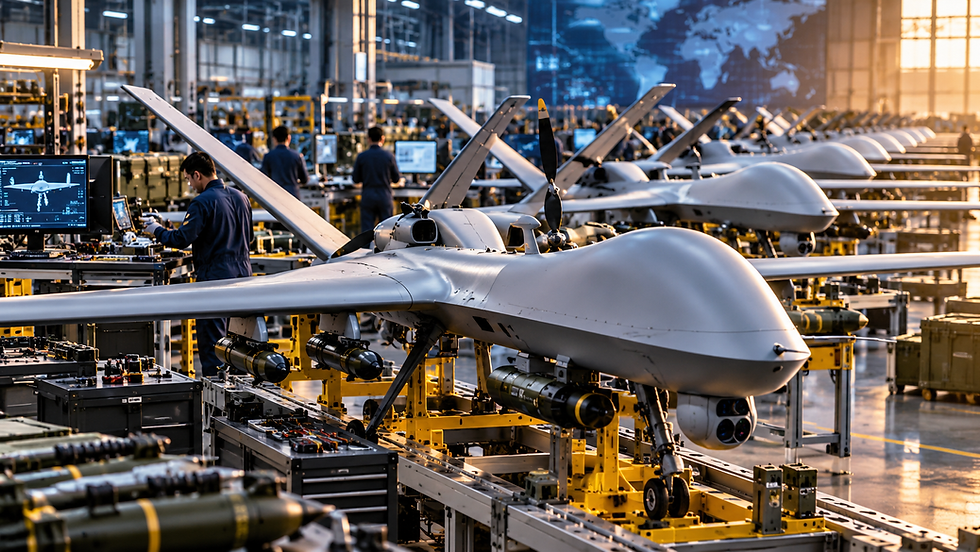
The defence industrial base is the interconnected network of factories, research institutions, component manufacturers, skilled workers, logistics providers, energy systems and supply chains that enables a country to create and sustain military power. For decades, military modernisation was frequently associated with acquiring increasingly sophisticated platforms. Yet equipment delivers its full strategic value only when a country can maintain, repair, replenish and eventually replace it. Industrial capacity is not merely a supporting element of national defence; it is a central determinant of how long a military can sustain its capabilities under pressure.
1. The Illusion of Military Superiority
The number of combat aircraft, the range of a missile or the sophistication of an air-defence network describes only part of a nation's military strength. Inventory figures do not reveal how many systems are operational, how quickly damaged equipment can be repaired, how much ammunition is available for sustained operations or how rapidly losses can be replaced. A military inventory is a snapshot of existing capability, whereas the industrial base reveals the capacity to regenerate that capability over time. A short operation may end before stockpiles become critical; a prolonged confrontation can turn manufacturing into a strategic contest in its own right.
2. The Ammunition Problem: When Consumption Outpaces Production
The war in Ukraine has highlighted the importance of ammunition production, industrial mobilisation and replenishment. Intense combat can consume munitions much faster than peacetime training, putting years of accumulated stockpiles under pressure. Expanding output involves more than asking a factory to work longer hours: manufacturers need machinery, qualified workers, secure supplies of chemicals and metals, testing facilities, dependable energy and long-term procurement commitments. Some components come from a limited number of suppliers, while specialised production processes take time to establish. Governments must invest in resilience before a crisis through multi-year contracts, reserve production capacity and dependable supply networks.
3. China's Industrial Advantage: Manufacturing as Strategic Power
China's industrial scale is central to long-term military competition. Its manufacturing ecosystem, shipbuilding capabilities, electronics industries and extensive supply chains can support production and supplier development at scale. A 2024 analysis by the Center for Strategic and International Studies highlighted differences in shipbuilding and defence-industrial capacity between China and the United States. Such comparisons have specific limits: shipyard capacity does not automatically translate into superiority in every class of warship, submarine technology, readiness or combat effectiveness. Nevertheless, manufacturing scale and responsiveness can influence the balance between major powers during a prolonged confrontation. Commercial electronics, batteries, sensors, machine tools and advanced materials may also support selected defence-related needs.
4. The American Challenge: Rebuilding the Capacity to Sustain a Major War
The United States retains major advantages in military technology, global logistics, research and operational experience, but technological leadership does not mean unlimited capacity to replace equipment during a high-intensity conflict. Industrial consolidation, specialised suppliers and long procurement cycles can make rapid expansion difficult. New facilities require investment, suppliers need predictable orders and workers must be trained. In a potential Indo-Pacific crisis, aircraft, naval platforms, long-range weapons, air defence and logistics could all face simultaneous demands. Credible deterrence therefore requires more than advanced designs; it requires production systems capable of sustaining commitments after the opening phase of a conflict.
5. Russia and Ukraine: The Economics of Attrition
The war between Russia and Ukraine demonstrates how production, procurement and maintenance shape the ability to sustain operations. Russia has continued producing and procuring military equipment despite extensive sanctions, challenging assumptions about how quickly external economic pressure would constrain its war effort. This does not mean sanctions have had no effect: restrictions can increase costs, limit access to technology and complicate procurement without immediately stopping production. Ukraine has combined external military assistance with domestic innovation and production, while donor countries balance support with their own stockpile needs and industrial lead times. The broader lesson is that domestic production, strategic reserves, maintenance and dependable partnerships reinforce one another.
6. The New Defence-Industrial Race: Drones, Electronics and Scalable Warfare
Uncrewed aerial systems, loitering munitions, electronic warfare equipment and networked sensors are changing the relationship between cost, capability and scale. In some applications, inexpensive systems can force an adversary to expend much more costly defensive resources, although drones cannot replace every function of advanced aircraft, missiles or other platforms. Some systems can be manufactured through more distributed networks, but military reliability, secure communications and resistance to interference remain demanding requirements. Modern forces need a balanced industrial model that supports sophisticated platforms and affordable equipment in meaningful quantities. Electronics and specialised components are particularly important because a shortage of a small input can delay a much larger weapons programme.
7. India's Strategic Opportunity: From Defence Buyer to Industrial Power
India must maintain a large and technologically diverse military, address demanding security requirements and protect maritime interests across the Indian Ocean. Indigenous production can strengthen operational independence, but self-reliance should be measured by whether critical equipment, spares and ammunition remain available when international supply chains are disrupted. India's Department of Defence Production reported approximately ₹1.78 lakh crore in domestic defence production and ₹38,424 crore in defence exports for FY 2025–26. These figures indicate a growing industrial base, but aggregate values alone cannot show whether every critical component can be made domestically or whether output can expand quickly during a crisis.
Building Depth in India's Defence Ecosystem
India's next stage should focus on industrial depth and reliability. Large public-sector enterprises provide scale and experience, while private manufacturers can contribute investment, competition and innovation. Micro, small and medium-sized enterprises are essential because complex platforms depend on extensive networks of precision manufacturers and component suppliers. India should identify dependencies that create the greatest strategic risks, build domestic capacity where practical and diversify international partnerships where complete self-sufficiency is unrealistic. Export orders can help manufacturers achieve scale and strengthen defence relationships, provided that delivery reliability and the needs of India's own armed forces remain central.
8. The Hidden Front: Supply Chains, Energy and Industrial Resilience
Defence factories depend on electricity, fuel, water, transportation, communications, industrial gases, raw materials, financial services and specialised workers. Disruption to any of these inputs can affect production even if the factory itself remains untouched. Resilience requires understanding dependencies below the final product, including specialised components, replacement machinery and the time needed to qualify alternative materials. Energy security, protected infrastructure, diversified suppliers and carefully maintained reserves can reduce vulnerabilities. Skilled technicians, engineers, metallurgists, software specialists and quality-control personnel are equally essential because industrial power depends on people who can turn resources into reliable equipment.
9. Can Artificial Intelligence Accelerate the Defence Arsenal?
Artificial intelligence could help defence industries improve design, predictive maintenance, automated inspection and production planning. These tools may identify bottlenecks, improve quality control and shorten some development cycles. However, AI cannot instantly create a specialised factory, produce scarce raw materials or train a workforce in complex manufacturing. AI-generated designs still require validation and testing, and automated systems depend on secure software and dependable hardware. For India, digital engineering, supply-chain analytics and predictive maintenance offer opportunities, provided that investment in technology is matched by secure data practices, skilled personnel and rigorous validation.
10. What Will Decide the Next Great Military Contest?
Future military power will continue to depend on technology, doctrine, intelligence, training, alliances and political leadership. Industrial capacity cannot replace these factors, and manufacturing scale alone does not guarantee victory. But the ability to regenerate military capability becomes increasingly important in prolonged conflicts involving precision weapons, drones, electronic warfare and attacks on infrastructure. The best-prepared countries will combine technological strength, dependable domestic production in critical areas, diversified supply chains, adequate reserves, flexible manufacturing and the ability to incorporate operational lessons. Governments must prepare without creating an economically unsustainable arms race, investing in resilience according to clear strategic priorities.
The SV Take: The Nation That Can Replenish Power
The next great contest between major powers may begin with a spectacular display of technological superiority, but its outcome could depend on what happens after the opening phase. When ammunition stocks decline, equipment is damaged and supply chains come under pressure, the ability to repair, replace and replenish military capability becomes a strategic asset. For India, the next stage of defence development must focus on industrial depth, critical technologies, dependable supply chains and the capacity to sustain the armed forces during a prolonged crisis. The objective is not simply to produce more weapons, but to build an ecosystem that supports readiness, innovation and strategic autonomy.
Conclusion
The most sophisticated weapon may win an engagement, but the industrial system behind it helps determine whether a country can continue fighting. Technology creates military options; industry makes those options sustainable. In a world where strategic competition may be prolonged and replenishment increasingly significant, the nations that connect technological excellence with manufacturing resilience will possess a critical advantage. The next great military advantage may belong to the nation that can keep building, repairing and replacing its weapons long after the first shots have been fired.
About Strategic Vanguard
Strategic Vanguard examines the intersection of military power, geopolitics, defence technology and national strategy.


Comments