

China’s Naval Expansion: Why Hull Numbers Don’t Equal Sea Power

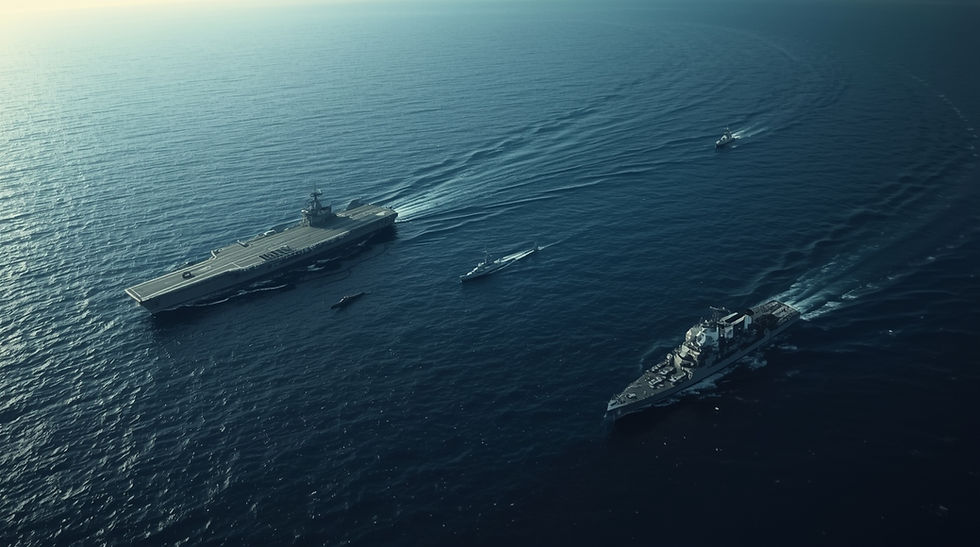
The world is witnessing a naval expansion unlike anything seen since the Second World War. The People’s Liberation Army Navy is inducting warships at a pace that has stunned naval analysts, policymakers, and strategic observers alike. Every year, new destroyers, frigates, corvettes, submarines, and aircraft carriers enter service. Satellite imagery regularly shows entire flotillas emerging from Chinese shipyards almost overnight, reinforcing the perception that China is on the cusp of absolute naval dominance.
This visual surge has led many to conclude that China is building the most formidable navy in history. Hull counts are compared, charts are drawn, and projections are made that assume numerical superiority automatically translates into real sea power. But naval power is not built on launch ceremonies or shipyard photographs. It is not determined by numbers alone, and it cannot be understood without examining the deeper realities that lie behind these impressive statistics.
A warship does not end its cost at launch. In fact, launch is merely the beginning of its true financial, human, and logistical burden. For the next thirty to forty years, a single ship continuously consumes resources. It requires fuel, spare parts, scheduled maintenance, system upgrades, dockyard access, and a fully trained crew. Over its lifetime, the cost of operating and sustaining a warship almost always exceeds its construction cost, often by a substantial margin.
Industrial capacity can produce steel at speed, but experienced sailors and officers cannot be generated on demand. Modern navies are complex human institutions, and their effectiveness depends far more on people than on platforms. Officers, engineers, technicians, and senior enlisted personnel must be recruited, trained, retained, and rotated over decades. This human dimension is where rapid naval expansion inevitably begins to encounter limits.
Every professional navy in the world operates under the same unavoidable cycle. At any given time, a ship can only exist in one of three states. It is either deployed and operating at sea, preparing for deployment through training and work-up, or undergoing maintenance and refit. This cycle is not a matter of doctrine or preference; it is imposed by physics, fatigue, safety requirements, and the unforgiving maritime environment.
Saltwater corrodes metal, electronics degrade, engines wear down, and hulls fatigue. Crews cannot remain at sea indefinitely without rest, retraining, and rotation. As a result, even the most capable navies accept that only about one-third of their total fleet can be operationally deployed at any given moment. Another third is in training, while the remaining third is undergoing maintenance. This reality applies universally, regardless of ambition or political system.
This is why large fleets exist in the first place. They are not designed to deploy every ship simultaneously, but to ensure sustained availability over time. The United States, for example, does not operate multiple aircraft carriers so that all of them can be at sea at once. It does so to guarantee that a smaller number are continuously available while others rotate through training and refit. China is bound by the same operational mathematics.
Aircraft carriers illustrate this constraint clearly. Regardless of how many carriers China builds, it cannot deploy them all simultaneously. At any given moment, one carrier will be deployed, another will be in training or certification, and another will be in maintenance. Increasing the total number of carriers raises availability only incrementally, not proportionally. The same logic applies to destroyers, frigates, and submarines.
Submarines impose even harsher constraints. They are technologically complex, maintenance-intensive, and inherently dangerous to operate without strict discipline and experience. Nuclear submarines require highly specialized crews and lengthy refit cycles, while diesel-electric submarines demand frequent maintenance and careful crew management. A submarine that is not at sea exerts no deterrence and poses no operational threat, regardless of how impressive it appears on paper.
The most critical limitation facing China’s naval expansion is not shipyards or funding, but human capital. Modern navies are officer-heavy institutions that depend on experienced commanders, engineers, aviation specialists, nuclear technicians, and senior non-commissioned officers. These professionals take years to train and decades to mature. Experience at sea cannot be simulated or accelerated without risk.
China’s rapid fleet growth has outpaced its ability to organically build this depth of experience. Ships are being commissioned faster than seasoned crews can be developed. As a result, many vessels see limited sea time and spend extended periods alongside. Some exist more as inventory than as active combat assets. Within naval circles, such ships are often referred to bluntly as “dock queens”—impressive in port, but rarely tested at sea.
Naval history consistently demonstrates that experience matters more than equipment. Navies that have conducted sustained deployments over decades develop institutional knowledge that cannot be replicated through production alone. They learn how systems behave under stress, how crews respond to emergencies, and how command decisions perform in real-world crises.
China’s navy is learning quickly, and its progress should not be underestimated. However, it remains a relatively young blue-water force. Operational maturity is earned through time at sea, not through statistics. For now, China’s paper strength exceeds its operational depth, even as that gap gradually narrows.
As fleets grow larger, sustainment costs rise faster. Fuel consumption increases, maintenance backlogs expand, personnel costs grow, and dockyards become congested. Over time, navies must balance new construction against readiness and upkeep. History shows that expansion eventually slows, not because ambition fades, but because sustainment becomes the dominant expense. China has not yet fully encountered this long-term financial gravity, but it will.
None of this suggests that China’s naval expansion is insignificant or that its navy is weak. On the contrary, it is becoming a powerful regional force and an increasingly capable global presence. What this analysis does suggest is that alarmist interpretations based solely on hull counts distort strategic reality.
True naval power rests on sustained deployments, trained crews, maintenance discipline, logistical depth, and institutional experience. When these factors are taken into account, China’s navy appears formidable but constrained—impressive, yet bounded by the same realities that govern every maritime force in history.
In the final analysis, naval power is not about what is launched into the water. It is about what sails, what stays at sea, and what can fight tomorrow after fighting today. Availability, not abundance, is the true measure of sea power.
Watch the complete analysis:


Comments