

How Ancient Indian Statecraft Still Shapes India’s Grand Strategy Today
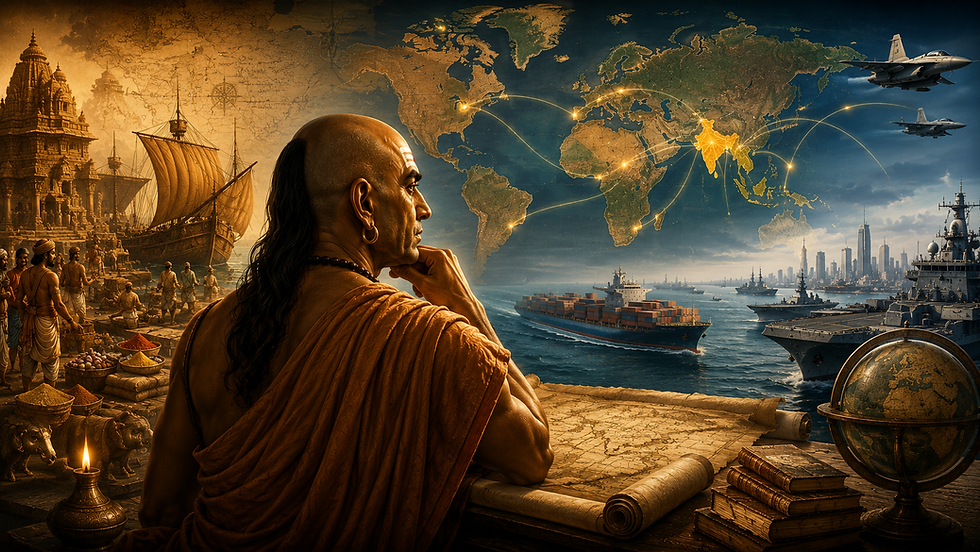
History rarely disappears.
It survives beneath institutions, strategic instincts, political culture, and national memory. Empires collapse, technologies evolve, and ideologies rise and fade, yet certain civilizations carry forward deeper patterns of thought that continue shaping how they understand power, security, diplomacy, and survival.
India may be one of the clearest examples of this phenomenon.
At first glance, India’s contemporary foreign policy appears entirely modern. It operates within a world of nuclear deterrence, cyber warfare, artificial intelligence, satellite surveillance, semiconductor competition, maritime chokepoints, and global supply chains. India participates in Quad meetings, engages in Indo-Pacific diplomacy, signs technology partnerships, modernizes its navy, strengthens border infrastructure, and balances relations between competing global powers.
But beneath this modern strategic behavior lies something much older.
A civilizational strategic tradition.
Long before modern international relations theory emerged in Europe, ancient Indian thinkers were already debating intelligence networks, alliance systems, economic statecraft, internal security, maritime trade, strategic geography, diplomacy, and the balance between ethics and political realism.
At the center of this tradition stands Chanakya, also known as Kautilya — the philosopher-strategist associated with the Arthashastra, one of the most sophisticated works of political and strategic thought in human history.
Today, as the world moves toward a more unstable and competitive multipolar order, India increasingly appears to be rediscovering many of those older strategic instincts.
Strategic autonomy.
Alliance balancing.
Long-term patience.
Economic resilience.
Maritime awareness.
Civilizational continuity.
These are not accidental features of Indian policy. They represent elements of a deeper strategic culture that has evolved across centuries.
And understanding modern India increasingly requires understanding the ancient foundations beneath it.
The global order today is undergoing profound transformation. The post-Cold War unipolar era dominated by the United States is gradually weakening. China is rising rapidly and attempting to reshape Asia’s strategic architecture. Russia continues asserting geopolitical relevance through military power. Europe remains economically significant but strategically fragmented. Across the Indo-Pacific, nations are preparing for prolonged geopolitical competition.
This is the return of geopolitics.
The return of balancing behavior.
The return of strategic statecraft.
And within this changing environment, India occupies a uniquely important position.
India is simultaneously:
A rising economic power.
A nuclear weapons state.
A democratic society.
A civilizational entity.
A maritime Indo-Pacific actor.
A technological power in transition.
And a nation attempting to preserve strategic independence amid intensifying global rivalry.
India cooperates with the United States through the Quad while continuing defense ties with Russia. India competes with China strategically while maintaining major economic interactions. India strengthens partnerships with Europe, Japan, Southeast Asia, and the Gulf while also positioning itself as a voice of the Global South.
To many outside observers, this appears contradictory.
But from the perspective of ancient Indian strategic thinking, it appears remarkably coherent.
Because ancient Indian statecraft viewed geopolitics not as a rigid ideological contest, but as a fluid system shaped by interests, geography, capability, timing, and balance.
One of the most famous examples of this realism is Chanakya’s Mandala Theory.
The Mandala Theory argued that neighboring powers often become natural rivals, while the rival of one’s rival may become a strategic partner. Alliances were viewed not as permanent moral commitments, but as instruments shaped by changing strategic realities.
This was not idealistic diplomacy.
It was strategic realism.
And remarkably, many elements of modern India’s foreign policy resemble this same logic.
India does not seek total alignment with any one bloc. Instead, it pursues multidirectional balancing. It works with multiple centers of power simultaneously while attempting to preserve freedom of action.
India cooperates militarily with the United States while refusing formal alliance dependency.
India maintains strategic relations with Russia despite Western pressure.
India strengthens Indo-Pacific partnerships while avoiding direct bloc confrontation.
India engages the Middle East, Europe, Africa, Southeast Asia, and the Global South simultaneously.
This is not geopolitical confusion.
It is strategic flexibility.
And that flexibility has deep historical roots.
Modern India often describes this behavior as “strategic autonomy,” a concept strongly associated with post-independence foreign policy and the Non-Aligned Movement. But the instinct itself predates modern India by centuries.
Ancient Indian strategic thought consistently emphasized the importance of preserving sovereign decision-making amid competing powers.
Dependence was dangerous.
Autonomy created leverage.
And in a fragmented multipolar world, leverage becomes essential for survival.
This instinct explains why India frequently resists external pressure to fully align with one geopolitical camp. Even when India shares concerns with the West regarding China’s rise, India still avoids treaty-style alliance structures.
Because India seeks partnership without surrendering strategic independence.
This becomes especially important in the Indo-Pacific.
The Indo-Pacific is emerging as one of the defining geopolitical theaters of the twenty-first century. Maritime trade routes, naval deployments, submarine operations, undersea cables, energy corridors, and chokepoints increasingly shape global power balances.
And India sits at the center of this strategic geography.
Historically, India often became excessively continental in strategic focus due to repeated land invasions and border concerns. But ancient India was also deeply maritime. Indian merchants, sailors, and trading networks connected East Africa, Arabia, Southeast Asia, and beyond for centuries.
The Indian Ocean was not peripheral to Indian civilization.
It was central to it.
Ancient Indian trade networks carried spices, textiles, precious stones, metallurgy, philosophical ideas, mathematics, culture, and religion across vast maritime routes. Indian influence extended through commercial and cultural connectivity rather than direct imperial conquest alone.
Today, modern India is rediscovering the strategic importance of maritime power.
This explains the growing emphasis on:
Aircraft carriers.
Naval aviation.
Submarine fleets.
Maritime surveillance.
Indo-Pacific partnerships.
Andaman and Nicobar positioning.
Anti-submarine warfare capabilities.
Strategic logistics agreements.
India increasingly understands that future geopolitical competition will not be determined solely along land borders. It will also be shaped across the Indian Ocean.
And maritime power historically separates regional powers from major strategic powers.
At the same time, India’s strategic thinking also reflects another ancient principle: sustainable external power requires internal stability.
Chanakya understood this clearly.
The Arthashastra was not merely a military manual. It devoted enormous attention to governance, economics, taxation, trade, intelligence, agriculture, administration, and internal order.
Because no state can remain geopolitically strong if it becomes internally fragile.
Economic instability eventually produces strategic weakness.
Institutional decay becomes geopolitical vulnerability.
Corruption weakens state capacity.
Internal fragmentation invites external pressure.
Modern India increasingly appears to recognize these realities.
Economic growth is no longer viewed merely as development policy. It is strategic capability.
Infrastructure is no longer simply domestic modernization. It is geopolitical preparation.
Semiconductor manufacturing, logistics corridors, AI ecosystems, digital infrastructure, energy security, rare earth processing, industrial production, and supply chain resilience are now directly connected to national power.
This represents a broader transformation in how India views strategy.
Military strength alone is insufficient.
True power requires comprehensive national capability.
And civilizations historically rise through systems — not symbolism.
This is especially relevant in India’s competition with China.
China represents India’s most significant long-term strategic challenge. Not merely militarily, but economically, technologically, industrially, and geopolitically.
China’s rise is reshaping Asia’s balance of power. Beijing seeks influence across the Indo-Pacific, Central Asia, Africa, the Middle East, and global supply chains. Its naval expansion, industrial capacity, technological investments, and infrastructure initiatives have transformed it into a systemic competitor for multiple powers simultaneously.
Yet India’s response to China has generally avoided reckless escalation.
Instead, India appears to be pursuing:
Long-term balancing.
Incremental military modernization.
Maritime counterbalancing.
Strategic partnerships.
Infrastructure development.
Industrial growth.
Economic diversification.
Technological advancement.
This resembles a form of strategic patience deeply embedded within ancient traditions of Indian statecraft.
Ancient Indian thinkers understood that major geopolitical contests are rarely resolved quickly. Sustainable competition requires preparation, endurance, timing, and capability accumulation.
Strategic patience is often misunderstood as weakness.
In reality, it can represent disciplined statecraft.
India appears increasingly aware that competition with China is not a temporary crisis. It is a generational contest that will unfold economically, militarily, technologically, and diplomatically over decades.
And therefore India’s focus increasingly centers on long-term positioning rather than impulsive confrontation.
Another remarkably modern feature of ancient Indian strategic thought was its emphasis on intelligence and information.
Chanakya understood that information itself was power.
The Arthashastra discussed espionage networks, covert operations, influence activities, perception management, and political intelligence in extraordinary detail for its time.
Today, this insight feels more relevant than ever.
Modern warfare increasingly includes:
Cyber operations.
AI-driven propaganda.
Surveillance systems.
Narrative warfare.
Information manipulation.
Social media influence campaigns.
Psychological operations.
The battlefield is no longer purely physical.
Perception itself has become strategic terrain.
And modern India’s growing emphasis on digital sovereignty, indigenous technology ecosystems, cybersecurity, data infrastructure, and information resilience reflects this changing environment.
Because sovereignty in the twenty-first century is no longer purely territorial.
It is also informational.
At a deeper level, however, perhaps the most significant transformation underway in India is psychological and civilizational.
For decades after independence, India often framed itself primarily through post-colonial developmental narratives. But increasingly, India is beginning to think of itself once again as a civilizational state.
This distinction matters enormously.
A nation-state typically derives legitimacy primarily from political structures and modern institutions.
A civilizational state derives legitimacy from historical continuity across centuries or even millennia.
Civilizational states often think differently about strategy.
They tend to:
Think in longer timelines.
Emphasize continuity.
Prioritize resilience.
Resist external ideological domination.
Seek strategic autonomy.
View themselves as historical actors rather than temporary political arrangements.
China increasingly behaves this way.
Russia often behaves this way.
Turkey increasingly behaves this way.
And India is gradually rediscovering aspects of this mindset as well.
This does not necessarily mean reviving the past literally. Nor does it mean romanticizing ancient history.
Ancient wisdom alone cannot solve modern geopolitical realities.
Artificial intelligence, quantum computing, semiconductor competition, space warfare, cyber conflict, autonomous systems, and hypersonic weapons require technological sophistication and industrial scale.
No civilization can survive purely on memory.
History offers strategic insight.
But power still depends on innovation.
This may ultimately become India’s defining challenge in the twenty-first century: adapting ancient strategic instincts to modern technological realities.
Because while the logic of power often remains constant across history, the instruments of power continuously evolve.
The nations that succeed are those capable of preserving strategic continuity while adapting to changing conditions.
In many ways, India’s rise today is not merely economic or military.
It is also psychological.
India increasingly appears to be rediscovering strategic confidence rooted in civilizational continuity.
A worldview that combines realism with restraint.
Power with balance.
Partnerships with autonomy.
Patience with preparation.
And in an unstable multipolar world, these instincts may become increasingly valuable.
The twenty-first century is beginning to resemble a far older geopolitical environment — one defined by fluid alliances, economic rivalry, strategic competition, technological contestation, and balancing behavior among major powers.
The era of absolute certainty is fading.
The era of strategic maneuvering is returning.
In such a world, ancient strategic traditions no longer appear obsolete.
They appear unexpectedly modern.
This is perhaps why Chanakya and the Arthashastra continue attracting attention not only in India, but globally. Modern policymakers, strategists, military thinkers, and scholars increasingly recognize that ancient civilizations often developed sophisticated understandings of power long before modern political science emerged.
The Arthashastra’s discussions on diplomacy, economics, espionage, alliances, internal governance, and strategic calculation demonstrate a level of realism comparable to later Western thinkers such as Machiavelli or Hobbes.
Yet Indian strategic thought also retained an awareness of moral restraint and societal stability through concepts linked to dharma and responsible governance.
This balance between realism and restraint may become increasingly important in the modern era.
Because today’s world faces multiple simultaneous crises:
Nuclear deterrence instability.
Technological disruption.
AI competition.
Maritime rivalry.
Economic fragmentation.
Supply chain weaponization.
Climate stress.
Information warfare.
Ideological polarization.
In such an environment, nations require not merely military power, but strategic maturity.
And civilizations that possess long historical memory often develop a greater capacity for patience and adaptation.
This does not guarantee success.
History never guarantees outcomes.
Civilizations can stagnate.
Nations can decline.
Strategic errors remain possible.
But civilizations that understand their own strategic traditions often possess deeper reservoirs of resilience.
India’s future trajectory will ultimately depend not merely on economic growth rates or military acquisitions, but on whether it can successfully combine civilizational confidence with modern capability.
That means:
Technological innovation.
Institutional efficiency.
Industrial modernization.
Military transformation.
Educational advancement.
Maritime expansion.
Information resilience.
Strategic coherence.
Ancient statecraft can provide philosophical guidance.
But modern power still requires modern capability.
Nevertheless, the deeper significance of India’s current transformation remains profound.
India increasingly appears to be re-emerging not simply as a post-colonial state navigating international politics, but as a civilizational actor rediscovering long-term strategic consciousness.
This changes how India views the world.
It changes how India approaches alliances.
It changes how India understands sovereignty.
And it changes how India positions itself within the emerging multipolar order.
Empires rise and fall.
Technologies evolve.
Weapons change.
Political systems transform.
But certain realities endure across centuries.
Geography still matters.
Economic resilience still matters.
Internal cohesion still matters.
Strategic patience still matters.
And perhaps this is why ancient Indian statecraft continues to echo within India’s modern grand strategy today.
The language has changed.
The institutions have changed.
The technologies have changed.
But beneath the surface, some strategic instincts remain remarkably familiar.
And in an increasingly unstable century, India may discover that some of its most modern geopolitical answers are also among its oldest.
That is not merely the survival of history.
It may be the return of civilizational statecraft itself.
Watch the complete analysis-


Comments