

The Forgotten Strategic Lessons of Ancient Indian Statecraft: Chanakya, Dharma, and the Art of Power
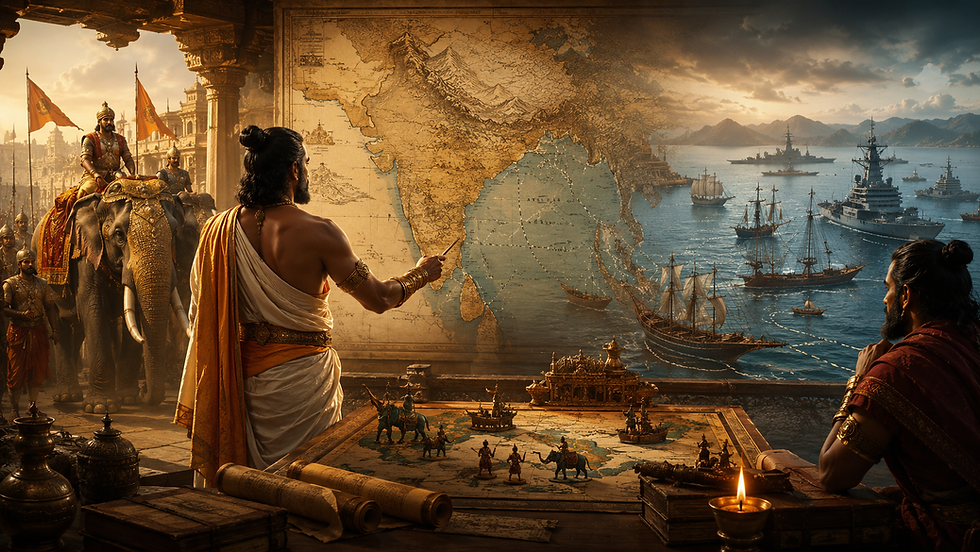
Modern geopolitics often presents strategy as a predominantly Western discipline. Contemporary discussions on power projection, diplomacy, intelligence networks, economic warfare, and strategic balancing usually revolve around European thinkers like Machiavelli, Clausewitz, Sun Tzu from China, or modern American strategic doctrine. Yet long before the rise of modern nation-states, India had already developed one of the most comprehensive traditions of strategic thought in human history.
Ancient India was not merely a land of philosophy and spirituality. It was also a civilization deeply aware of power, statecraft, economics, war, intelligence, and geopolitical survival. The subcontinent produced rulers, administrators, strategists, and thinkers who understood that moral aspiration alone could not protect a civilization. Order required strength. Prosperity required stability. Dharma required power.
At the center of this strategic tradition stood the idea that governance was not simply about ruling territory. It was about preserving civilization itself.
Today, however, much of this strategic inheritance has faded from public consciousness. India’s ancient statecraft is often reduced to simplistic references, selective quotations, or romanticized nostalgia. What is forgotten is the extraordinary sophistication of the systems that ancient India developed—systems involving intelligence networks, alliance structures, trade security, military organization, psychological operations, and civilizational diplomacy.
The tragedy is not merely historical amnesia. It is strategic amnesia.
Because many of the geopolitical challenges India faces today—border threats, maritime competition, economic coercion, internal fragmentation, influence warfare, and strategic encirclement—were challenges ancient Indian thinkers had already studied in remarkable depth.
The lessons remain astonishingly relevant.
Ancient India Understood That Morality Without Power Is Fragile
One of the most misunderstood aspects of ancient Indian strategic thought is the relationship between ethics and power.
Modern narratives often portray ancient India as exclusively idealistic or spiritually detached from political realism. But ancient Indian statecraft never believed that morality alone could sustain order. Rather, it argued that moral order depended upon strategic strength.
This distinction is crucial.
Ancient Indian thinkers recognized that a weak state could not protect justice, culture, trade, or social harmony. If the state collapsed, dharma itself became vulnerable. Therefore, the preservation of order required political realism.
This is why ancient Indian strategic philosophy combined ethical governance with ruthless practicality.
The ruler was expected to pursue prosperity, maintain military strength, preserve internal stability, and neutralize threats. Compassion was important, but sentimentality was dangerous. Excessive idealism could invite invasion, subversion, or collapse.
In many ways, ancient Indian strategy viewed power not as an end in itself, but as the shield that protected civilization.
This distinction explains why ancient Indian empires often invested heavily in administration, taxation systems, intelligence networks, logistics, roads, ports, and military organization. Stability was not accidental. It was engineered.
The state was expected to remain vigilant because geopolitical threats never disappeared.
That lesson remains deeply relevant today.
The Arthashastra Was Far More Advanced Than Most People Realize
No discussion of ancient Indian statecraft can avoid the monumental influence of the Arthashastra.
Often compared to Machiavelli’s The Prince, the comparison actually understates its sophistication. The Arthashastra was not simply a political manual. It was a comprehensive strategic doctrine covering governance, economics, espionage, diplomacy, military affairs, law, urban administration, taxation, trade, and psychological warfare.
What made it extraordinary was its systemic understanding of power.
The Arthashastra treated the state as an interconnected organism where economic strength, military capability, internal stability, and intelligence collection all reinforced one another.
Its worldview was brutally realistic.
It assumed that states naturally competed for power and survival. Alliances were temporary. Rivals constantly calculated advantages. Neighbouring powers could become threats. Weakness invited aggression.
Centuries before modern realism emerged in Europe, ancient Indian thinkers had already developed sophisticated geopolitical frameworks.
One of the most remarkable ideas was the “Mandala Theory” of interstate relations.
The theory essentially argued that neighbouring states were natural rivals, while the neighbour's neighbor could become a strategic partner. This produced a constantly shifting balance of alliances and counterbalances.
In modern terms, this resembles balance-of-power geopolitics.
Ancient Indian strategists understood that states rarely acted permanently out of friendship or morality. They acted based on interests, security calculations, and survival.
This principle remains visible in global geopolitics today.
Intelligence Was Considered the Backbone of National Security
Perhaps one of the most advanced dimensions of ancient Indian statecraft was its emphasis on intelligence gathering.
Ancient Indian rulers understood that wars were often won before battles began.
Information superiority mattered.
The Arthashastra described extensive intelligence systems involving covert operatives, infiltrators, informants, double agents, and psychological influence operations. Intelligence was not treated as a secondary tool. It was considered central to governance itself.
The state monitored both external enemies and internal instability.
Ancient Indian strategy recognized several enduring truths:
External enemies exploit internal divisions.
Corruption weakens state resilience.
Disinformation can destabilize kingdoms.
Economic sabotage can undermine military power.
Espionage is continuous, not temporary.
Modern states still operate according to these realities.
Today’s cyber warfare, digital surveillance, narrative battles, and influence operations are technologically different but strategically familiar. Ancient Indian thinkers would likely recognize the logic immediately.
They understood that perception itself was a strategic battlefield.
This explains why strategic communication, public morale, and legitimacy were viewed as essential components of power.
A ruler who lost legitimacy became vulnerable from within.
Economic Power Was Viewed as the Foundation of Strategic Strength
Ancient Indian statecraft placed enormous emphasis on economic management.
This is another area where modern discussions often underestimate the sophistication of ancient Indian governance.
The state was expected to maintain trade routes, agricultural productivity, taxation efficiency, infrastructure, and commercial security. Wealth generation was not viewed as separate from national security—it was inseparable from it.
Without economic prosperity:
armies could not be maintained,
alliances could not be sustained,
infrastructure would decay,
internal unrest would rise,
and external enemies would gain advantage.
Ancient Indian thinkers recognized that economic resilience produced strategic resilience.
This principle explains why many Indian kingdoms heavily protected trade networks across the Indian Ocean. Maritime commerce was not simply commercial activity; it was geopolitical influence.
India’s ancient maritime connections stretched across Southeast Asia, the Arabian world, and East Africa. Trade routes became channels for cultural influence, diplomacy, and strategic outreach.
Civilizational influence often travelled alongside commerce.
Modern geopolitics increasingly reflects this ancient reality again.
Today, supply chains, energy routes, semiconductor access, shipping lanes, digital infrastructure, and trade dependencies all shape geopolitical power.
The ancient lesson remains unchanged:
Economic strength is strategic strength.
Ancient Indian Strategy Understood Psychological Warfare
Modern discussions of psychological operations often frame them as contemporary innovations. Yet ancient Indian strategic thinking deeply understood the power of narratives, perception, morale, and psychological influence.
Ancient rulers recognized that fear, confidence, uncertainty, prestige, and legitimacy could shape outcomes as much as battlefield victories.
A powerful image of strength could deter aggression.
A reputation for instability could invite intervention.
A ruler who appeared weak could trigger rebellion.
A ruler who projected order could consolidate authority.
The Arthashastra discussed deception, strategic signaling, covert influence, and morale manipulation with remarkable sophistication.
This was not merely cynical manipulation. It reflected a deeper understanding of human behavior and political psychology.
Wars were not only physical struggles. They were contests of perception.
Modern information warfare, media influence campaigns, digital propaganda, and strategic messaging operate on the same principles.
The battlefield has changed. Human psychology has not.
Ancient India Practiced Civilizational Diplomacy
One of the most fascinating aspects of ancient Indian strategic influence was its ability to project power without direct conquest.
Unlike many imperial systems that primarily expanded through military occupation, Indian civilization often expanded culturally, economically, and intellectually.
Across Southeast Asia, Indian influence spread through trade, language, philosophy, architecture, governance models, literature, religion, and diplomacy.
Indianized kingdoms emerged not because India imposed direct colonial control, but because its civilizational prestige became attractive.
This form of influence was subtle yet profound.
Ancient Indian statecraft understood that soft power could shape geopolitical environments over centuries.
Cultural influence created strategic depth.
Shared civilizational frameworks strengthened diplomatic relationships.
Trade networks reinforced political ties.
Ideas became instruments of influence.
In the modern era, this lesson carries immense significance.
India’s future global role may depend not only on military and economic growth, but also on its ability to project civilizational confidence through education, technology, culture, democratic resilience, strategic thought, and intellectual influence.
Civilizations that lose confidence in their own intellectual traditions often struggle to shape global narratives.
Ancient India understood the importance of narrative power long before modern strategic communication emerged.
Strategic Patience Was a Core Principle
Ancient Indian strategic thinking often emphasized long-term positioning over impulsive action.
This reflected civilizational time horizons.
Many ancient kingdoms understood that geopolitical competition unfolded across generations, not merely years. Short-term victories could become long-term disasters if not strategically managed.
This fostered a strategic culture that valued:
patience,
timing,
gradual consolidation,
economic preparation,
alliance management,
and calibrated escalation.
Not every provocation required immediate reaction.
Not every confrontation required total war.
Sometimes endurance itself became strategy.
This mindset remains highly relevant in modern geopolitics.
Rising powers often succeed not through emotional reactions but through sustained institutional development, economic resilience, technological advancement, and strategic consistency.
Ancient Indian statecraft frequently prioritized survival and continuity over dramatic but reckless confrontation.
Civilizations survive through adaptability.
Internal Unity Was Seen as the Greatest Strategic Multiplier
Ancient Indian strategists repeatedly warned that internal fragmentation invited external aggression.
This lesson appears again and again throughout Indian history.
Foreign powers often exploited divisions among kingdoms, elites, communities, or factions. Strategic disunity weakened collective resilience.
Ancient thinkers understood that internal cohesion directly influenced external security.
A divided polity became vulnerable to:
foreign manipulation,
economic disruption,
military defeat,
and political destabilization.
This lesson remains profoundly relevant today.
Modern conflicts increasingly involve hybrid warfare, disinformation, ideological polarization, economic coercion, and social fragmentation.
Strategic competition now targets societal cohesion itself.
Ancient Indian statecraft would likely recognize this immediately.
Civilizations rarely collapse solely from external attack. They often weaken internally first.
National resilience depends not only on military power but also on institutional trust, social stability, economic inclusion, and strategic confidence.
Maritime Strategy Was Central to Ancient Indian Influence
Modern Indian strategic discussions increasingly focus on the Indo-Pacific, maritime security, and naval modernization. Yet India’s maritime strategic tradition is far older than commonly acknowledged.
Ancient Indian kingdoms understood the immense geopolitical importance of sea power.
The Indian Ocean was not a peripheral space. It was a civilizational highway.
Trade, diplomacy, religion, culture, and strategic influence moved across maritime networks linking India with Southeast Asia, East Africa, Arabia, and beyond.
Control over ports, shipping routes, and maritime commerce created both wealth and geopolitical leverage.
Maritime connectivity amplified Indian influence far beyond the subcontinent.
This historical memory matters today.
As the Indo-Pacific becomes the central theater of 21st-century geopolitics, India is once again rediscovering the strategic importance of naval power, maritime logistics, island partnerships, and sea lane security.
The return of maritime competition is not a new phenomenon.
It is the return of an old geopolitical reality.
Ancient Indian Statecraft Was Deeply Institutional
One of the greatest misconceptions about ancient governance is the assumption that states depended purely on individual rulers.
In reality, many ancient Indian systems emphasized institutional continuity.
Administration, taxation, intelligence, trade regulation, military organization, and local governance often relied upon structured bureaucratic systems.
Strong institutions allowed kingdoms to survive beyond individual rulers.
Ancient strategists recognized that charismatic leadership alone was insufficient. Durable governance required systems.
This remains one of the defining lessons for modern states.
Nations rise not only through inspirational leaders, but through resilient institutions capable of surviving crises, transitions, and external pressure.
Strategic depth emerges from institutional depth.
Why These Lessons Matter Today
The world is entering an era of renewed geopolitical competition.
Globalization is fragmenting.
Supply chains are weaponized.
Information warfare shapes public opinion.
Maritime routes are contested.
Technological rivalry intensifies.
Economic coercion becomes normalized.
Civilizational narratives are returning to international politics.
In many ways, the world is moving closer to the strategic environment ancient Indian thinkers understood well: a competitive system where states continuously balance power, alliances, economics, intelligence, and influence.
The relevance of ancient Indian statecraft therefore extends beyond historical curiosity.
It offers a framework for strategic thinking rooted in realism, resilience, adaptability, and civilizational continuity.
Ancient India did not survive for millennia because of naïveté.
It survived because generations of thinkers understood that civilization required protection, strategy, and institutional sophistication.
The Strategic Vanguard Take
One of the greatest intellectual mistakes of the modern era has been the tendency to view Indian civilization exclusively through the lens of spirituality while ignoring its strategic genius.
Ancient India was not strategically passive.
It produced some of the most advanced geopolitical frameworks in pre-modern history. It understood intelligence operations, economic statecraft, maritime power, alliance systems, psychological warfare, and long-term strategic balancing long before these concepts became formalized in modern international relations theory.
The tragedy is that modern India often rediscovers its own strategic traditions through foreign frameworks instead of studying its own civilizational inheritance directly.
Yet the future may increasingly demand precisely such rediscovery.
Because the 21st century is becoming an age of civilizational states, strategic competition, information warfare, maritime rivalry, and geopolitical balancing—the very conditions ancient Indian statecraft spent centuries analyzing.
The forgotten lessons are becoming relevant again.
Not because history repeats mechanically.
But because the fundamental realities of power, human behavior, geography, economics, and political competition endure across time.
Civilizations that understand their strategic traditions gain confidence.
Civilizations that forget them risk intellectual dependency.
And in geopolitics, intellectual dependency eventually becomes strategic dependency.
Conclusion
Ancient Indian statecraft was far more than a relic of history. It was a deeply sophisticated strategic tradition built upon centuries of observation, governance, diplomacy, trade, and geopolitical experience.
Its lessons remain startlingly modern:
Power protects order.
Intelligence shapes outcomes.
Economic strength underpins security.
Internal unity determines resilience.
Maritime influence creates strategic reach.
Narratives shape geopolitical legitimacy.
Strategic patience often outlasts impulsive aggression.
These were not abstract theories.
They were civilizational survival principles.
As India rises again in an increasingly unstable world, the rediscovery of its strategic heritage may become not merely an academic exercise, but a geopolitical necessity.
The future of Indian strategy may depend not only on new technologies, modern weapons, or economic growth, but also on recovering the strategic confidence embedded within its own civilizational memory.
And perhaps that is the deepest forgotten lesson of all.


Comments