

The Silent War: How Electronic Intelligence (ELINT) Detects Enemies Before the First Shot
Updated: 6 days ago
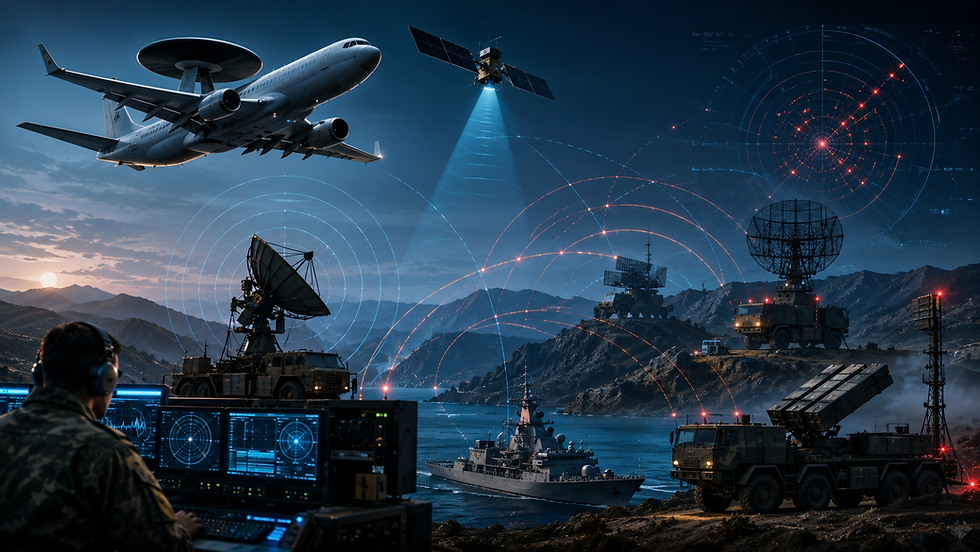
Modern warfare is often portrayed through spectacular images of fighter aircraft launching precision-guided weapons, missile batteries intercepting incoming threats, warships exchanging salvos across the sea, or tanks advancing across hostile terrain. Yet these dramatic moments represent only the visible culmination of an invisible contest that usually begins days, weeks or even months before the first missile leaves its launcher. Long before commanders order an attack, militaries are already competing in a silent battle fought across the electromagnetic spectrum. Every radar pulse, satellite transmission, navigation beacon and electronic sensor becomes both a source of information and a potential vulnerability. The side capable of collecting, interpreting and exploiting these invisible emissions gains a decisive advantage, often determining the outcome of military operations before conventional combat even begins. This hidden contest is known as Electronic Intelligence, or ELINT, and it has become one of the defining capabilities of twenty-first century warfare.
Unlike traditional reconnaissance that depends upon visual observation, ELINT focuses entirely on the electronic signatures produced by military systems. Every modern military platform—whether a long-range surveillance radar, a surface-to-air missile battery, an airborne early warning aircraft, a naval destroyer or even a sophisticated fighter aircraft—continuously interacts with the electromagnetic spectrum. These interactions generate unique electronic fingerprints that reveal invaluable information about the platform's identity, location, operating frequency, transmission power, scanning pattern and tactical role. Even when an adversary carefully conceals military assets beneath camouflage or deploys them hundreds of kilometres beyond visual range, their electronic emissions often betray their presence. Electronic Intelligence transforms these invisible signals into actionable intelligence, allowing military planners to build an extraordinarily detailed picture of enemy deployments without crossing borders or firing a single shot.
Many people mistakenly use the terms ELINT, SIGINT and COMINT interchangeably, but each serves a distinct purpose within the broader intelligence community. Signals Intelligence, commonly abbreviated as SIGINT, represents the overall discipline of intercepting electronic signals for intelligence purposes. Within this larger framework, Communications Intelligence, or COMINT, focuses specifically on intercepting voice communications, encrypted military radio traffic, satellite communications, digital messaging systems and command networks. Electronic Intelligence, however, is concerned with non-communication electronic emissions generated by radars, missile guidance systems, electronic surveillance equipment, navigation aids and fire-control systems. Together, COMINT and ELINT provide commanders with complementary perspectives—one revealing what the enemy is saying, the other revealing what the enemy is doing. This combination enables militaries to understand not only operational intentions but also the technical capabilities and deployment patterns of opposing forces.
Collecting Electronic Intelligence requires an extensive network of specialised platforms operating across multiple domains. Dedicated reconnaissance aircraft equipped with sophisticated receivers routinely fly along international airspace boundaries, passively monitoring radar emissions from neighbouring countries without violating sovereign airspace. Airborne early warning aircraft also contribute to electronic intelligence by continuously analysing radar environments while conducting routine surveillance missions. Naval vessels equipped with Electronic Support Measures patrol international waters, mapping coastal radar installations and identifying naval activity far beyond the visual horizon. Satellites orbiting the Earth continuously monitor electronic emissions on a global scale, providing persistent surveillance of missile test ranges, air defence networks and military bases. Increasingly, unmanned aerial vehicles are assuming greater responsibility for dangerous reconnaissance missions, allowing nations to gather highly detailed electronic signatures while reducing risks to human crews. Together, these systems create a comprehensive electronic picture that is continuously updated in real time.
Perhaps nowhere is Electronic Intelligence more valuable than during Suppression of Enemy Air Defences, widely known by its military acronym SEAD. Before combat aircraft can safely penetrate hostile airspace, commanders must understand the complete structure of the opposing air defence network. They need to identify every surveillance radar, target acquisition radar, fire-control radar and missile battery protecting strategic targets. Electronic Intelligence provides these answers by observing how radar systems operate under normal conditions, measuring operating frequencies, scan intervals, antenna rotation speeds and response patterns. Over months and sometimes years, intelligence agencies construct comprehensive electronic order-of-battle databases that reveal not only where enemy radar systems are located but also how they function under various operational conditions. During conflict, electronic warfare aircraft can exploit this knowledge to jam hostile radars, deceive missile guidance systems or direct precision strikes against the most critical nodes in the air defence network. Consequently, modern air campaigns increasingly depend upon superior information rather than overwhelming firepower alone.
The emergence of stealth technology has significantly altered aerial warfare, yet it has not diminished the importance of Electronic Intelligence. Stealth aircraft are specifically designed to minimise their radar cross-section, making them difficult to detect through conventional radar systems. However, stealth does not render an aircraft completely invisible. Whenever a stealth platform activates its own radar, transmits radio communications or emits other electronic signals, it risks exposing its position to sophisticated ELINT systems. This reality explains why modern stealth operations emphasise strict Emissions Control (EMCON) procedures. Pilots minimise unnecessary electronic transmissions, rely extensively on passive sensors and utilise secure low-probability-of-intercept communications whenever possible. In contemporary military doctrine, electronic silence itself has become a tactical weapon, illustrating how Electronic Intelligence continues to influence operational planning even in the age of fifth-generation and future sixth-generation combat aircraft.
Electronic Intelligence is equally indispensable in naval warfare. Modern warships constantly emit electronic signatures through navigation radars, air search radars, fire-control radars, communication systems and electronic support equipment. These emissions allow hostile reconnaissance platforms to identify individual classes of warships, estimate fleet composition and monitor naval movements across vast oceanic distances. Maritime patrol aircraft, reconnaissance satellites and intelligence-gathering vessels routinely collect electronic signatures from naval task forces operating in international waters. This information enables analysts to determine whether a fleet is conducting training exercises, preparing for amphibious operations or positioning itself for strategic deterrence missions. In an era where aircraft carriers, submarines and missile destroyers represent national power projection, controlling the electromagnetic spectrum has become just as important as controlling the sea itself.
For India, Electronic Intelligence occupies an increasingly central role in national security planning. Surrounded by two nuclear-armed neighbours and operating across diverse geographical environments that include mountainous frontiers, deserts and the Indian Ocean, India requires continuous situational awareness to respond effectively to evolving security challenges. The Indian Armed Forces have steadily invested in airborne surveillance platforms, indigenous radar technologies, electronic warfare systems, satellite reconnaissance and integrated command-and-control networks. Programmes such as the Integrated Air Command and Control System (IACCS), advanced airborne early warning aircraft, Defence Research and Development Organisation initiatives and indigenous electronic warfare suites collectively strengthen India's ability to monitor potential threats across multiple theatres simultaneously. As network-centric warfare becomes the foundation of future military operations, Electronic Intelligence will increasingly serve as the invisible backbone supporting India's defence architecture.
The future of Electronic Intelligence will be shaped by artificial intelligence, machine learning and advanced data analytics. Modern military sensors generate enormous quantities of electronic information every second, overwhelming the capacity of human analysts to process data manually. Artificial intelligence offers the ability to recognise unfamiliar radar signatures, classify emitters automatically, identify behavioural anomalies and generate immediate threat assessments within seconds. Rather than merely recording electronic emissions, next-generation ELINT systems will predict adversary behaviour, identify emerging operational patterns and assist commanders in making faster and more accurate decisions. As military competition expands into cyberspace, outer space and the electromagnetic spectrum, nations capable of integrating artificial intelligence with Electronic Intelligence will enjoy significant operational advantages over technologically slower adversaries.
Ultimately, Electronic Intelligence demonstrates that modern warfare is no longer fought solely across land, sea and air. The electromagnetic spectrum has evolved into an operational domain where information itself has become a strategic weapon. Every radar transmission, electronic pulse and digital emission contributes to a vast and continuous contest for situational awareness. The military that can observe without being observed, detect without revealing itself and understand the enemy before the enemy understands it possesses a decisive advantage that often determines success before combat even begins. Wars may still be remembered for the explosions that dominate headlines, but increasingly they are won by those who master the silent signals that remain invisible to everyone else.
Strategic Vanguard Insight
Electronic Intelligence is rapidly becoming the nervous system of modern military operations. As radar networks, artificial intelligence, cyber capabilities and network-centric warfare continue to evolve, the battle for dominance in the electromagnetic spectrum will only intensify. Future conflicts are unlikely to begin with tanks crossing borders or missiles striking targets. They will begin with sensors quietly listening, algorithms analysing vast streams of data, and commanders making decisions based on information gathered long before the first shot is fired. In the wars of tomorrow, the side that sees first will almost certainly strike first—and often win first.
Related Strategic Vanguard Analysis
Electronic intelligence works alongside broader electronic-warfare capabilities to shape the sensing contest. Read The Invisible War: Electronic Warfare.
The information gathered by sensors must be translated into decisions and coordinated action. Explore The Invisible War: How Command and Control Decides Modern Battles.
Space-based sensors and communications add another dimension to modern intelligence networks. Read When Satellites Become Targets.


Comments