The Combined-Arms Revolution: Why Modern Armies Must Fight as One Integrated Force

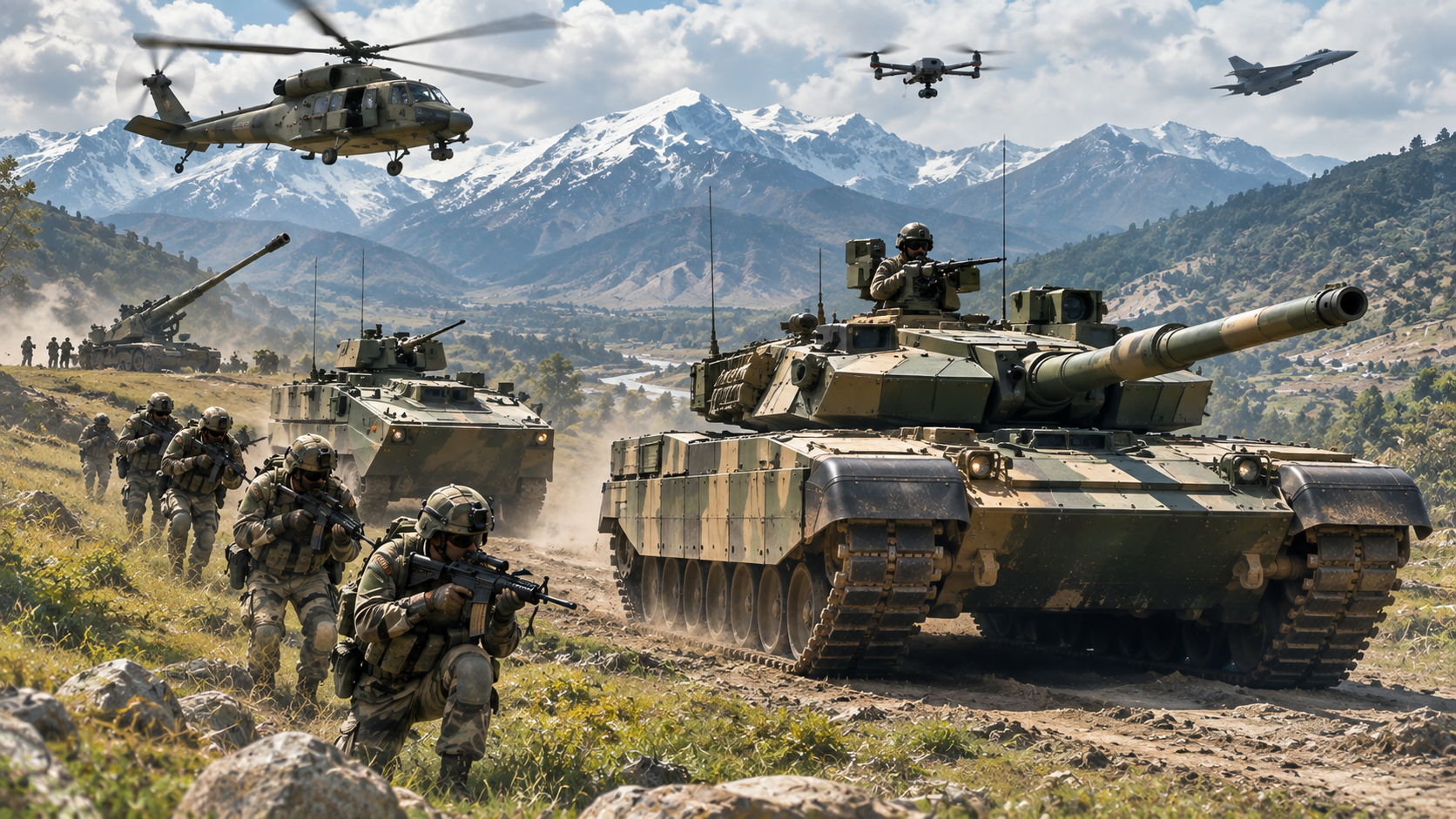
The effectiveness of a modern army cannot be judged by its most powerful tank, fastest fighter aircraft or most sophisticated missile alone. Military strength also depends on whether a nation can combine its capabilities into a coordinated, resilient and sustainable fighting system. A technologically advanced weapon may dominate an individual engagement, but the larger military outcome depends on the relationship between reconnaissance, intelligence, firepower, mobility, protection, communications, logistics and command. The central challenge of modern warfare is therefore not simply acquiring better weapons. It is organising people, platforms and information so that their combined effect is greater than the sum of their individual contributions.
This principle is known as combined-arms warfare. It is neither a new invention nor a concept made obsolete by drones, artificial intelligence or precision-guided weapons. It is one of the enduring foundations of military effectiveness. What is changing is the complexity of the environment in which combined arms must operate. Modern forces must coordinate traditional combat formations with unmanned systems, electronic warfare, satellite-based intelligence and increasingly sophisticated air-defence networks. When this coordination extends across the armed services and incorporates capabilities in space and cyberspace, it also involves joint and multi-domain operations. These concepts overlap, but they are not interchangeable. The battlefield is becoming more connected, while the ability to maintain that connection under attack is becoming more difficult.
The significance of this transformation is visible in contemporary conflicts, particularly the war in Ukraine. That conflict has demonstrated the destructive potential of drones and precision weapons, but it has also revealed the continuing importance of artillery, infantry, armoured vehicles, engineers and logistics. New technology has not removed the requirement for combined arms. It has made the coordination of combined arms more demanding. Forces that can observe, decide, move, strike, protect and sustain themselves as an integrated organisation are better placed to exploit their available capabilities. Their success, however, also depends on equipment quality, numbers, readiness, leadership, industrial capacity and the ability to adapt to an opponent.
What Combined-Arms Warfare Actually Means Combined-arms warfare is the coordinated employment of different military capabilities so that the strengths of one compensate for the vulnerabilities of another. It seeks to create dilemmas for an opponent by presenting several threats that cannot be answered effectively through a single defensive response. Infantry can secure terrain and operate in environments where vehicles are restricted. Armour provides protected mobility and direct firepower. Artillery delivers powerful effects at a distance. Engineers overcome obstacles and enable movement. Air-defence systems protect formations from aerial attack. Reconnaissance identifies enemy positions and opportunities. Logistics keeps the entire formation functioning.
These capabilities are not combined merely because they are present in the same geographical area. Their employment must be coordinated around a common operational purpose. A tank formation advancing without adequate infantry protection may become vulnerable to anti-tank teams, mines and concealed positions. Infantry advancing without fire support may suffer unacceptable casualties against fortified defenders. Artillery operating without reliable target information may expend large quantities of ammunition without producing decisive effects. Engineers arriving after an assault has begun may be unable to clear obstacles quickly enough to preserve momentum. Each capability has value, but its effectiveness is influenced by the support and protection provided by the others.
The distinction is between possessing military components and creating a functioning military system. A force can have excellent equipment across every category and still perform poorly if its units cannot communicate, share information, coordinate movement or support one another. Conversely, a force with fewer advanced platforms may achieve disproportionate results through better organisation, tactical discipline, situational awareness and effective coordination. This does not mean that superior equipment or numerical strength is unimportant. It means that their contribution must be understood in relation to the wider organisation employing them.
Combined arms is therefore as much an organisational and intellectual challenge as it is a technological one. It requires commanders to understand how different capabilities interact, how their effects can be sequenced and how the enemy may exploit gaps between them. It also requires training and doctrine that encourage cooperation across organisational boundaries rather than allowing each arm to operate as an isolated institution.
From the First World War to the Modern Battlefield The development of combined-arms warfare was gradual. The First World War exposed the limitations of armies that relied on separate branches without sufficiently integrating their actions. Machine guns, artillery, trenches, barbed wire and modern rifles created a defensive environment in which unsupported infantry attacks could suffer catastrophic losses. The introduction of tanks offered a means of overcoming some battlefield obstacles, but early armoured vehicles were mechanically unreliable, slow and difficult to coordinate with infantry and artillery.
The experience of the war gradually encouraged armies to develop more systematic methods of combining firepower, protection and movement. By the Hundred Days campaign of 1918, some Allied formations were already employing sophisticated combined-arms tactics, although the level of proficiency varied between formations. Military historian Jonathan Boff's study, Combined Arms during the Hundred Days Campaign, August–November 1918, documents the development of British combined-arms methods while showing that implementation was uneven. The evolution of combined arms was therefore already well underway before the Second World War.
The important historical lesson is that combined-arms warfare did not suddenly emerge from a single technological breakthrough. It developed through battlefield experience, institutional adaptation and the recognition that no individual weapon could overcome every tactical problem. Tanks could breach obstacles and provide protected firepower, but they needed infantry to deal with threats that armoured vehicles could not effectively engage. Artillery could suppress enemy positions, but its effects needed to be coordinated with the timing and direction of the assault. Engineers could open routes, but their work had to be protected by the wider formation.
The Second World War accelerated the institutional development of combined-arms formations. Armoured organisations increasingly brought together tanks, mechanised infantry, reconnaissance, artillery, engineers and support elements. German armoured formations became particularly associated with rapid manoeuvre and the concentration of different capabilities, but combined-arms development was not exclusive to Germany. The Soviet Union developed increasingly sophisticated methods of coordinating artillery, armour, infantry and operational reserves. Allied armies also refined the integration of ground forces, air power and logistics. The American experience of armoured development involved a transition from collections of tanks towards formations integrating infantry, artillery, reconnaissance, engineers and combat support.
The experience of the Second World War established an enduring lesson: battlefield mobility is not simply the speed at which a vehicle travels. It is the ability of an entire formation to move, fight, protect itself and sustain its operations while confronting an opposing force. A tank may travel quickly, but an armoured formation cannot maintain its operational tempo if fuel, ammunition, maintenance, infantry protection and communications fail to keep pace.
This distinction remains relevant today. Many advanced military platforms impose demanding requirements for information, maintenance and specialist support. Operational value therefore depends not only on technical performance but also on availability, repairability and the ability to sustain the platform in combat. In some circumstances, comparatively simple equipment that can be repaired locally may offer important advantages over more sophisticated systems that are difficult to maintain or keep supplied. The most advanced platform is not necessarily the most useful if it cannot remain operational when the formation needs it.
The Key Components of the Combined-Arms System There is no universally recognised doctrinal classification that limits combined arms to a fixed list of five pillars. For explanatory purposes, however, several broad capability groups help illustrate how a modern formation functions. These categories are not exhaustive, and their organisation differs between armies, missions and operational environments.
Infantry remains essential because territory must ultimately be controlled. Infantry can operate in urban areas, forests, mountains, trenches and other environments where large vehicles have restricted freedom of movement. Soldiers can clear buildings, secure routes, occupy defensive positions and identify threats that may be difficult to detect from a distance. They can also protect armoured vehicles against close-range threats and help establish control over terrain after enemy positions have been neutralised. The continued importance of infantry does not mean that infantry should be expected to absorb every battlefield risk. Modern infantry depends on reconnaissance, communications, fire support, mobility and protection. Its effectiveness increases when it can identify threats before contact, receive accurate supporting fire and coordinate movement with other units.
Armour provides protected mobility and direct firepower. Tanks and other armoured vehicles allow forces to move through hostile environments with a degree of protection unavailable to dismounted troops. Their weapons can engage fortified positions, enemy vehicles and other targets. Their psychological and physical impact can be considerable when employed in favourable conditions. Yet armour is not invulnerable. Anti-tank guided missiles, mines, artillery, loitering munitions and unmanned aerial systems have made the battlefield increasingly dangerous for exposed vehicles. This does not make tanks obsolete. It changes the circumstances in which they can be employed effectively. Armour requires reconnaissance, infantry protection, engineering support, air defence, electronic protection and a plan for suppressing enemy anti-armour capabilities.
Artillery remains a central source of battlefield firepower. It can suppress enemy positions, destroy defensive works, disrupt concentrations and support the movement of friendly forces. Drones have improved target acquisition and battlefield observation, but they have not eliminated the value of artillery. Artillery can deliver substantial payloads and provide sustained fire support when unmanned systems or their communications are degraded. Its effectiveness nevertheless depends on ammunition availability, accurate targeting, communications, mobility and the ability to avoid counter-battery fire. Its employment is also affected by weather, terrain, enemy countermeasures and the availability of suitable targets.
Combat aviation and air defence shape the freedom of action available to ground forces. Aircraft and helicopters can provide reconnaissance, transport, close support and strikes against targets beyond the immediate reach of ground formations. Air power can also disrupt enemy logistics, command infrastructure and reinforcement routes. At the same time, ground forces require protection from enemy aircraft, missiles and drones. Air defence is therefore not simply a separate defensive activity. It contributes directly to the survival and operational freedom of the entire formation.
Engineers, signals, maintenance and logistics enable the fighting system to function. Engineers clear obstacles, construct routes, support river crossings and help overcome defensive barriers. Signals units maintain communications and information networks. Maintenance personnel keep vehicles and weapons operational. Medical services preserve the force's human strength. Logistics provides ammunition, fuel, food, spare parts and other necessities. These capabilities are sometimes less visible than tanks or aircraft, but a formation that cannot move, communicate, repair or resupply cannot sustain combat operations. The central point is that these capabilities must be planned and employed together. Their value is not determined only by their individual performance, but by the quality of their integration.
The Drone Revolution: A New Layer of Battlefield Integration One of the most consequential recent developments has been the mass employment of unmanned systems, particularly their integration into reconnaissance, targeting and strike networks. Drones have expanded the ability of military forces to observe the battlefield, identify targets and assess the results of attacks. Relatively inexpensive systems can provide local reconnaissance, while more sophisticated platforms can operate over greater distances or perform specialised missions.
Their importance is not simply that they can carry weapons. A reconnaissance drone can identify an enemy position and transmit information to an artillery unit. The artillery unit can engage the target, after which another drone may assess the effect of the strike. A command post can use the information to adjust the formation's movement. In this way, the drone becomes part of a wider chain connecting observation, decision and firepower.
This relationship has changed the tactical environment. Concealment is more difficult when small unmanned systems can observe roads, defensive positions and movement routes. Large concentrations of vehicles may become vulnerable to detection and precision attack. Supply convoys and engineering equipment can be exposed before they reach the area where they are required. Commanders must consider not only the enemy's visible weapons but also the sensors and communication networks that connect those weapons to targets.
However, battlefield observation should not be confused with perfect transparency. Persistent surveillance makes concealment and surprise harder, but not impossible. Weather, terrain, deception, counter-reconnaissance and electronic warfare can create temporary gaps in observation. Drones may be intercepted, jammed, destroyed or prevented from transmitting useful information. Their effectiveness depends on operators, communications, processing capacity, endurance and power supply, and the ability to connect observations to the wider command system.
It is also important to distinguish remotely controlled drones from autonomous systems. A remotely piloted aircraft is not necessarily autonomous simply because it performs some automated functions. Full autonomy remains a developing capability, and the operational implications of systems that can independently select and engage targets raise additional legal, ethical and command questions.
The most important lesson is therefore not that drones have replaced traditional weapons. It is that unmanned systems have become another layer of the combined-arms system. Their contribution is greatest when they improve the effectiveness of infantry, armour, artillery, air defence and command networks. A drone that identifies a target but cannot communicate its location reliably may have limited operational value. A drone that provides information to a responsive artillery unit or a manoeuvre commander can have a much greater effect.
Electronic Warfare: The Contest for the Invisible Battlefield Modern military formations depend on the electromagnetic spectrum. Radios, satellite navigation, data links, radar, remote-control systems and digital command networks enable forces to coordinate across large areas. This dependence creates opportunities, but also vulnerabilities. An opponent that can interfere with communications, disrupt navigation or identify the electromagnetic signatures of military units may degrade a formation without physically destroying its vehicles or weapons.
Electronic warfare has consequently become a central component of modern combined-arms operations. It can include electronic support measures that detect and identify emissions, electronic attack that disrupts or deceives enemy systems, and electronic protection designed to preserve friendly capabilities. These functions influence the ability of forces to communicate, navigate, observe and coordinate their actions.
The relationship between drones and electronic warfare is particularly important. Some drones depend on satellite navigation, radio control or data links. If those links are disrupted, the system may lose effectiveness or become unreliable. However, not every unmanned system has the same vulnerabilities. Fibre-optically controlled drones and platforms using onboard navigation can reduce dependence on vulnerable radio links, although they retain other operational limitations. Different control and navigation arrangements create different vulnerabilities, and countermeasures must account for those differences.
Forces have responded to electronic interference by developing alternative navigation methods, more resilient communications, different operating frequencies and systems capable of performing selected functions when connectivity is degraded. The objective is not to eliminate dependence on networks entirely, but to ensure that the loss of one system does not render the entire formation ineffective.
Electronic warfare also creates a difficult coordination problem. Friendly jamming can interfere with friendly drones, radios and navigation systems. A formation may successfully disrupt an adversary's communications while simultaneously degrading its own ability to coordinate movement. The challenge is therefore not simply to possess powerful jamming equipment. It is to manage the electromagnetic environment so that friendly systems retain sufficient freedom to operate while enemy systems are disrupted.
This requires close coordination between commanders, signals units, electronic warfare specialists, air-defence operators and unmanned-system teams. Spectrum management becomes an operational responsibility rather than a technical issue confined to specialist personnel.
The war in Ukraine provides important evidence of this challenge. In Emergent Approaches to Combined Arms Manoeuvre in Ukraine, published by the Royal United Services Institute on 23 October 2025, Dr Jack Watling examines emerging methods among selected Ukrainian formations rather than a uniform Ukrainian doctrine. The paper highlights the value of integrating reconnaissance, electronic warfare, fires, infantry and protected mobility, while also examining the difficulty of synchronising capabilities under persistent surveillance and electronic interference.
The wider lesson is that electronic warfare can degrade an otherwise physically intact formation. Vehicles may remain operational, weapons may be loaded and personnel may be ready, but if communications and situational awareness fail, the formation may struggle to coordinate its actions. In a network-dependent force, the ability to operate when networks are disrupted is as important as the ability to exploit them when they function.
Ukraine: A Battlefield Laboratory, Not a Universal Template The Russia-Ukraine war has become one of the most closely examined examples of modern high-intensity warfare. It has exposed the interaction between drones, artillery, electronic warfare, air defence, armoured vehicles, infantry and contested logistics. It has also challenged assumptions formed during decades in which many Western militaries operated with considerable technological advantages in communications, surveillance and air power.
One of the conflict's most visible characteristics has been the extensive use of unmanned aerial systems. Both sides have employed drones for reconnaissance, target acquisition, artillery correction and direct attack. Their widespread presence has increased the danger associated with exposed movement and made battlefield concealment more difficult. Yet the conflict has not demonstrated that traditional military capabilities have lost their relevance. Artillery remains important. Infantry continues to hold and contest terrain. Armoured vehicles remain useful, although their employment has been constrained by mines, surveillance and anti-armour threats.
The operational problem is increasingly one of synchronisation. A formation must identify enemy positions, protect its own movement, suppress opposing fires, clear obstacles, maintain communications and sustain its logistics. If one part of this chain fails, the entire operation may lose momentum. A unit may identify a vulnerable enemy position but lack the firepower or communications to exploit it. An armoured group may be ready to advance but unable to move because engineers have not cleared obstacles. An assault may succeed tactically but fail to achieve a larger objective because ammunition and fuel cannot reach the forward elements.
RUSI's October 2025 paper is particularly useful because it examines how selected Ukrainian formations have adapted to these conditions. It highlights the importance of integrating observation, electronic warfare, fires and manoeuvre, while recognising that the practices of particular units cannot simply be transferred to every army or operational environment. The requirements of a force conducting area defence and attrition are not identical to those of a force preparing to conduct a large-scale offensive manoeuvre. The paper also draws attention to the difficulty of moving and sustaining formations when reconnaissance and precision fires can threaten vehicles, engineering assets and supply routes.
A separate CSIS report by Colonel Matthew N. Slusher, published on 2 May 2025, examines five interconnected subjects arising from the Ukraine conflict: autonomous systems, information operations, electronic warfare, contested logistics and evolving air-defence strategies. The report draws on interviews with four senior defence experts conducted in March 2025. It is an analytical white paper, not an official military doctrine or a comprehensive battlefield dataset. Its value lies in identifying the organisational and operational challenges that military planners must consider. It also makes an important distinction between remotely controlled systems and full autonomy: many effective unmanned systems remain dependent on human operators, even when they incorporate limited automated functions.
The experience of Ukraine should therefore be studied carefully rather than copied mechanically. Geography, climate, force structure, industrial capacity, doctrine and the nature of the opponent all influence how combined arms can be employed. A method that works for a particular formation in a particular sector may not be appropriate for a different army or theatre. The enduring lesson is the need for continuous adaptation, not the assumption that one battlefield has produced a universal formula for future wars.
The Logistics Problem: The Force Must Be Able to Keep Fighting Military history repeatedly demonstrates that the ability to sustain combat operations is as important as the ability to begin them. Modern combined-arms formations are particularly demanding because their different components consume different resources and depend on specialised supply chains. Tanks require fuel, ammunition and maintenance. Artillery requires large quantities of shells and propellant. Drones require batteries, replacement components and communications equipment. Air-defence systems require missiles, sensors and technical support. Infantry needs food, medical supplies, transport and equipment.
The more sophisticated a military system becomes, the more important its supporting infrastructure may become. A technologically advanced platform is not useful if it cannot be maintained or supplied. A formation that advances faster than its logistics can support may find itself operationally isolated. A force that concentrates its ammunition and fuel in a small number of large depots may expose those supplies to long-range attack.
Modern surveillance and precision-strike capabilities have increased the danger to logistics networks. Supply vehicles, repair facilities, bridges, rail connections and distribution points may be observed and targeted. This encourages a shift towards more dispersed and resilient logistics arrangements. Instead of relying exclusively on a few large supply nodes, forces may need multiple smaller distribution points, alternative routes, greater redundancy and the ability to relocate support facilities.
The principle is not that all logistics should be dispersed permanently. Dispersal can increase complexity and make coordination more difficult. The objective is to balance survivability with efficiency: distribute resources when necessary, protect critical functions and retain the ability to concentrate supplies where operations demand them.
The CSIS study by Slusher identifies contested logistics as one of the major lessons emerging from the Ukraine conflict. It draws attention to the vulnerabilities of supply chains and the importance of resilience when commercial and military infrastructure may be disrupted. The implications extend beyond the battlefield. Industrial capacity, transport networks, repair facilities and the availability of critical components all influence a nation's ability to sustain a prolonged conflict.
This is particularly important for countries that depend on external suppliers for key military technologies or components. A force may possess advanced weapons but remain vulnerable if it cannot obtain replacement parts, specialised ammunition or maintenance support during a crisis. Defence preparedness must therefore consider not only the number of platforms acquired but also the industrial and logistical systems required to keep them operational.
India's Challenge: Building Formations That Can Fight as Integrated Systems For India, combined-arms integration has direct relevance to the country's diverse security environment. The Indian Army must prepare for operations across very different geographical conditions, including high-altitude mountain terrain, deserts, plains, river systems and densely populated areas. The requirements of a formation operating in the Himalayas are not identical to those of a formation deployed in the western sector. Equipment, mobility, logistics, fire support and operational planning must reflect the terrain and the likely mission.
The challenge is not simply to acquire more tanks, artillery systems, drones or missiles. It is to ensure that these capabilities can be coordinated at the formation level. Reconnaissance must be connected to decision-making and fire support. Infantry and armour must be able to operate together. Engineers must be available to overcome obstacles. Communications must function across different units. Air defence must protect vulnerable elements. Logistics must sustain the formation under difficult geographical and operational conditions.
India's Integrated Battle Group programme is an important development in this context. The concept seeks to organise combat and supporting capabilities into more compact, responsive formations under a unified command structure. Rather than requiring separate organisations to coordinate every operational requirement through multiple layers, an integrated formation is intended to bring relevant capabilities closer to the commander responsible for the mission.
The programme has moved beyond conceptual exploration. According to reporting by The Tribune in July 2026, the Indian Army began raising five Integrated Battle Groups under the Mountain Strike Corps for the northeastern sector, with Sikkim and Arunachal Pradesh identified in the report. The report stated that the raising process was expected to be completed by mid-2027. These formations are intended to bring combat and supporting capabilities under a single commander, improving responsiveness and reducing the coordination required between separate organisations. This is a reported programme status, not independent confirmation that all five formations have achieved full operational readiness.
The significance of the IBG concept lies in its potential to improve responsiveness and reduce the time required to assemble the capabilities needed for a particular mission. In mountainous terrain, where movement routes are limited and weather can complicate deployment, the ability to coordinate combat and support elements within a more self-contained formation may offer important advantages.
However, organisational restructuring alone cannot guarantee operational effectiveness. An integrated formation requires reliable communications, realistic training, clear command responsibilities and sufficient logistical support. Its units must understand how to operate together under pressure. The integration of equipment on an organisational chart is only the beginning; genuine integration must be demonstrated through exercises, readiness and operational performance.
India must also consider the relationship between combined-arms formations and its wider joint military capabilities. Army formations may depend on the Indian Air Force for air support, surveillance, air-defence coordination and transport. Maritime developments may influence operations along the coastline and in the wider Indian Ocean region. Space-based services, cyber capabilities and intelligence networks may contribute to operational awareness and command. These are not merely internal army coordination questions. They require joint planning across the services and other national institutions.
The Indian Army's future effectiveness will therefore depend on two connected tasks: improving integration within its own formations and strengthening coordination with the wider joint force. The objective should be a military system capable of combining tactical responsiveness with national-level operational coordination.
Combined Arms, Joint Operations and Multi-Domain Operations The terms combined arms, joint operations and multi-domain operations are related, but they are not interchangeable. Combined arms principally concerns the complementary employment of different arms and capabilities, particularly within a land formation. It seeks to combine the effects of infantry, armour, artillery, engineers, reconnaissance and other supporting elements.
Joint operations involve the coordinated employment of capabilities from more than one military service. An army formation may depend on air force assets for surveillance, transport or strike support, while naval forces may contribute maritime security, intelligence or operations affecting the wider theatre. Joint operations require coordination across service structures, command arrangements and operational priorities.
Multi-domain operations extend this framework further. They consider how capabilities operating across land, air, maritime, space and cyberspace can be combined to create advantages against an opponent. Information and the electromagnetic spectrum are also central to this environment. The purpose is not to replace traditional combined arms, but to extend its application within a broader operational framework.
The United States Army's 2022 Field Manual 3-0, Operations, established multidomain operations as its operational concept. The doctrine describes them as the combined-arms employment of joint and Army capabilities to create and exploit relative advantages. This illustrates the relationship: multi-domain operations incorporate combined-arms principles rather than rendering them unnecessary. They extend the application of those principles across a wider operational environment and require commanders to understand how capabilities outside their immediate control can support or constrain their missions.
For India, the distinction matters because the future battlefield will not be confined to the boundaries of a single service. A ground operation may depend on satellite communications, cyber protection, air surveillance, electronic warfare, precision fires and maritime developments. The effectiveness of the land formation will partly depend on capabilities it does not directly command. This makes joint planning and interoperability essential.
The challenge is to ensure that multi-domain ambitions do not become an abstract exercise in terminology. The practical question remains whether commanders can obtain the information, authority and support required to act at the right time. An elaborate architecture that cannot deliver reliable information or coordinate effects under pressure will offer limited advantage. Integration must be measured by operational results, not by the number of systems connected to a network.
The Human and Organisational Dimension Technology is changing the battlefield, but military effectiveness remains dependent on people and institutions. A combined-arms formation requires commanders who understand the capabilities and limitations of different units. It needs officers and soldiers who can communicate across organisational boundaries, make decisions under uncertainty and adapt when the original plan no longer fits the situation.
This is particularly important when communications are degraded. Modern command systems can provide commanders with extensive information, but they may also create a dangerous dependence on continuous connectivity. If a headquarters loses contact with subordinate units, the ability of those units to continue operating depends on training, initiative and clarity of command intent.
Mission command and decentralised decision-making can help address this challenge. Higher commanders establish objectives, priorities and constraints, while subordinate commanders retain the ability to act when circumstances change. This does not mean that every unit operates independently. It means that the formation has enough shared understanding and trust to continue functioning when centralised control becomes difficult.
Training must also reflect the conditions of modern conflict. Exercises should test formations under electronic interference, disrupted navigation, loss of communications, simulated drone surveillance, ammunition shortages and attacks against logistical infrastructure. Units must learn to coordinate when their preferred systems are unavailable. A formation that performs effectively only under ideal training conditions may struggle when confronted by an adversary capable of disrupting its networks.
The organisational challenge is therefore continuous. Doctrine must evolve, equipment must be adapted, lessons must be incorporated and training must be repeated. Procurement decisions should be informed by the operational system into which equipment will be introduced. Buying a drone, radar or electronic warfare system without considering how it connects to the wider formation risks creating another isolated capability rather than strengthening the force.
The Future: Combined Arms Within Joint and Multi-Domain Operations The next stage of military development will not be defined by the disappearance of traditional combat arms. It will be shaped by the growing interaction between conventional platforms and new technologies. Infantry, tanks, artillery and engineers will continue to perform essential functions, but their effectiveness will increasingly depend on access to information, resilient communications, electronic protection and support from other domains.
Artificial intelligence may improve the speed at which information is processed and help commanders identify patterns across large volumes of data. Unmanned systems may provide reconnaissance or perform selected missions in environments too dangerous for human operators. Networked sensors may connect ground units with aircraft, satellites and other platforms. Precision weapons may allow smaller formations to engage targets at greater distances.
Yet these technologies introduce new vulnerabilities. Digital networks can be disrupted. Sensors can be deceived. Data can be delayed or corrupted. Satellite services may be degraded. Automated systems can produce errors if their information is incomplete or misleading. The military organisation must therefore preserve the ability to question information, operate through alternative methods and maintain human responsibility for critical decisions.
The future combined-arms formation will need both technological sophistication and resilience. It must be able to exploit connected systems when they are available, but continue to operate when they are not. It must combine high-end platforms with affordable and expendable systems, while ensuring that the loss of individual components does not collapse the entire network. It must also maintain the industrial and logistical capacity to replace equipment and sustain operations over time.
This is where the lessons of Ukraine become particularly relevant. The conflict demonstrates the importance of unmanned systems, electronic warfare, information operations, air defence and contested logistics. But it also reinforces the need for organisational adaptation and realistic training. The ability to introduce a new technology is only one part of military innovation. The more difficult task is changing doctrine, command structures, training and procurement so that the technology contributes to a coherent fighting system.
Conclusion: The Strength of an Army Lies in Its Integration The history of warfare is filled with weapons that transformed individual engagements. The machine gun, tank, aircraft, radar, missile and drone each changed the tactical environment. But no weapon has eliminated the need to organise military capabilities into a coherent force. Every technological development creates new opportunities, but it also introduces vulnerabilities that an opponent will seek to exploit.
Combined-arms warfare remains central because modern military operations demand complementary capabilities. Infantry must be protected and supported. Armour must be employed under favourable conditions. Artillery needs accurate information and reliable ammunition. Drones must be integrated with communications and fire support. Electronic warfare must be coordinated so that friendly systems remain functional. Logistics must sustain the formation even when supply routes and infrastructure are under attack.
For India, the challenge is to translate this principle into formations, doctrine, training and joint operational capability suited to the country's strategic environment. The development of Integrated Battle Groups is one important organisational step, but the wider requirement is a military system in which information, command, combat power and sustainment work together across services and domains.
Superior weapons matter. Their contribution depends on how effectively trained, supplied and coordinated forces employ them. An army's strength is therefore not measured only by the number of platforms it possesses, but by its ability to combine those platforms and the people who operate them into a resilient fighting system. In modern warfare, integration is not an administrative convenience. It is a fundamental condition of military effectiveness.
Research References Jack Watling, Emergent Approaches to Combined Arms Manoeuvre in Ukraine, Royal United Services Institute, 23 October 2025. https://www.rusi.org/explore-our-research/publications/insights-papers/emergent-approaches-combined-arms-manoeuvre-ukraine
Matthew N. Slusher, Lessons from the Ukraine Conflict: Modern Warfare in the Age of Autonomy, Information, and Resilience, Center for Strategic and International Studies, 2 May 2025. https://www.csis.org/analysis/lessons-ukraine-conflict-modern-warfare-age-autonomy-information-and-resilience
Army begins raising 5 Integrated Battle Groups along China border, The Tribune, July 2026. https://www.tribuneindia.com/news/top-headlines/army-begins-raising-5-integrated-battle-groups-along-china-border/
Jonathan Boff, Combined Arms during the Hundred Days Campaign, August–November 1918, War in History, Vol. 17, Issue 4, 2010. https://doi.org/10.1177/0968344510376456
John R. Walker, Bracketing the Enemy: Forward Observers and Combined Arms Effectiveness during the Second World War, PhD dissertation, Kent State University, 2009. https://etd.ohiolink.edu/acprod/odb_etd/etd/r/1501/10?clear=10&p10_accession_num=kent1248041184
U.S. Army Training and Doctrine Command, U.S. Army Training and Doctrine Command announces release of new Army capstone operations manual, 10 October 2022. https://www.army.mil/article/260945/u_s_army_training_and_doctrine_command_announces_release_of_new_army_capstone_operations_manual
Editorial qualification The Indian Integrated Battle Group section reflects the programme status reported in July 2026. Commencement of the raising process should not be interpreted as confirmation of full operational readiness. The Ukraine examples are treated as lessons from selected formations and a particular conflict, not as a universal model for every military.
Stay Informed with Strategic Vanguard
Subscribe to the Strategic Vanguard Brief for independent Indian perspectives on defence, geopolitics, military strategy and international security. Join our readership and receive our latest analysis, articles, videos and podcasts.
Related Strategic Vanguard Analysis


Comments