

The War Above the War: Why Space Is Becoming the Next Battlefield

For most of human history, wars were fought on the ground and at sea. The arrival of aircraft created a third dimension, transforming warfare by allowing armies to strike from above. Then came missiles, nuclear weapons, cyber networks and electronic warfare, each pushing the battlefield further away from the traditional front line. But there is another transformation now underway, one that is easy to overlook because it happens hundreds or thousands of kilometres above the Earth. Space is becoming an increasingly contested domain of military power.
The next major conflict may not begin with tanks crossing a border or aircraft entering hostile airspace. It could begin with a satellite losing contact, a navigation signal becoming unreliable, a communications network being jammed, an intelligence satellite being blinded, or a military command network suddenly losing access to information. The physical battlefield may remain on Earth, but the ability to see, communicate, navigate and coordinate across that battlefield increasingly depends on infrastructure in orbit. That changes the strategic equation. A military force can possess advanced aircraft, ships, missiles and armoured formations, yet its effectiveness can be significantly degraded if the information architecture connecting those weapons is disrupted.
This is why the future of warfare cannot be understood simply by looking at new fighter aircraft, aircraft carriers or hypersonic missiles. The deeper transformation is occurring in the infrastructure that allows those weapons to function as a coherent military system. Satellites have become part of the nervous system of modern warfare. And once an infrastructure becomes strategically indispensable, it inevitably becomes a potential target.
Space Was Never Really Separate From Warfare
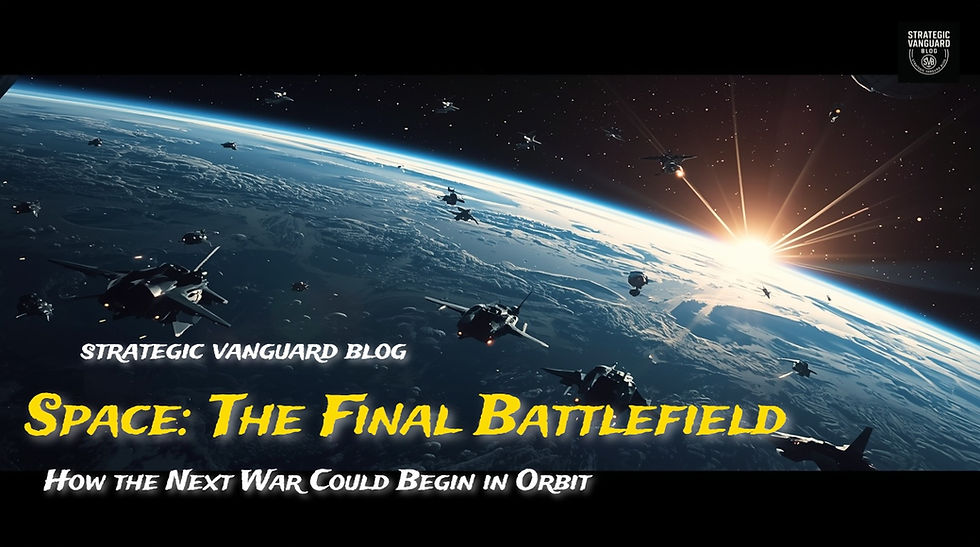
The popular image of space warfare often resembles science fiction: satellites attacking one another with lasers, enormous orbital weapons and spacecraft manoeuvring through combat zones. The reality is considerably more complicated—and strategically more important.
Military dependence on space is much broader than the concept of weapons in orbit. Satellites perform functions that support almost every layer of modern military operations. Communications satellites can connect commanders with units separated by enormous distances. Navigation systems provide positioning, navigation and timing. Earth-observation satellites can contribute to intelligence and surveillance. Missile-warning systems can detect launches. Weather satellites provide information necessary for military aviation and maritime operations. Space-based sensors can contribute to the tracking of objects and activities across vast geographical areas.
The United States Space Force itself identifies satellite communications and positioning, navigation and timing as core military capabilities, including communications for battlespace awareness, targeting, logistics and command and control. It also emphasises the importance of anti-jam and resilient systems because interference, denial and deception are recognised as operational challenges.
The significance of this is profound. Space is not simply another military theatre in the traditional sense. It is increasingly an enabler of military power across every other theatre.
A naval task force may operate in the Indian Ocean, but its communications may depend partly on satellites. An aircraft conducting a long-range mission may rely on satellite-enabled navigation and communications. A missile warning system may use space-based sensors. A commander thousands of kilometres away may depend on satellite networks to maintain situational awareness. The battlefield may be on Earth, but portions of its information architecture are above it.
This creates a new strategic vulnerability.
The Satellite Is Becoming Part of the Battlefield
The traditional military target was something that directly represented fighting power: an airbase, warship, radar installation, command centre, ammunition depot or troop formation. Satellites are different because they may not carry weapons at all, yet disabling them can affect the performance of an entire military network.
Imagine a naval force operating far from its home waters. Its ships remain physically intact. Its missiles remain loaded. Its radars remain operational. Its aircraft remain capable of flying. Yet the force suddenly experiences severe disruption in communications and navigation. Information that previously flowed continuously becomes intermittent. Some sensors lose connectivity. Data links become unreliable. Commanders have less confidence in their picture of the battlespace.
Nothing has necessarily been physically destroyed.
And yet the military system has been degraded.
That is one of the most important characteristics of space warfare. The objective does not always have to be destruction. It can be denial.
A satellite can potentially be attacked through multiple pathways. Its signals can be jammed. Navigation information can be spoofed. Ground infrastructure can be targeted through cyber operations. Space-based sensors can potentially be degraded or disrupted. Optical systems can potentially be dazzled. A satellite can potentially be physically intercepted by an anti-satellite weapon. The wider network supporting the satellite can also become a target.
This means that the traditional distinction between space warfare, electronic warfare and cyber warfare is becoming increasingly blurred.
The battlefield is becoming a system of systems.
The Most Dangerous Attack May Be the One That Leaves No Explosion
The destructive power of an anti-satellite missile is visually obvious. A satellite is intercepted, fragments are created, and the physical consequences can be observed. But from a strategic perspective, kinetic destruction is only one possible method of attacking space-based capability.
Electronic warfare may offer another pathway.
If a satellite depends upon radio-frequency communications, disrupting those communications can affect its usefulness without physically destroying the spacecraft. If a navigation receiver is presented with manipulated information, the problem becomes more subtle. The system may continue to operate while receiving incorrect information.
That distinction matters.
A destroyed satellite is immediately recognised as a failure. A compromised information environment can be much harder to diagnose. Is the signal weak because of atmospheric conditions? Is there deliberate interference? Is the navigation information inaccurate because of equipment malfunction? Is the communication network being attacked? Is the satellite itself compromised, or is the problem on the ground?
Modern warfare increasingly rewards the ability to create uncertainty.
This is where space warfare converges with electronic warfare and cyber warfare. A conflict in space does not necessarily require spacecraft firing weapons at one another. It can involve attempts to manipulate the information environment on which military forces depend.
The result is a battlefield where information itself becomes the contested terrain.
Anti-Satellite Weapons Changed the Strategic Conversation
The most dramatic expression of space becoming a military domain is the development of anti-satellite, or ASAT, capabilities.
The basic concept is straightforward: if satellites provide military advantage, a state may seek the capability to hold an adversary's satellites at risk. But the strategic consequences are considerably more complicated.
India demonstrated an ASAT capability through Mission Shakti on 27 March 2019, when a DRDO-developed interceptor engaged an Indian satellite in low Earth orbit using a hit-to-kill method. The Indian government stated that the test demonstrated the country's capability to defend its space assets and placed India among a small group of countries possessing such a capability.
Mission Shakti was important not merely because India demonstrated an ability to destroy a satellite. Its larger significance was that it established a new layer of strategic capability. India was no longer looking at space solely through the lens of communications, remote sensing, navigation and scientific exploration. Space had become part of the national-security equation.
But ASAT weapons create a paradox.
The more countries demonstrate the ability to destroy satellites, the more vulnerable the space environment potentially becomes. A kinetic interception can produce large quantities of orbital debris, creating risks not only for the targeted spacecraft but also for unrelated satellites.
That is why space warfare cannot be viewed simply through the traditional logic of destroying the enemy's assets.
Destroying one satellite may create consequences for everyone.
The Debris Problem: Winning the Battle and Damaging the Battlefield
Space is not an unlimited empty expanse.
Earth orbit contains operational spacecraft, inactive satellites, rocket bodies, fragments from previous missions and other objects. The more crowded orbital environments become, the more complicated the problem of collision avoidance becomes.
India's Indian Space Situational Awareness Report for 2025, released in April 2026, illustrates how rapidly the orbital environment is changing. ISRO reported 328 launch attempts during 2025, with 315 successful launches placing 4,198 known operational satellites into orbit. The report also recorded approximately 160,000 close-approach alerts during the year, highlighting the growing congestion of near-Earth space.
That figure is strategically significant.
Every additional satellite can provide capability, but every additional object also contributes to a more complicated orbital environment. Large constellations can improve resilience by distributing capability across many spacecraft, but they also increase the number of objects that must be tracked and managed.
This produces an unusual characteristic of space warfare: the battlefield itself is fragile.
On Earth, destroying an enemy radar does not normally make your own radar unusable. In space, however, a kinetic engagement can create debris that potentially threatens spacecraft belonging to both sides—and even spacecraft belonging to countries that are not participants in the conflict.
The consequences can therefore extend beyond the immediate military confrontation.
Space security is consequently not simply about protecting one's satellites. It is also about preserving the long-term usability of the orbital environment.
The Rise of Satellite Constellations Changes the Equation
For decades, space power was associated with relatively small numbers of extraordinarily expensive satellites.
That model is changing.
Commercial space companies and national programmes are increasingly deploying large constellations of smaller satellites. Instead of relying on a handful of extremely capable spacecraft, a network can distribute functions across many satellites.
This creates a different military problem.
Destroying one satellite may no longer be sufficient to disable a capability. An adversary may have to attack multiple nodes or disrupt the network through other means. Redundancy can therefore become a form of defence.
The logic resembles the transformation already occurring in naval warfare.
A fleet concentrated around a few exceptionally valuable platforms creates a different vulnerability profile from a distributed force consisting of many interconnected platforms. In space, the equivalent is the transition from monolithic satellite architectures to resilient distributed constellations.
This does not make constellations invulnerable. It simply changes the economics and operational requirements of attacking them.
The attacker must now consider whether it is more effective to destroy individual satellites, disrupt communications, attack ground infrastructure, interfere with frequencies, compromise networks or attack the software and control architecture connecting the constellation.
Space warfare therefore increasingly becomes a question of architecture versus attack.
The Ground Station May Be as Important as the Satellite
One of the easiest mistakes in discussions about space warfare is to focus entirely on objects in orbit.
Satellites do not operate independently.
They depend on launch infrastructure, mission-control systems, ground stations, communication networks, data-processing facilities, software, operators and power systems. A satellite may be physically safe in orbit while the infrastructure required to control or exploit it is compromised on Earth.
This creates an enormous expansion of the potential battlespace.
A military planner seeking to degrade an adversary's space capability does not necessarily need to attack the spacecraft itself. The supporting architecture can become equally important.
The strategic lesson is straightforward: space power is not located entirely in space.
It is distributed between orbit and Earth.
This is why cyber security is becoming inseparable from space security. As satellites become more software-defined and increasingly connected to terrestrial networks, their vulnerabilities can exist across the entire chain.
A future space conflict could therefore involve very few visible events in orbit while producing major consequences on Earth.
Space, Cyber and Electronic Warfare Are Merging
The previous Strategic Vanguard examination of electronic warfare focused on the electromagnetic spectrum as a battlefield. Space adds another dimension to that contest.
Satellites communicate through electromagnetic signals. Navigation systems depend on signals. Sensors transmit and receive information. Ground stations exchange data with spacecraft. Military users depend on networks to transform satellite information into operational decisions.
This means that the electromagnetic spectrum effectively connects the Earth-based battlefield with the orbital battlefield.
Cyber warfare then adds another layer.
The spacecraft, ground station and command network all rely on software. Software can be attacked. Networks can be penetrated. Data can potentially be manipulated. Control systems can become targets.
The result is a battlefield with at least three interacting dimensions:
Physical space — satellites, launch systems, ground stations and spacecraft.
Electromagnetic space — communications, radar, navigation, signals, jamming and interference.
Cyber space — software, networks, data, command systems and digital infrastructure.
A military that dominates only one of these dimensions may still be vulnerable.
The real strategic contest is therefore increasingly about controlling the information architecture connecting all three.
Space Power Is Becoming a Measure of Military Resilience
There was a time when military space programmes were primarily associated with prestige.
Today, the strategic question is increasingly different.
Can a military continue operating when its space infrastructure is degraded?
That is a much more demanding question.
A resilient military space architecture must assume that some systems may fail. Communications may be disrupted. Navigation may become unreliable. Satellites may be damaged or lost. Ground networks may be attacked. Cyber systems may be compromised.
Resilience therefore requires redundancy.
Alternative communications pathways become important. Terrestrial systems may need to complement satellite networks. Multiple navigation sources can reduce dependence on a single system. Distributed satellites can reduce the impact of individual losses. Rapid launch capabilities can potentially replace damaged spacecraft. Autonomous systems can reduce the dependence on continuous human intervention.
The objective is not simply to create better satellites.
It is to create a military system that can continue fighting when satellites are under attack.
That distinction will become increasingly important.
India and the Emerging Space-Security Equation
For India, the strategic importance of space is particularly significant.
India is simultaneously a major space-faring nation, a continental military power and a maritime power with growing interests across the Indian Ocean. Its military geography makes satellite-enabled surveillance, communications and navigation highly relevant.
The Indian space programme has traditionally been strongly associated with civilian development, remote sensing, communications, navigation and scientific exploration. But national security requirements have increasingly expanded the importance of space-based capabilities.
Mission Shakti was the clearest public demonstration of India's counter-space capability. But an effective space-security architecture extends far beyond ASAT weapons.
One of the most important developments is space situational awareness.
ISRO's System for Safe and Sustainable Space Operations Management, or IS4OM, coordinates India's space-sustainability and space-situational-awareness activities. Its work includes monitoring close approaches, assessing collision risks, tracking the evolution of the space-object population and supporting the protection of Indian space assets.
This is strategically important because knowing what is happening in orbit is itself a form of power.
A satellite cannot be protected effectively if its operators do not know what is approaching it.
A potential threat cannot be assessed if there is insufficient information about the behaviour of surrounding objects.
Space domain awareness therefore becomes the orbital equivalent of maritime domain awareness and air domain awareness.
Before a country can control its space environment, it must first be able to see it.
India's Challenge Is Bigger Than Building Weapons
India's space-security challenge should not be reduced to the question of whether it possesses ASAT weapons.
The larger question is whether India can build a resilient military space ecosystem.
That ecosystem would include communications, navigation, surveillance, space situational awareness, secure ground infrastructure, electronic warfare protection, cyber security, rapid launch capabilities, satellite redundancy and the ability to operate through disruption.
The distinction matters because an adversary does not necessarily need to destroy an Indian satellite to create military problems.
If communications can be degraded, if navigation can be disrupted, if data can be manipulated or if ground infrastructure can be compromised, the strategic effects can still be significant.
The objective should therefore be to ensure that India's military system does not possess a single point of failure.
This is particularly important for a country whose strategic interests stretch across the Indian Ocean and beyond.
A naval force operating thousands of kilometres from India's coastline needs persistent awareness. Air forces operating across large geographical areas need reliable communications and navigation. Missile forces require secure command networks. Intelligence systems require continuous information flows.
Space connects all of them.
The Indian Ocean May Become a Space-Dependent Battlefield
There is an important connection between India's maritime strategy and its space strategy.
The Indian Ocean is enormous. Ships cannot be monitored continuously using only coastal radar. Aircraft cannot remain everywhere at once. Submarines are designed precisely to disappear from conventional observation. Maritime surveillance therefore increasingly depends on the combination of satellites, aircraft, unmanned systems, surface sensors, undersea sensors and information networks.
Space is the layer that can help connect these systems.
A satellite can observe a wide geographical area. Communications satellites can connect widely dispersed forces. Navigation systems can support ships and aircraft. Earth-observation systems can contribute to maritime surveillance.
But that dependence creates vulnerability.
If space-based information becomes contested during a major maritime crisis, the quality of the operational picture could deteriorate.
This is why the future of Indian naval power cannot be separated completely from India's space power.
The aircraft carrier, destroyer and submarine may remain physical instruments of sea power. But the information environment surrounding them increasingly extends into orbit.
The Future Battlefield May Be Distributed Across Five Domains
The classic military formulation of land, sea and air is no longer sufficient to describe modern conflict.
Cyber and space have become increasingly important, while the electromagnetic spectrum cuts across all of them.
A future major conflict could therefore unfold simultaneously across:
Land — armies, missile systems, logistics and infrastructure.
Sea — naval forces, submarines, maritime trade and undersea infrastructure.
Air — aircraft, drones, missiles and air-defence networks.
Cyber and electromagnetic spectrum — networks, communications, sensors, navigation and information systems.
Space — satellites, launch systems, orbital infrastructure and space-based sensors.
The crucial point is that these domains are not independent.
An attack in one can produce effects in another.
A cyber attack can disrupt a satellite ground station. Electronic warfare can interfere with navigation used by aircraft and ships. A space-based sensor can provide targeting information to a missile battery. A satellite communications network can connect naval forces across an ocean.
The modern battlefield is therefore becoming multi-domain by design.
The Weaponisation of Dependence
There is another strategic reality that deserves attention.
The most important military space assets may not always be the ones that carry weapons. They may be the systems that everything else depends upon.
This creates what could be called the weaponisation of dependence.
If an adversary knows that a military relies heavily on satellite navigation, disrupting navigation becomes strategically attractive.
If a fleet depends on satellite communications, those communications become potential targets.
If an intelligence architecture depends on a particular class of satellites, those satellites become high-value assets.
The more indispensable a system becomes, the more attractive it becomes as a target.
This creates a paradox at the heart of technological warfare.
Technology increases military capability.
But technological dependence can also increase vulnerability.
The military power of the future will therefore not necessarily belong to the country with the most sophisticated space infrastructure. It may belong to the country that can maintain operational effectiveness after that infrastructure is attacked.
The Legal Framework Was Written Before This Battlefield Existed
The international legal framework governing outer space was largely constructed during the early decades of the space age.
The 1967 Outer Space Treaty established foundational principles for activities in outer space. It prohibits placing nuclear weapons and other weapons of mass destruction in orbit and establishes principles concerning the peaceful use of celestial bodies, state responsibility and liability. At the same time, the treaty does not simply prohibit all military activity in outer space.
That distinction is important.
Military satellites exist. Military personnel operate space systems. States develop capabilities designed to protect or potentially interfere with space assets.
The legal environment therefore exists alongside a rapidly changing technological environment.
The central challenge is that technology can move faster than international consensus.
The emergence of anti-satellite capabilities, autonomous spacecraft, rendezvous and proximity operations, cyber attacks against space infrastructure and increasingly commercialised satellite constellations creates questions that were not central when the original legal architecture was developed.
Space security therefore presents not only a military challenge but also a diplomatic and legal one.
The question is no longer simply what countries can do in space.
It is increasingly about what countries should be permitted to do, what behaviour should be considered destabilising, and how responsible behaviour can be distinguished from preparation for conflict.
The Space Race Is Becoming a Resilience Race
The first space race was about reaching space.
The second was about exploiting space.
The emerging competition is increasingly about surviving in space.
That means developing systems capable of operating in a hostile and congested environment.
Satellites need better protection. Networks need redundancy. Communications need anti-jamming capabilities. Navigation needs alternatives. Ground infrastructure needs cyber protection. Spacecraft need better awareness of nearby objects. Militaries need the ability to operate with degraded satellite support.
The most valuable space capability may therefore not be the ability to destroy another country's satellite.
It may be the ability to keep your own military functioning after someone tries to destroy, disrupt or deceive yours.
This is a very different concept of space power.
What Will the Battlefield of 2035 Look Like?
By the 2030s, the battlefield above Earth could look very different from the space environment of the early twenty-first century.
There may be far more satellites. Large constellations may provide communications, surveillance and other services. Artificial intelligence may assist with satellite operations and space-domain awareness. Autonomous spacecraft may increasingly perform navigation and manoeuvring tasks. Commercial systems may become deeply integrated with military architectures.
The distinction between civilian and military space infrastructure may become increasingly difficult to maintain.
That creates both opportunity and vulnerability.
A commercially operated satellite constellation could provide extraordinary resilience and capacity. But once military operations depend upon commercial infrastructure, that infrastructure may become strategically relevant during conflict.
The future space battlefield may therefore contain an unusual mixture of military spacecraft, commercial satellites, scientific missions, civilian communications systems and debris.
That makes escalation particularly dangerous.
A state may attempt to attack a military capability and unintentionally create consequences for civilian infrastructure or third-party space assets.
The orbital environment does not respect political boundaries.
The Real Battle May Be for Information
When we speak about space warfare, it is tempting to imagine the destruction of satellites as the ultimate objective.
But the deeper contest is likely to be about something less visible.
Information.
Who can see?
Who can communicate?
Who can navigate?
Who can detect a missile launch?
Who can identify a naval formation?
Who can maintain command and control?
Who can continue operating when the electromagnetic spectrum becomes hostile?
Who can maintain a reliable picture of the battlefield when some sensors have been blinded or disrupted?
These questions reveal why space has become so important.
The satellite itself is only the platform.
The real strategic value lies in the information it enables.
That means the future contest in space may be less about controlling territory and more about controlling the flow of information between Earth and orbit.
The War Above the War
For centuries, military strategists focused on controlling territory.
Then came control of the seas.
The twentieth century added control of the air.
The twenty-first century is adding control of information.
Space sits above all of these domains and increasingly connects them.
That is why the phrase “the war above the war” captures something important about the emerging strategic environment.
A conflict on Earth could increasingly be shaped before the first major engagement by events occurring in orbit. Satellites could be degraded. Communications could be disrupted. Navigation could become uncertain. Intelligence networks could be attacked. Space-based sensors could alter the operational picture.
And none of this necessarily requires a spectacular explosion in the sky.
The first signs of a space conflict might simply be silence.
A satellite that stops responding.
A navigation signal that suddenly becomes unreliable.
A communication link that disappears.
A sensor that no longer sees what it should.
A network that cannot explain what has happened.
That is the future battlefield Strategic Vanguard needs to watch.
Because the next great transformation in warfare may not come from a new missile, fighter or warship.
It may come from the realisation that the battlefield has moved upward—and that every battlefield below it now depends upon what happens there.
Strategic Vanguard Take
Space is no longer merely the frontier of scientific exploration or a prestige arena for major powers. It is becoming an essential component of military power.
But the future of space warfare will not be determined simply by who possesses the most destructive anti-satellite weapon.
It will be determined by resilience, redundancy, awareness, connectivity and the ability to fight through disruption.
For India, this has particular significance. The country has already demonstrated an ASAT capability through Mission Shakti and is developing increasingly sophisticated space situational-awareness capabilities. ISRO's 2025 assessment demonstrates just how rapidly the orbital environment is becoming more crowded and operationally complex.
The next step is therefore not simply to prepare for a war in space.
It is to prepare for a war in which space, cyber, electromagnetic warfare, air power, naval power and missile warfare become parts of one interconnected battlespace.
The country that understands that convergence will possess an important strategic advantage.
The country that assumes its satellites will remain untouched may discover that the most important battle was already underway—far above the battlefield.


Comments